International Driving Permit: where to get one in Eswatini and where you need it

Where to get an International Driving Permit in Eswatini
For a driving licence from Eswatini, the International Driving Permit (IDP) is issued by the Road Transport Department.
Fees, documents and processing times are on the official website. The permit is issued outside both the 1949 and the 1968 road-traffic conventions, so it carries no convention basis abroad.
Where you need an International Driving Permit with a licence from Eswatini
What you need to carry as a tourist with this licence, according to IDA's guides to 240 countries and territories. Linked names open the country guide.
IDP required – any model (1): Nepal.
Your licence is recognised; an IDP of the 1949 model is advised, which is not issued in your country, so ask your rental company what it accepts (3): Australia, Canada, United States of America.
An IDP of any model is advised, as a translation of your licence (3): Italy, Mexico, Micronesia.
A locally issued document is required; an IDP does not replace it (15): Antigua and Barbuda, Bermuda, China, Cook Islands, Dominica, Equatorial Guinea, Eritrea, Grenada, Guam, Niue, Samoa, Sri Lanka, St. Kitts and Nevis, St. Lucia, U.S. Virgin Islands.
As a tourist, you cannot drive there on your licence; ask the local authorities (9): Bosnia and Herzegovina, Ghana, Hungary, Ireland, Japan, Maldives, North Korea, Russian Federation, Syria.
Not established – check with the destination's authorities before you travel (139): Abkhazia, Afghanistan, Algeria, Andorra, Angola, Argentina, Armenia, Austria, Azad Kashmir, Azerbaijan, Bahrain, Barbados, Belgium, Benin, Bhutan, Bolivia, Botswana, Brazil, Brunei, Bulgaria, Burkina Faso, Burundi, Cambodia, Cameroon, Cape Verde, Caribbean Netherlands, Cayman Islands, Central African Republic, Chad, Comoros, Congo (Brazzaville), Congo (Democratic Rep.), Croatia, Curacao, Czech Republic, Djibouti, Dominican Republic, Ecuador, Egypt, Ethiopia, France, French Guiana, French Polynesia, Gabon, Gambia, Germany, Gibraltar, Greece, Guadeloupe, Guernsey, Guinea, Guinea Bissau, Haiti, Honduras, India, Indonesia, Iran, Iraq, Israel, Ivory Coast, Jamaica, Kazakhstan, Kenya, Kyrgyzstan, Laos, Lesotho, Lithuania, Luxembourg, Macau, Macedonia, Madagascar, Malawi, Malaysia, Mali, Martinique, Mauritania, Mauritius, Mayotte Island, Moldova, Monaco, Mongolia, Montenegro, Montserrat, Myanmar, New Caledonia, Niger, Nigeria, Norway, Pakistan, Palestine Autonomous, Peru, Poland, Portugal, Puerto Rico, Qatar, Republic of Artsakh, Reunion, Romania, Rwanda, Sahrawi Republic, Saint Martin, Saint Pierre and Miquelon, São Tomé and Príncipe, Senegal, Serbia, Sierra Leone, Singapore, Sint Maarten, Slovak Republic, Slovenia, Somalia, Somaliland, South Korea, South Ossetia, South Sudan, Spain, St. Vincent, Taiwan, Tajikistan, Tanzania, Thailand, Togo, Tokelau Islands, Tonga, Transnistria, Trinidad and Tobago, Tunisia, Turkmenistan, Uganda, Ukraine, United Arab Emirates, Uruguay, Uzbekistan, Vatican, Venezuela, Vietnam, Wallis and Futuna, Western Sahara, Yemen.
Your licence is enough on its own; conditions such as a maximum stay are in the country guide (70): Albania, American Samoa, Aruba, Bahamas, Bangladesh, Belarus, Belize, British Virgin Islands, Chile, Colombia, Costa Rica, Cuba, Cyprus, Denmark, East Timor, El Salvador, Estonia, Falkland Islands, Faroe Islands, Fiji, Finland, Georgia, Greenland, Guatemala, Guyana, Hong Kong, Iceland, Jersey, Jordan, Kiribati, Kosovo, Kuwait, Latvia, Lebanon, Liberia, Libya, Liechtenstein, Malta, Marshall Islands, Morocco, Mozambique, Namibia, Nauru, Netherlands, New Zealand, Nicaragua, Northern Cyprus, Northern Mariana Islands, Oman, Palau, Panama, Papua New Guinea, Paraguay, Philippines, San Marino, Saudi Arabia, Seychelles, Solomon Islands, South Africa, Sudan, Suriname, Sweden, Switzerland, Turkey, Turks and Caicos Islands, Tuvalu, United Kingdom, Vanuatu, Zambia, Zimbabwe.
The IDA document does not replace an International Driving Permit in any of these countries. Where your licence is enough on its own, you don't need it; where an IDP is advised, the IDA document can at most make your licence easier to read at a rental desk. Rules change: check the country guide before you travel.


The IDA document: a translation of your licence, not an International Driving Permit
- It is not an International Driving Permit
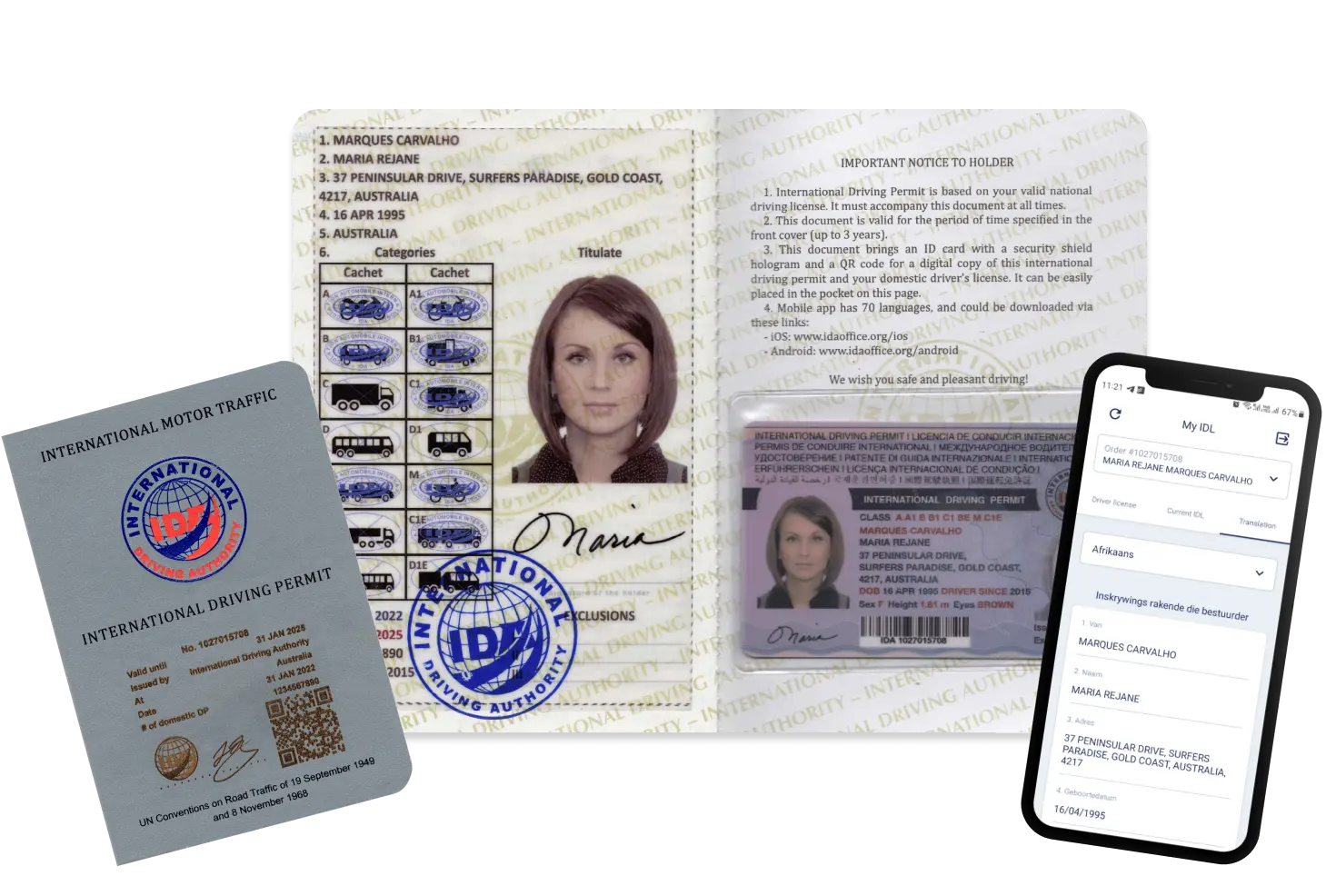
- It is a private translation of your licence that you carry with it
- It can make your licence easier to read at a rental desk
- It does not replace an IDP or a certified translation where the law requires one
- Translated into 70 languages
- Express delivery worldwide
How to order the IDA document online
- 1. A photo of your valid domestic driving license
- 2. Your personal data
- 3. A photo of yourself
- 4. Your signature (scan or photo it)
Who issues official IDPs is explained above.
How much does the IDA document cost?
7 days money back guarantee!
You may return the documents issued by the International Driving Authority anytime before the delivery or within 7 days after the delivery of the document for a full refund.
-
UN Standard International Driving Permit
- The United Nations Standard International Driving Permit includes a plastic ID card, a booklet and a mobile application for Android and iOS with the translation into 70 languages (29 in a booklet and all 70 in a mobile app). The IDP is made in compliance with United Nations Conventions on road traffic standards for document size, color, format, etc.
-
Electronic International Driving License
- The Electronic International Driving License or eIDL includes a printable PDF document of a booklet and a mobile application for Android and iOS with the translation into 70 languages.
- De jure, according to the United Nations Convention on road traffic, physical copy of IDL is mandatory, as there is no such notion in the UN Convention as an eIDL yet. De facto we and our clients used digital version many times, and road police and car rentals accept it. However, we advise you to choose the United Nations standard IDP if you have enough time for delivery.
- Cancelation and refund are possible only until your order is not processed. Once an order is processed, and an email with eIDL is submitted to you, our service is completed, and the respective PDF file shall be considered exploited and shall become non-redeemable.
Frequently asked questions about the International Driving Permit
Where do I get an International Driving Permit in Eswatini?
expand_more
From the Road Transport Department. Fees, documents and processing times: official website.
Can I apply for an International Driving Permit online?
expand_more
No: according to our data, it is not issued online. The IDA document, which you order online, is not an International Driving Permit: it is a private translation of your licence.
Which International Driving Permit model can be issued in Eswatini?
expand_more
Eswatini is party to neither the 1949 nor the 1968 convention, so its IDP is not a convention permit and may not be recognised abroad (see the lists above).
What is the IDA document, and how is it different from an International Driving Permit?
expand_more
IDA's International Driver's Document is a translation of your licence that you carry together with it. It is not an International Driving Permit issued under the 1949 or 1968 conventions by the body your country authorises, and it is not a certified, sworn or otherwise official translation: no authority certifies it, and where the law requires an IDP or an official translation, the IDA document does not meet that requirement. It is a private translation meant to make your licence easier to read at rental desks.
Can I rent a car with the IDA document?
expand_more
Rental companies set their own rules. Where an International Driving Permit is required, the IDA document does not replace it: ask the rental company before you book.
Coming to Eswatini with a foreign licence? What you need to know
🗓 Facts checked against Eswatini's road-traffic law and official sources. Research last updated: . You may copy this information only if you provide a link back to this page.
⚠ This page is general information about driving rules, not legal advice. Rules change, and each authority applies its own — confirm your case with the relevant authority before you drive.
ℹ We are a private company. We are not a government body, a licensing or issuing authority, or a treaty organisation, and we are not affiliated with, endorsed by, or acting for any of them. The International Driver's Document we sell is a translation of your national driving licence: it is not a driving licence, and it is not a government-issued document.
- Driving in Eswatini: key facts
- Do you need an International Driving Permit in Eswatini?
- What side of the road does Eswatini drive on?
- How long can you drive in Eswatini with a foreign licence?
- Is Eswatini a party to the 1949 or 1968 Road Traffic Convention?
- Why acceptance of your licence varies from place to place
- Can you drive in Eswatini with your country's licence?
- Where to get an International Driving Permit
- Moving to Eswatini? Rules for new residents
- Driving rules in Eswatini tourists get fined for
- Read more about driving in Eswatini
- Sources
Driving in Eswatini: key facts
| Question | Answer |
|---|---|
| Side of the road | Left |
| International Driving Permit (IDP) | Not required for 231 of the 240 origin licences, 9 of which have no established rule — see the row for your country of issue, in the table below |
| IDP types accepted | Both — 1949 Geneva (valid 1 year) and 1968 Vienna (valid 3 years) |
| UN Road Traffic Conventions | Party to neither convention |
| Time limit for visitors | No numeric period appears in the Act. |
| EU / EEA licences | Fully valid, no formality (Road Traffic Act, 2007 (Act 6 of 2007), s.35(1)(a)) |
| Minimum age | 20 to drive |
| Alcohol limit | 0.05 g per 100 ml of blood. |
| Speed limits | No numeric limits in the Act. s.54(1) leaves the general limits for urban roads, non-urban roads and freeways to be "as prescribed" by regulation, and those regulations were not locatable online. Obey posted signs, which override the general limit downwards (s.54(2)), and reduce speed for livestock, potholes, slow trucks and unlit rural roads. |
| Emergency number | Ambulance: 977. Fire: 933. Police: 999. For serious cases the FCDO warns that "For serious accidents and emergencies or specialised treatment, it's likely you would need to go to South Africa" and advises insurance and funds "to cover the cost of medical evacuation to South Africa and repatriation". |
Do you need an International Driving Permit in Eswatini?
An IDP is not legally required in Eswatini. Section 35(1)(a) of the Road Traffic Act 2007 deems "a licence authorising the driver of a motor vehicle and which is issued in any country other than Swaziland" to be a licence for the purposes of the Act, with no treaty condition attached; the international driver's permit is the separate alternative in s.35(1)(b), not an add-on. The Act's definition of "Convention" covers the 1926 Paris, 1949 Geneva and 1968 Vienna conventions, and "international driver's permit" means one "issued in terms of a Convention or recognized thereunder" — so a 1949 or a 1968 booklet both fall inside the statutory definition. UK FCDO guidance nevertheless tells travellers they need "both the 1949 version of the international driving permit (IDP)" and their national licence; roadblocks and rental desks routinely ask for one. Practical advice: carry an IDP (the 1949 booklet if your country issues both) alongside the original licence, but understand it is a convenience and enforcement-smoothing document here, not a legal precondition.
- Tourists and short-term visitors: carry your national licence together with the document named in the row for your country of issue, in the table below — for most origin licences that document is not an IDP, so read your own answer rather than assuming one.
- Car renters: UK FCDO guidance goes further than the statute and tells travellers: "You'll need to have both the 1949 version of the international driving permit (IDP)" and your national licence in the car, and "You cannot buy an IDP outside the UK, so get one before you travel." The Act does not require it, but roadblocks and rental desks expect it — carrying one avoids an argument you cannot win at the roadside.
- EU / EEA licence holders: no IDP needed — EU/EEA licences are valid in Eswatini — but not because of any EU-specific arrangement, of which there is none.
No specific penalty for driving without the required document was verified from an authoritative source. Unofficial legal database.
What side of the road does Eswatini drive on?
Eswatini drives on the left-hand side of the road, and overtaking is done on the right. Cars in Eswatini are right-hand drive.
How long can you drive in Eswatini with a foreign licence?
No numeric period appears in the Act. Section 35(2)(a) provides: "The period for which a licence or a permit referred to in subsection (1) shall be deemed to be a licence for the purposes of this Act, shall be as prescribed and different periods may be so prescribed in respect of licences or permits issued by different countries." The period therefore sits in the Road Traffic Regulations, which could not be located in a dependable public source — and Eswatini expressly reserves the right to give different countries different periods. Treat the practical window as your authorised stay, bounded by the earliest of: expiry of the national licence, expiry of the IDP if you carry one, expiry of immigration permission, the rental contract, or the insurance. Do not confuse this with the 12-month period in s.14(2) — that governs how long a foreign-registered vehicle is deemed registered, not how long you may drive. (Road Traffic Act, 2007, s.35(2)(a) (period delegated to regulations); s.14(2) (vehicle registration, 12 months — different clock))
Planning to move to Eswatini? Different rules apply once you become a resident — see the residents section below.
Is Eswatini a party to the 1949 or 1968 Road Traffic Convention?
Eswatini is party to neither the 1949 Geneva Convention nor the 1968 Vienna Convention on Road Traffic. An official convention IDP cannot be issued in Eswatini, and convention rules do not bind it — licence acceptance is governed purely by local law and bilateral arrangements.
Why acceptance of your licence varies from place to place
Whether a foreign country accepts your driving licence hangs on a tangle of variables: three different road-traffic conventions signed decades apart (1926, 1949, 1968) — the oldest predates the United Nations itself, and only the latter two were concluded under it — countries at different stages of joining each (signed vs. accepted vs. ratified), licences printed in alphabets local police can't read, vehicle-category systems that don't line up between countries, document generations that may not meet a convention's format even when the country is a member, bilateral deals between individual states, and local laws that are looser in one place and stricter in the next. The same licence can be fine at one border and rejected at the next — even at the next rental desk. The International Driving Permit exists to cut through most of it: a standardized, multilingual presentation of your existing licence, with harmonized category symbols, that most officials can read at a glance. It doesn't replace your national licence or grant new rights — you carry both — and it doesn't guarantee acceptance: a handful of destinations still require a local permit alongside or instead of it, but for most it meaningfully improves your odds.
Can you drive in Eswatini with your country's licence?
This table is for tourists and temporary visitors. Moving to Eswatini as a resident? Different rules apply — see the residents section below. Find your licence's country of issue below. Eswatini recognises foreign driving licences broadly and without a treaty gate: s.35(1)(a) of the Road Traffic Act 2007 deems a licence issued in any country other than Eswatini to be a licence for the purposes of the Act, so an IDP is not legally required. UK government guidance still tells travellers to carry a 1949 IDP with the national licence, and roadblocks and rental desks expect one, so carrying it is the sensible practical choice. Keep the licence in the vehicle — s.23(1) makes leaving it behind the same offence as not holding one. Drive on the left, mind the 20-year minimum age, and if you cross the border in your own car pay the road levy and keep the receipt. Rules change — confirm with official sources before you travel. Last verified: October 2026.
Legend: "1949" — Geneva Convention on Road Traffic (IDP valid up to 1 year); "1968" — Vienna Convention (IDP valid up to 3 years).
What the Status column means on this page:
- National licence OK — the destination lets a visitor drive on the national licence itself. The row for your country of issue, in the table below, gives the basis, and any period or condition that qualifies it.
- National licence OK — IDP advised — the destination does not require an IDP for this licence, but carrying one is advised. The row for your country of issue, in the table below, gives the reason and any conditions attached.
- National licence OK — IDD/translation advised — the destination does not require an IDP for this licence, and no official convention IDP can be issued for it; carry an IDD or a certified translation instead. The row for your country of issue, in the table below, gives the reason and any conditions attached.
- Not established — the record does not settle whether you may drive here on this licence; confirm with the destination's licensing authority before you rely on it. The row for your country of issue, in the table below, says what could not be confirmed.
Show the full list, all 240
| Country of licence | # |
|---|---|
| Abkhazia | 13 |
| Afghanistan | 7 |
| Albania | 1 |
| Algeria | 1 |
| American Samoa | 5 |
| Andorra | 1 |
| Angola | 1 |
| Antigua and Barbuda | 10 |
| Argentina | 1 |
| Armenia | 1 |
| Aruba | 1 |
| Australia | 5 |
| Austria | 2 |
| Azad Kashmir | 13 |
| Azerbaijan | 1 |
| Bahamas | 5 |
| Bahrain | 5 |
| Bangladesh | 5 |
| Barbados | 5 |
| Belarus | 1 |
| Belgium | 2 |
| Belize | 5 |
| Benin | 1 |
| Bermuda | 5 |
| Bhutan | 5 |
| Bolivia | 5 |
| Bosnia and Herzegovina | 1 |
| Botswana | 1 |
| Brazil | 1 |
| British Virgin Islands | 5 |
| Brunei | 5 |
| Bulgaria | 2 |
| Burkina Faso | 1 |
| Burundi | 1 |
| Cambodia | 1 |
| Cameroon | 1 |
| Canada | 5 |
| Cape Verde | 1 |
| Caribbean Netherlands | 1 |
| Cayman Islands | 5 |
| Central African Republic | 1 |
| Chad | 8 |
| Chile | 5 |
| China | 11 |
| Colombia | 5 |
| Comoros | 12 |
| Congo (Brazzaville) | 1 |
| Congo (Democratic Rep.) | 1 |
| Cook Islands | 5 |
| Costa Rica | 5 |
| Croatia | 2 |
| Cuba | 1 |
| Curacao | 1 |
| Cyprus | 2 |
| Czech Republic | 2 |
| Denmark | 2 |
| Djibouti | 1 |
| Dominica | 5 |
| Dominican Republic | 5 |
| East Timor | 1 |
| Ecuador | 5 |
| Egypt | 6 |
| El Salvador | 5 |
| Equatorial Guinea | 1 |
| Eritrea | 11 |
| Estonia | 2 |
| Ethiopia | 6 |
| Falkland Islands | 1 |
| Faroe Islands | 1 |
| Fiji | 5 |
| Finland | 2 |
| France | 2 |
| French Guiana | 2 |
| French Polynesia | 1 |
| Gabon | 1 |
| Gambia | 1 |
| Georgia | 1 |
| Germany | 2 |
| Ghana | 1 |
| Gibraltar | 1 |
| Greece | 2 |
| Greenland | 1 |
| Grenada | 10 |
| Guadeloupe | 2 |
| Guam | 5 |
| Guatemala | 5 |
| Guernsey | 1 |
| Guinea | 1 |
| Guinea Bissau | 1 |
| Guyana | 5 |
| Haiti | 1 |
| Honduras | 5 |
| Hong Kong | 5 |
| Hungary | 2 |
| Iceland | 2 |
| India | 5 |
| Indonesia | 5 |
| Iran | 6 |
| Iraq | 1 |
| Ireland | 2 |
| Israel | 1 |
| Italy | 2 |
| Ivory Coast | 1 |
| Jamaica | 5 |
| Japan | 6 |
| Jersey | 1 |
| Jordan | 5 |
| Kazakhstan | 1 |
| Kenya | 1 |
| Kiribati | 1 |
| Kosovo | 1 |
| Kuwait | 5 |
| Kyrgyzstan | 1 |
| Laos | 1 |
| Latvia | 2 |
| Lebanon | 5 |
| Lesotho | 1 |
| Liberia | 1 |
| Libya | 7 |
| Liechtenstein | 2 |
| Lithuania | 2 |
| Luxembourg | 2 |
| Macau | 1 |
| Madagascar | 1 |
| Malawi | 1 |
| Malaysia | 5 |
| Maldives | 1 |
| Mali | 1 |
| Malta | 2 |
| Marshall Islands | 10 |
| Martinique | 2 |
| Mauritania | 1 |
| Mauritius | 5 |
| Mayotte Island | 2 |
| Mexico | 5 |
| Micronesia | 10 |
| Moldova | 1 |
| Monaco | 1 |
| Mongolia | 1 |
| Montenegro | 1 |
| Montserrat | 5 |
| Morocco | 1 |
| Mozambique | 1 |
| Myanmar | 5 |
| Nagorno-Karabakh | 13 |
| Namibia | 1 |
| Nauru | 1 |
| Nepal | 5 |
| Netherlands | 2 |
| New Caledonia | 1 |
| New Zealand | 5 |
| Nicaragua | 5 |
| Niger | 1 |
| Nigeria | 5 |
| Niue | 5 |
| Northern Cyprus | 13 |
| Northern Mariana Islands | 5 |
| North Korea | 11 |
| North Macedonia | 8 |
| Norway | 2 |
| Oman | 5 |
| Pakistan | 5 |
| Palau | 10 |
| Palestine | 9 |
| Panama | 5 |
| Papua New Guinea | 5 |
| Paraguay | 1 |
| Peru | 5 |
| Philippines | 1 |
| Poland | 2 |
| Portugal | 2 |
| Puerto Rico | 5 |
| Qatar | 5 |
| Reunion | 2 |
| Romania | 2 |
| Russian Federation | 1 |
| Rwanda | 1 |
| Sahrawi Republic | 13 |
| Saint Martin | 1 |
| Saint Pierre and Miquelon | 1 |
| Samoa | 10 |
| San Marino | 1 |
| São Tomé and Príncipe | 1 |
| Saudi Arabia | 5 |
| Senegal | 1 |
| Serbia | 1 |
| Seychelles | 1 |
| Sierra Leone | 1 |
| Singapore | 5 |
| Sint Maarten | 1 |
| Slovak Republic | 2 |
| Slovenia | 2 |
| Solomon Islands | 10 |
| Somalia | 1 |
| Somaliland | 13 |
| South Africa | 1 |
| South Korea | 5 |
| South Ossetia | 13 |
| South Sudan | 1 |
| Spain | 2 |
| Sri Lanka | 1 |
| St. Kitts and Nevis | 5 |
| St. Lucia | 5 |
| St. Vincent | 5 |
| Sudan | 5 |
| Suriname | 1 |
| Sweden | 2 |
| Switzerland | 3 |
| Syria | 6 |
| Taiwan | 6 |
| Tajikistan | 1 |
| Tanzania | 1 |
| Thailand | 5 |
| Togo | 1 |
| Tokelau Islands | 9 |
| Tonga | 5 |
| Transnistria | 13 |
| Trinidad and Tobago | 5 |
| Tunisia | 1 |
| Turkey | 1 |
| Turkmenistan | 1 |
| Turks and Caicos Islands | 5 |
| Tuvalu | 1 |
| Uganda | 1 |
| Ukraine | 1 |
| United Arab Emirates | 5 |
| United Kingdom | 4 |
| United States of America | 5 |
| Uruguay | 5 |
| U.S. Virgin Islands | 5 |
| Uzbekistan | 1 |
| Vanuatu | 1 |
| Vatican | 1 |
| Venezuela | 5 |
| Vietnam | 1 |
| Wallis and Futuna | 1 |
| Western Sahara | 13 |
| Yemen | 5 |
| Zambia | 1 |
| Zimbabwe | 5 |
| # | Status | Country of licence | What you need to carry | Why |
|---|---|---|---|---|
| 1 | National licence OK | Albania, Algeria, Andorra, Angola, Argentina, Armenia, Aruba, Azerbaijan, Belarus, Benin, Bosnia and Herzegovina, Botswana, Brazil, Burkina Faso, Burundi, Cambodia, Cameroon, Cape Verde, Caribbean Netherlands, Central African Republic, Congo (Brazzaville), Congo (Democratic Rep.), Cuba, Curacao, Djibouti, East Timor, Equatorial Guinea, Falkland Islands, Faroe Islands, French Polynesia, Gabon, Gambia, Georgia, Ghana, Gibraltar, Greenland, Guernsey, Guinea, Guinea Bissau, Haiti, Iraq, Israel, Ivory Coast, Jersey, Kazakhstan, Kenya, Kiribati, Kosovo, Kyrgyzstan, Laos, Lesotho, Liberia, Macau, Madagascar, Malawi, Maldives, Mali, Mauritania, Moldova, Monaco, Mongolia, Montenegro, Morocco, Mozambique, Namibia, Nauru, New Caledonia, Niger, Paraguay, Philippines, Russian Federation, Rwanda, Saint Martin, Saint Pierre and Miquelon, San Marino, São Tomé and Príncipe, Senegal, Serbia, Seychelles, Sierra Leone, Sint Maarten, Somalia, South Africa, South Sudan, Sri Lanka, Suriname, Tajikistan, Tanzania, Togo, Tunisia, Turkey, Turkmenistan, Tuvalu, Uganda, Ukraine, Uzbekistan, Vanuatu, Vatican, Vietnam, Wallis and Futuna, Zambia (101) | Your national licence (Period is fixed by regulation, not the Act; keep the licence in the vehicle.) | Any valid foreign licence is accepted by law [1] |
| 2 | National licence OK | Austria, Belgium, Bulgaria, Croatia, Cyprus, Czech Republic, Denmark, Estonia, Finland, France, French Guiana, Germany, Greece, Guadeloupe, Hungary, Iceland, Ireland, Italy, Latvia, Liechtenstein, Lithuania, Luxembourg, Malta, Martinique, Mayotte Island, Netherlands, Norway, Poland, Portugal, Reunion, Romania, Slovak Republic, Slovenia, Spain, Sweden (35) | Your EU/EEA licence | Recognised by Eswatini's own rules for licences issued in EU/EEA states [2] |
| 3 | National licence OK | Switzerland (1) | Your national licence | Eswatini's Road Traffic Act 2007 (section 35) treats a licence issued outside Eswatini, such as a Swiss licence, as valid for the classes it covers; the period is left to regulations. [3] |
| 4 | National licence OK | United Kingdom (1) | Your national licence | Eswatini's Road Traffic Act 2007 (section 35) treats a licence issued outside Eswatini, such as a UK licence, as valid for the classes it covers; the period is left to regulations. [3] |
| 5 | National licence OK — IDP advised | American Samoa, Australia, Bahamas, Bahrain, Bangladesh, Barbados, Belize, Bermuda, Bhutan, Bolivia, British Virgin Islands, Brunei, Canada, Cayman Islands, Chile, Colombia, Cook Islands, Costa Rica, Dominica, Dominican Republic, Ecuador, El Salvador, Fiji, Guam, Guatemala, Guyana, Honduras, Hong Kong, India, Indonesia, Jamaica, Jordan, Kuwait, Lebanon, Malaysia, Mauritius, Mexico, Montserrat, Myanmar, Nepal, New Zealand, Nicaragua, Nigeria, Niue, Northern Mariana Islands, Oman, Pakistan, Panama, Papua New Guinea, Peru, Puerto Rico, Qatar, Saudi Arabia, Singapore, South Korea, St. Kitts and Nevis, St. Lucia, St. Vincent, Sudan, Thailand, Tonga, Trinidad and Tobago, Turks and Caicos Islands, United Arab Emirates, United States of America, Uruguay, U.S. Virgin Islands, Venezuela, Yemen, Zimbabwe (70) | Your national licence (Period is fixed by regulation, not the Act; keep the licence in the vehicle.); an IDP is advisable | Any valid foreign licence is accepted by law [1] [a] |
| 6 | National licence OK — IDP advised | Egypt, Ethiopia, Iran, Japan, Syria, Taiwan (6) | Your national licence (Period is fixed by regulation, not the Act; keep the licence in the vehicle.); an IDP is strongly advisable | Any valid foreign licence is accepted by law [1]; your licence has no Latin-script data — an IDP sets out its details in the standard international form [a] |
| 7 | National licence OK — IDP advised | Afghanistan, Libya (2) | Your national licence (Period is fixed by regulation, not the Act; keep the licence in the vehicle.); an IDP is strongly advisable | Any valid foreign licence is accepted by law [1]; your licence has no Latin-script data — an IDP sets out its details in the standard international form |
| 8 | National licence OK — IDP advised | Chad, North Macedonia (2) | Your national licence (Period is fixed by regulation, not the Act; keep the licence in the vehicle.); an IDP is advisable | Any valid foreign licence is accepted by law [1]; licence format not independently verified for this country |
| 9 | National licence OK — IDP advised | Palestine, Tokelau Islands (2) | Your national licence (Period is fixed by regulation, not the Act; keep the licence in the vehicle.); an IDP is advisable | Any valid foreign licence is accepted by law [1]; licence format not independently verified for this country [a] |
| 10 | National licence OK — IDD/translation advised | Antigua and Barbuda, Grenada, Marshall Islands, Micronesia, Palau, Samoa, Solomon Islands (7) | Your national licence (Period is fixed by regulation, not the Act; keep the licence in the vehicle.); no official convention IDP is issued for it — carry an IDD/translation [b] | Any valid foreign licence is accepted by law [1] [a] |
| 11 | National licence OK — IDD/translation advised | China, Eritrea, North Korea (3) | Your national licence (Period is fixed by regulation, not the Act; keep the licence in the vehicle.); no official convention IDP is issued for it — carry an IDD/translation [b] | Any valid foreign licence is accepted by law [1]; your licence has no Latin-script data — a certified translation sets out its details [a] |
| 12 | National licence OK — IDD/translation advised | Comoros (1) | Your national licence (Period is fixed by regulation, not the Act; keep the licence in the vehicle.); no official convention IDP is issued for it — carry an IDD/translation [b] | Any valid foreign licence is accepted by law [1]; licence format not independently verified for this country |
| 13 | Not established | Abkhazia, Azad Kashmir, Nagorno-Karabakh, Northern Cyprus, Sahrawi Republic, Somaliland, South Ossetia, Transnistria, Western Sahara (9) | Check with local authorities before travel | The recognition norm covers foreign-state-issued licences; this issuer’s statehood is not generally recognized — validity not established |
Sources and notes for the table above
[1] Road Traffic Act, 2007 (Act 6 of 2007), s.35(1)(a), read with s.23(1); commenced 29 February 2008
[2] Road Traffic Act, 2007 (Act 6 of 2007), s.35(1)(a)
[3] Road Traffic Act, 2007 (Act 6 of 2007), s.35(1)(a) and (2)(a), read with s.23(1); Swaziland Government Gazette Extraordinary No. 100, 21 September 2007
[a] Licence categories do not follow the convention A–E scheme — rental staff may ask for an IDP to map them.
[b] IDD = International Driver's Document, a standardized translation of your national driving licence. You can apply here: https://idaoffice.org/apply-now/.
Where to get an International Driving Permit
An International Driving Permit must be obtained before you travel, and only certain countries may issue one to you — you cannot buy an official IDP from an unrelated country. Under the 1968 Vienna Convention it may be issued only by the Contracting Party where you normally reside and which issued or recognizes your licence — by that Party's competent authority or by an association it has duly empowered. Under the 1949 Geneva Convention it is issued by the competent authority of a Contracting State, or by an association that authority has duly empowered. Which body that is varies by country: a government agency in some, an authorized motoring club in others.
- Travelling from Eswatini? Eswatini's IDPs are issued by Road Transport Department. Official site. Eswatini is party to neither road-traffic convention, so the permit is issued outside the UN convention framework and is not an official convention IDP — check that your destination accepts it.
- Travelling from another country? Ask that country's driving-licence authority which body it authorizes to issue IDPs — a government agency in some countries, an authorized motoring club in others.
Separately, IDA offers a digital International Driver's Document — a translation of your national licence that you carry alongside it. It is not an International Driving Permit issued under the 1949 or 1968 conventions by the body your country authorizes for that purpose, and it is not a certified, sworn or otherwise official translation: no authority certifies it, and where a country requires an official or certified translation by law, our document does not satisfy that requirement. It is a private translation meant to make your national licence readable at rental desks and roadside checks.
Moving to Eswatini? Rules for new residents
Two separate clocks. An IDP is expressly unavailable to residents: s.35(1)(b) recognises an international driver's permit only "while the holder thereof was not permanently or ordinarily resident in Swaziland". A foreign national licence under s.35(1)(a) carries no such residence carve-out on its face, but its recognition period is "as prescribed" (s.35(2)(a)) and is a visitor mechanism, not a permanent substitute — anyone settling in Eswatini should obtain an Eswatini licence. Official source.
Driving rules in Eswatini tourists get fined for
- Mandatory equipment: The Act itself contains no seat-belt, child-restraint or carry-this-kit provisions — such requirements sit in the Road Traffic Regulations, which could not be verified. What is verifiable: keep the licence (or deemed foreign licence/IDP) in the vehicle (s.23(1)), and if the vehicle is foreign-registered keep the customs declaration and road-levy receipt in it too. Check the rental firm's own list for warning triangle, spare wheel and roadworthiness.
- Drink-driving: 0.05 g per 100 ml of blood. Road Traffic Act 2007 s.91(2) prohibits driving "while the concentration of alcohol in any specimen of blood taken from any part of his body is 0,05 grams per 100 millilitres or more"; s.91(5) sets the breath equivalent at "0,38 milligrams per 1000 millilitres". A reading taken within two hours of the offence is presumed to reflect the level at the time of driving. The safest rule remains zero. Serious. s.122(2) makes a s.91 conviction punishable by "a fine not exceeding E5 000 or to imprisonment for a period not exceeding four years or to both". FCDO: "The police operate random roadside checks regularly and strictly enforce the law." You must provide a breath or blood specimen on reasonable suspicion (s.91(9)).
- Speed limits: No numeric limits in the Act. s.54(1) leaves the general limits for urban roads, non-urban roads and freeways to be "as prescribed" by regulation, and those regulations were not locatable online. Obey posted signs, which override the general limit downwards (s.54(2)), and reduce speed for livestock, potholes, slow trucks and unlit rural roads.
- Carry the licence physically in the vehicle. s.23(1) makes it an offence to drive "unless he keeps such licence or document or any other prescribed authorisation with him in the vehicle" — a licence left at the hotel is the same offence as no licence at all.
- UK FCDO guidance goes further than the statute and tells travellers: "You'll need to have both the 1949 version of the international driving permit (IDP)" and your national licence in the car, and "You cannot buy an IDP outside the UK, so get one before you travel." The Act does not require it, but roadblocks and rental desks expect it — carrying one avoids an argument you cannot win at the roadside.
- An IDP (or a provisional licence) does not authorise everything a full licence does: under the s.35(1) proviso it "shall not authorise the driving of a motor vehicle carrying passengers for which an operator must be registered, in terms of the Road Transportation Act".
- Drive on the left: s.58(1) requires driving "on the left side of the roadway". FCDO adds that minor roads "are not well maintained with some potholes, and road markings are poor", warns of "slow moving lorries" on hills, and advises avoiding rural night driving because of "abandoned, unlit trailers and poorly lit heavy vehicles, as well as animals".
- Entering in your own vehicle: "If your vehicle is not registered in Eswatini, you must complete a customs declaration form at the border post" and pay a road fund levy in Swazi emalangeni (E) — E150 for a car, E80 for a motorcycle, more for commercial vehicles. Payment can be made in South African rand. "You must always carry proof of your customs declaration and levy payment in the vehicle." Vehicles may be searched at borders.
Read more about driving in Eswatini
Watch what driving in Eswatini looks like
A few minutes of real POV footage is the fastest way to feel confident before your first drive in Eswatini:
Open the video on YouTube if the player does not load.
Sources
- National road-traffic law
- Resident licence conversion rule
- Road Traffic Act, 2007 — official Laws.Africa source PDF (Internet Archive capture, 14 March 2026) — ss.2, 23, 27, 35, 54, 58, 91, 122
- UK FCDO Eswatini — driving, 1949 IDP, drink-driving limit, road conditions
- UK FCDO Eswatini — customs declaration and road fund levy (E150 car / E80 motorcycle)
- UK FCDO Eswatini — emergency numbers (ambulance 977, fire 933, police 999)
- UK FCDO Eswatini — medical facilities and evacuation to South Africa
- UN depositary status, 1949 Geneva Convention on Road Traffic — Swaziland appears only as a 1965 UK territorial extension, not as a party
- UN depositary status, 1968 Vienna Convention on Road Traffic — Eswatini/Swaziland absent
- Road Transport Department — authorized IDP issuer in Eswatini
- UN Treaty Collection — 1949 Geneva Convention on Road Traffic
- UN Treaty Collection — 1968 Vienna Convention on Road Traffic
