International Driving Permit in Luxembourg

International Driving Permit for your travel in Luxembourg
- Instant approval
- Fast & Easy Process
- Valid from 1 to 3 years
- Drive Legally Overseas
- Translated in 70 Languages
- Recognized in over 150 countries
- Worldwide Express Shipping
Where to get an International Driving Permit in Luxembourg?
Obtaining an International Driving Permit (IDP) in Luxembourg is straightforward if you hold a valid Luxembourg national driver's license. For those planning a visit to Luxembourg, it is advisable to contact the relevant authority in your home country to secure an IDP before departure. However, if you are already traveling and do not possess the IDP, you may opt to have your national driver's license translated online. This method offers a quicker, more convenient, and efficient way to ensure you can legally drive during your travels.
The International Driving Permit is a translation of the national driving license into many languages. The first ID cards appeared in 1926, after the Paris International Convention relative to Motor Traffic. The International Driving Permit was also influenced by two other conventions in 1949 and 1968. The International Driving Permit is the same as the International Driving License.
We remind you that the IDP works only with a valid national license.

How to obtain an International Driving Permit in Luxembourg online?
- 1. A photo of your valid domestic driving license
- 2. Your personal data
- 3. A photo of yourself
- 4. Your signature (scan or photo it)
Get an International Driving Permit (IDP) now and travel easily.
International Driving Permit price in Luxembourg?
7 days money back guarantee!
You may return the documents issued by the International Driving Authority anytime before the delivery or within 7 days after the delivery of the document for a full refund.
-
UN Standard International Driving Permit
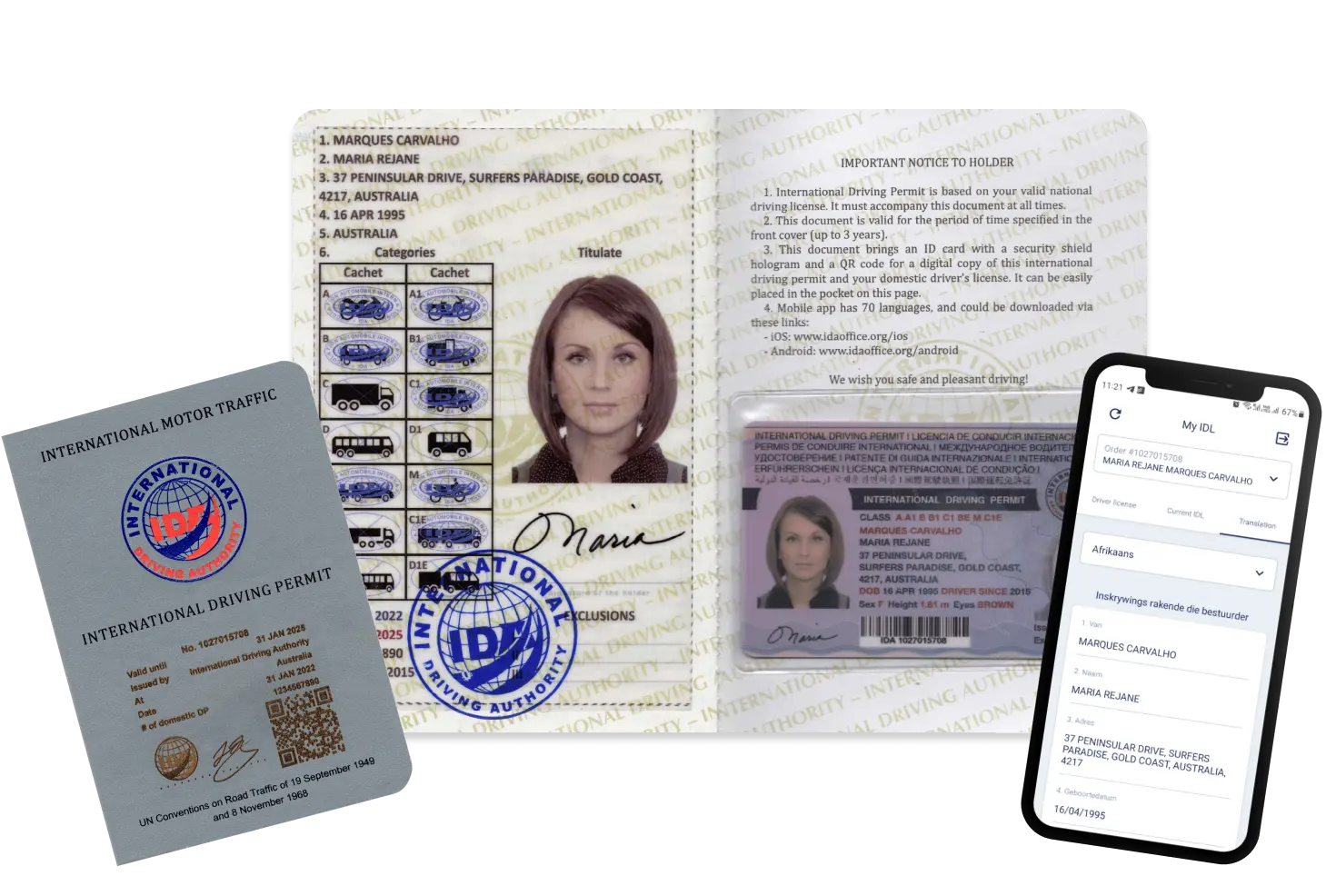
- The United Nations Standard International Driving Permit includes a plastic ID card, a booklet and a mobile application for Android and iOS with the translation into 70 languages (29 in a booklet and all 70 in a mobile app). The IDP is made in compliance with United Nations Conventions on road traffic standards for document size, color, format, etc.
-
Electronic International Driving License
- The Electronic International Driving License or eIDL includes a printable PDF document of a booklet and a mobile application for Android and iOS with the translation into 70 languages.
- De jure, according to the United Nations Convention on road traffic, physical copy of IDL is mandatory, as there is no such notion in the UN Convention as an eIDL yet. De facto we and our clients used digital version many times, and road police and car rentals accept it. However, we advise you to choose the United Nations standard IDP if you have enough time for delivery.
- Cancelation and refund are possible only until your order is not processed. Once an order is processed, and an email with eIDL is submitted to you, our service is completed, and the respective PDF file shall be considered exploited and shall become non-redeemable.

How to get an International Driving Permit in Luxembourg?
According to the Vienna Convention of 1968, International Driving Permits (IDPs) are authorized to be issued by national governments or designated organizations. In most countries, this function is carried out by automobile associations affiliated with the AIT/FIA, the police, or other authorized entities. To obtain an International Driving Permit in Luxembourg, you must possess a local license and apply to the relevant authorities here (please notify us if the link is not working). The cost and processing time for an IDP vary by country.
If you hold a national license not issued in Luxembourg, you must verify if your license permits you to drive and if you require an IDP. If an IDP is necessary, the only option is to order a translation of your driver's license, available either via delivery or as an electronic version (confirm with the rental car company if an electronic version is acceptable), for example, through our services.
For U.S. citizens with only a U.S. driver's license, you can obtain an IDP from AAA, but it must be done before traveling to Luxembourg!
FAQ
How to get an International Driving Permit in Luxembourg?
expand_more
If you have a local license and want to travel, contact a competent organization. If you are an American and plan to travel in advance, you can get an IDP from AAA. In other cases, you can have your driver's license translated into the required languages so that you can travel with your national license and its translation.
How to apply for International Driving Permit?
expand_more
Our application process is fast and simple. Complete the IDP application form, attach a copy of your valid driver's license, your handwritten signature and a color ID photo, and make the payment. You can apply for an IDP online here.
Do I need an International Driving Permit for Luxembourg?
expand_more
Luxembourg has unified its driving license in accordance with the 1968 Vienna Convention. If you have a driver's license from one of the 67 countries that did the same, you do NOT need an International Driving Permit to drive in Luxembourg. Drivers from other countries not on the list need an International Driving Permit, unless there is an additional agreement between Luxembourg and the country that issued your driver's licence about special conditions.
Can I drive in Luxembourg with a US license?
expand_more
You can only drive in Luxembourg with your driver's license if you have a valid International Driving Permit (IDP). Additional information for traveling U.S. citizens can be found on the government website.
Can an American drive in Luxembourg?
expand_more
To drive an American in Luxembourg, you must have an International Driving Permit (IDP). Additional information for traveling U.S. citizens can be found on the government website.
What is the International Driver's Document?
expand_more
Our IDD is ideal for travelers visiting multilingual destinations. No test is required, and the IDD is valid for up to three years. This document is used in conjunction with, but does not replace, your valid national license; it is a translation of your driver’s license in three formats.
Can I rent a car with this document?
expand_more
Usually, yes. However, as requirements vary from region to region, you are advised to inquire directly with car rental companies.
Can I purchase car insurance with the IDD?
expand_more
Usually, yes. However, as requirements vary from region to region, you are advised to inquire directly with local insurances companies.
What do you need to know to drive in Luxembourg?
🗓 Facts checked against Luxembourg's road-traffic law and official sources. Research last updated: . You may copy this information only if you provide a link back to this page.
⚠ This page is general information about driving rules, not legal advice. Rules change, and each authority applies its own — confirm your case with the relevant authority before you drive.
ℹ We are a private company. We are not a government body, a licensing or issuing authority, or a treaty organisation, and we are not affiliated with, endorsed by, or acting for any of them. The International Driver's Document we sell is a translation of your national driving licence: it is not a driving licence, and it is not a government-issued document.
- Driving in Luxembourg: key facts
- Do you need an International Driving Permit in Luxembourg?
- What side of the road does Luxembourg drive on?
- How long can you drive in Luxembourg with a foreign licence?
- Is Luxembourg a party to the 1949 or 1968 Road Traffic Convention?
- Why acceptance of your licence varies from place to place
- Can you drive in Luxembourg with your country's licence?
- Where to get an International Driving Permit
- Moving to Luxembourg? Rules for new residents
- Driving rules in Luxembourg tourists get fined for
- Read more about driving in Luxembourg
- Sources
Driving in Luxembourg: key facts
| Question | Answer |
|---|---|
| Side of the road | Right |
| International Driving Permit (IDP) | Accepted for 131 of the 240 origin licences, 75 of which have no established rule — see the row for your country of issue, in the table below, for what each one accepts alongside it, and on what basis |
| IDP types accepted | Both — 1949 Geneva (valid 1 year) and 1968 Vienna (valid 3 years) |
| UN Road Traffic Conventions | 1949 Geneva — ratification 17 Oct 1952; 1968 Vienna — ratification 25 Nov 1975 |
| Time limit for visitors | Luxembourg's Code de la route names no visitor period for driving on a foreign licence, and no Luxembourg government page found states one. |
| EU / EEA licences | Fully valid, no formality (EU mutual recognition of driving licences (Directive 2006/126/EC), as stated by the European Commission's Your Europe portal: 'If your licence was issued in an EU country, you can use it anywhere in the EU.') |
| Minimum age | 18 to drive — Guichet.lu: 'To obtain a category B driving licence, you must reside in Luxembourg and be at least 18 years old.' |
| Alcohol limit | The limit is 0.5 g/l of alcohol in the blood (0.25 mg/l in exhaled breath), lowered to 0.2 g/l (0.10 mg/l) for a list of drivers that includes learners, probationary drivers and drivers under 18. |
| Speed limits | Drive on the right. Unless signs say otherwise, the limits are 50 km/h in built-up areas, 90 km/h outside them and 130 km/h on motorways (110 km/h in rain or other precipitation), 20 km/h in pedestrian, residential and shared zones and 30 km/h on cycle streets. Buses, coaches, vehicles towing a trailer and vehicles over 7,500 kg are limited to 75 km/h outside built-up areas and 90 km/h on motorways (Code de la route: arrêté grand-ducal du 23 novembre 1955, art. 139). The Code is written in French, and only the French text is legally binding. |
| Emergency number | 112 — ambulance and fire. 113 — police. (UK FCDO Luxembourg 'Getting help' page.) 112 also works as the general EU emergency number. |
Do you need an International Driving Permit in Luxembourg?
Luxembourg is a contracting party to both road-traffic conventions (Geneva 1949, ratified 17 Oct 1952; Vienna 1968, ratified 25 Nov 1975), approved by the loi du 22 juillet 1952 and the loi du 27 mai 1975. A valid EU/EEA licence is recognised on its own. A valid licence issued by another party to either convention is recognised on the conditions those conventions set (1949 Convention, art. 24; 1968 Convention, art. 41), and the Code de la route does not itself require an IDP. For a licence issued where neither convention applies, the rule is not established: the Code de la route requires a valid driving licence but does not say whether such a licence is valid for a visitor, so check with the authorities before you travel. An IDP never replaces the national licence and must be carried with it.
- Tourists and short-term visitors: carry your national licence together with the document named in the row for your country of issue, in the table below — for most non-exempt licences that is an IDP.
- EU / EEA licence holders: no IDP needed — A valid EU/EEA licence is recognised in Luxembourg for the whole period of its validity, with no IDP and no translation.
Driving without the required document is punishable under Loi du 14 février 1955, art. 7; arrêté grand-ducal du 23 novembre 1955, arts. 70 and 173 with a fine of €25 to €1,000.
What side of the road does Luxembourg drive on?
Luxembourg drives on the right-hand side of the road, and overtaking is done on the left. Cars in Luxembourg are left-hand drive.
How long can you drive in Luxembourg with a foreign licence?
Luxembourg's Code de la route names no visitor period for driving on a foreign licence, and no Luxembourg government page found states one. A licence issued by another party to the road-traffic conventions is recognised under those conventions, which Luxembourg approved by law (loi du 22 juillet 1952; loi du 27 mai 1975); for a licence issued where neither convention applies, the rule is not established, so check in advance. The widely quoted 'one year' is a residence clock, not a tourist clock — it starts when you establish normal residence in Luxembourg. Separately, the UK FCDO documents that a UK photocard licence may be used to drive in Luxembourg for one year. (Guichet.lu: 'After having established your normal residence in Luxembourg, you have a maximum of one year in which to convert your foreign driving licence' / 'During that year, you can, however, drive in Luxembourg using your foreign licence.' UK FCDO: 'You can use a UK photocard driving licence to drive in Luxembourg for one year.')
Planning to move to Luxembourg? Different rules apply once you become a resident — see the residents section below.
Is Luxembourg a party to the 1949 or 1968 Road Traffic Convention?
Luxembourg is a Contracting Party to both United Nations Conventions on Road Traffic — the Geneva Convention of 19 September 1949 and the Vienna Convention of 8 November 1968. International Driving Permits of both the 1949 and the 1968 type are therefore issued against its framework; which types Luxembourg accepts from visitors is shown in the table above.
- 1949 Geneva Convention on Road Traffic: ratification on 17 Oct 1952.
- 1968 Vienna Convention on Road Traffic: ratification on 25 Nov 1975.
Why acceptance of your licence varies from place to place
Whether a foreign country accepts your driving licence hangs on a tangle of variables: three different road-traffic conventions signed decades apart (1926, 1949, 1968) — the oldest predates the United Nations itself, and only the latter two were concluded under it — countries at different stages of joining each (signed vs. accepted vs. ratified), licences printed in alphabets local police can't read, vehicle-category systems that don't line up between countries, document generations that may not meet a convention's format even when the country is a member, bilateral deals between individual states, and local laws that are looser in one place and stricter in the next. The same licence can be fine at one border and rejected at the next — even at the next rental desk. The International Driving Permit exists to cut through most of it: a standardized, multilingual presentation of your existing licence, with harmonized category symbols, that most officials can read at a glance. It doesn't replace your national licence or grant new rights — you carry both — and it doesn't guarantee acceptance: a handful of destinations still require a local permit alongside or instead of it, but for most it meaningfully improves your odds.
Can you drive in Luxembourg with your country's licence?
This table is for tourists and temporary visitors. Moving to Luxembourg as a resident? Different rules apply — see the residents section below. Find your licence's country of issue below. Luxembourg is an EU member state and a contracting party to both road-traffic conventions — Geneva 1949 (ratified 1952) and Vienna 1968 (ratified 1975). EU/EEA licences are mutually recognised for as long as they are valid, with no IDP and no translation. A valid licence issued by another party to either convention is recognised on the conditions those conventions set, which Luxembourg approved by law (loi du 22 juillet 1952; loi du 27 mai 1975). For a licence issued where neither convention applies, the rule is not established: the Code de la route requires a valid driving licence but does not say whether such a licence is valid for a visitor, so check with the authorities before you travel. The 'one year' figure quoted everywhere is a residence clock, not a tourist clock: it starts when you settle in Luxembourg, and a licence not converted within that year stops being valid here. Rules change — confirm with official sources before you travel. Last verified: October 2026.
Legend: "1949" — Geneva Convention on Road Traffic (IDP valid up to 1 year); "1968" — Vienna Convention (IDP valid up to 3 years).
What the Status column means on this page:
- National licence OK — the destination lets a visitor drive on the national licence itself. The row for your country of issue, in the table below, gives the basis, and any period or condition that qualifies it.
- Treaty recognises licence — IDP advised — the 1949 Geneva Convention obliges this destination to recognise your national licence, and separately allows a destination to require a 1949-type IDP; this row states the treaty position and does not settle which of the two this destination chose, so carrying an IDP is advised. The row for your country of issue, in the table below, gives the basis.
- Treaty recognises licence + IDP — advised — the 1968 Vienna Convention obliges this destination to recognise a national licence conforming to Annex 6 of that Convention, and separately an IDP presented together with the national licence it belongs to; this row does not record whether your own licence conforms to Annex 6, and the licence-and-IDP pair is recognised either way, so carrying both is advised. The row for your country of issue, in the table below, gives the basis.
- Not established — the record does not settle whether you may drive here on this licence; confirm with the destination's licensing authority before you rely on it. The row for your country of issue, in the table below, says what could not be confirmed.
| Country of licence | Status | What you need to carry | Why |
|---|---|---|---|
| Abkhazia | Not established | Check with local authorities before travel | The Code de la route requires a valid driving licence but does not say whether one issued where neither road-traffic convention applies is valid for a visitor; the conventions Luxembourg approved by law cover only their parties' licences. [1] |
| Afghanistan | Not established | Check with local authorities before travel | The Code de la route requires a valid driving licence but does not say whether one issued where neither road-traffic convention applies is valid for a visitor; the conventions Luxembourg approved by law cover only their parties' licences. [1] |
| Albania | Treaty recognises licence + IDP — advised | Your national licence; an IDP (1968 type) is strongly advised and works only alongside it | Convention party (1949+1968) — the 1968 Vienna Convention has a national licence recognised where it conforms to Annex 6, and an IDP recognised only when presented with the licence it belongs to; whether your licence conforms to Annex 6 is not recorded here, so the licence-and-IDP pair is what this row can stand behind [2] |
| Algeria | Treaty recognises licence — IDP advised | Your national licence; an IDP (1949 type) is strongly advised | Convention party (1949) — the Geneva Convention has your national licence recognised and lets the destination require a 1949-type IDP; the Convention provides no translation route [2] |
| American Samoa | Treaty recognises licence — IDP advised | Your national licence; an IDP (1949 type) is strongly advised | Convention party (1949) — the Geneva Convention has your national licence recognised and lets the destination require a 1949-type IDP; the Convention provides no translation route (via United States of America — territorial application) [2] |
| Andorra | Treaty recognises licence + IDP — advised | Your national licence; an IDP (1968 type) is strongly advised and works only alongside it | Convention party (1968) — the 1968 Vienna Convention has a national licence recognised where it conforms to Annex 6, and an IDP recognised only when presented with the licence it belongs to; whether your licence conforms to Annex 6 is not recorded here, so the licence-and-IDP pair is what this row can stand behind [2] |
| Angola | Not established | Check with local authorities before travel | The Code de la route requires a valid driving licence but does not say whether one issued where neither road-traffic convention applies is valid for a visitor; the conventions Luxembourg approved by law cover only their parties' licences. [1] |
| Antigua and Barbuda | Not established | Check with local authorities before travel | The Code de la route requires a valid driving licence but does not say whether one issued where neither road-traffic convention applies is valid for a visitor; the conventions Luxembourg approved by law cover only their parties' licences. [1] |
| Argentina | Treaty recognises licence — IDP advised | Your national licence; an IDP (1949 type) is strongly advised | Convention party (1949) — the Geneva Convention has your national licence recognised and lets the destination require a 1949-type IDP; the Convention provides no translation route [2] |
| Armenia | Treaty recognises licence + IDP — advised | Your national licence; an IDP (1968 type) is strongly advised and works only alongside it | Convention party (1968) — the 1968 Vienna Convention has a national licence recognised where it conforms to Annex 6, and an IDP recognised only when presented with the licence it belongs to; whether your licence conforms to Annex 6 is not recorded here, so the licence-and-IDP pair is what this row can stand behind [2] |
| Aruba | Treaty recognises licence — IDP advised | Your national licence; an IDP (1949 type) is strongly advised | Convention party (1949) — the Geneva Convention has your national licence recognised and lets the destination require a 1949-type IDP; the Convention provides no translation route (via Netherlands — territorial application) [2] |
| Australia | Treaty recognises licence — IDP advised | Your national licence; an IDP (1949 type) is strongly advised | Convention party (1949) — the Geneva Convention has your national licence recognised and lets the destination require a 1949-type IDP; the Convention provides no translation route [2] |
| Austria | National licence OK | Your EU/EEA licence | EU/EEA mutual recognition |
| Azad Kashmir | Not established | Check with local authorities before travel | The Code de la route requires a valid driving licence but does not say whether one issued where neither road-traffic convention applies is valid for a visitor; the conventions Luxembourg approved by law cover only their parties' licences. [1] |
| Azerbaijan | Treaty recognises licence + IDP — advised | Your national licence; an IDP (1968 type) is strongly advised and works only alongside it | Convention party (1968) — the 1968 Vienna Convention has a national licence recognised where it conforms to Annex 6, and an IDP recognised only when presented with the licence it belongs to; whether your licence conforms to Annex 6 is not recorded here, so the licence-and-IDP pair is what this row can stand behind [2] |
| Bahamas | Treaty recognises licence + IDP — advised | Your national licence; an IDP (1968 type) is strongly advised and works only alongside it | Convention party (1968) — the 1968 Vienna Convention has a national licence recognised where it conforms to Annex 6, and an IDP recognised only when presented with the licence it belongs to; whether your licence conforms to Annex 6 is not recorded here, so the licence-and-IDP pair is what this row can stand behind [2] |
| Bahrain | Treaty recognises licence + IDP — advised | Your national licence; an IDP (1968 type) is strongly advised and works only alongside it | Convention party (1949+1968) — the 1968 Vienna Convention has a national licence recognised where it conforms to Annex 6, and an IDP recognised only when presented with the licence it belongs to; whether your licence conforms to Annex 6 is not recorded here, so the licence-and-IDP pair is what this row can stand behind [2] |
| Bangladesh | Treaty recognises licence — IDP advised | Your national licence; an IDP (1949 type) is strongly advised | Convention party (1949) — the Geneva Convention has your national licence recognised and lets the destination require a 1949-type IDP; the Convention provides no translation route [2] |
| Barbados | Treaty recognises licence — IDP advised | Your national licence; an IDP (1949 type) is strongly advised | Convention party (1949) — the Geneva Convention has your national licence recognised and lets the destination require a 1949-type IDP; the Convention provides no translation route [2] |
| Belarus | Treaty recognises licence + IDP — advised | Your national licence; an IDP (1968 type) is strongly advised and works only alongside it | Convention party (1968) — the 1968 Vienna Convention has a national licence recognised where it conforms to Annex 6, and an IDP recognised only when presented with the licence it belongs to; whether your licence conforms to Annex 6 is not recorded here, so the licence-and-IDP pair is what this row can stand behind [2] |
| Belgium | National licence OK | Your EU/EEA licence | EU/EEA mutual recognition |
| Belize | Not established | Check with local authorities before travel | The Code de la route requires a valid driving licence but does not say whether one issued where neither road-traffic convention applies is valid for a visitor; the conventions Luxembourg approved by law cover only their parties' licences. [1] |
| Benin | Treaty recognises licence + IDP — advised | Your national licence; an IDP (1968 type) is strongly advised and works only alongside it | Convention party (1949+1968) — the 1968 Vienna Convention has a national licence recognised where it conforms to Annex 6, and an IDP recognised only when presented with the licence it belongs to; whether your licence conforms to Annex 6 is not recorded here, so the licence-and-IDP pair is what this row can stand behind [2] |
| Bermuda | Not established | We cannot confirm a convention basis for a Bermuda licence — confirm with Luxembourg's licensing authority before you travel | The depositary record does not settle whether a road-traffic convention covers Bermuda: the state responsible for its international relations enumerated its 1949 territorial extensions one by one without naming Bermuda, but separately told the depositary that the 1949 Convention continues in force for its Crown Dependencies and Overseas Territories. No convention basis for the licence can be established either way — check with the authorities before you travel [2] |
| Bhutan | Not established | Check with local authorities before travel | The Code de la route requires a valid driving licence but does not say whether one issued where neither road-traffic convention applies is valid for a visitor; the conventions Luxembourg approved by law cover only their parties' licences. [1] |
| Bolivia | Not established | Check with local authorities before travel | The Code de la route requires a valid driving licence but does not say whether one issued where neither road-traffic convention applies is valid for a visitor; the conventions Luxembourg approved by law cover only their parties' licences. [1] |
| Bosnia and Herzegovina | Treaty recognises licence + IDP — advised | Your national licence; an IDP (1968 type) is strongly advised and works only alongside it | Convention party (1968) — the 1968 Vienna Convention has a national licence recognised where it conforms to Annex 6, and an IDP recognised only when presented with the licence it belongs to; whether your licence conforms to Annex 6 is not recorded here, so the licence-and-IDP pair is what this row can stand behind [2] |
| Botswana | Treaty recognises licence — IDP advised | Your national licence; an IDP (1949 type) is strongly advised | Convention party (1949) — the Geneva Convention has your national licence recognised and lets the destination require a 1949-type IDP; the Convention provides no translation route [2] |
| Brazil | Treaty recognises licence + IDP — advised | Your national licence; an IDP (1968 type) is strongly advised and works only alongside it | Convention party (1968) — the 1968 Vienna Convention has a national licence recognised where it conforms to Annex 6, and an IDP recognised only when presented with the licence it belongs to; whether your licence conforms to Annex 6 is not recorded here, so the licence-and-IDP pair is what this row can stand behind [2] |
| British Virgin Islands | Not established | We cannot confirm a convention basis for a British Virgin Islands licence — confirm with Luxembourg's licensing authority before you travel | The depositary record does not settle whether a road-traffic convention covers British Virgin Islands: the state responsible for its international relations enumerated its 1949 territorial extensions one by one without naming British Virgin Islands, but separately told the depositary that the 1949 Convention continues in force for its Crown Dependencies and Overseas Territories. No convention basis for the licence can be established either way — check with the authorities before you travel [2] |
| Brunei | Treaty recognises licence — IDP advised | Your national licence; an IDP (1949 type) is strongly advised | Convention party (1949) — the Geneva Convention has your national licence recognised and lets the destination require a 1949-type IDP; the Convention provides no translation route [2] |
| Bulgaria | National licence OK | Your EU/EEA licence | EU/EEA mutual recognition |
| Burkina Faso | Treaty recognises licence — IDP advised | Your national licence; an IDP (1949 type) is strongly advised | Convention party (1949) — the Geneva Convention has your national licence recognised and lets the destination require a 1949-type IDP; the Convention provides no translation route [2] |
| Burundi | Not established | Check with local authorities before travel | The Code de la route requires a valid driving licence but does not say whether one issued where neither road-traffic convention applies is valid for a visitor; the conventions Luxembourg approved by law cover only their parties' licences. [1] |
| Cambodia | Treaty recognises licence — IDP advised | Your national licence; an IDP (1949 type) is strongly advised | Convention party (1949) — the Geneva Convention has your national licence recognised and lets the destination require a 1949-type IDP; the Convention provides no translation route [2] |
| Cameroon | Not established | Check with local authorities before travel | The Code de la route requires a valid driving licence but does not say whether one issued where neither road-traffic convention applies is valid for a visitor; the conventions Luxembourg approved by law cover only their parties' licences. [1] |
| Canada | Treaty recognises licence — IDP advised | Your national licence; an IDP (1949 type) is strongly advised | Convention party (1949) — the Geneva Convention has your national licence recognised and lets the destination require a 1949-type IDP; the Convention provides no translation route [2] |
| Cape Verde | Treaty recognises licence + IDP — advised | Your national licence; an IDP (1968 type) is strongly advised and works only alongside it | Convention party (1968) — the 1968 Vienna Convention has a national licence recognised where it conforms to Annex 6, and an IDP recognised only when presented with the licence it belongs to; whether your licence conforms to Annex 6 is not recorded here, so the licence-and-IDP pair is what this row can stand behind [2] |
| Caribbean Netherlands | Treaty recognises licence — IDP advised | Your national licence; an IDP (1949 type) is strongly advised | Convention party (1949) — the Geneva Convention has your national licence recognised and lets the destination require a 1949-type IDP; the Convention provides no translation route (via Netherlands — territorial application) [2] |
| Cayman Islands | Treaty recognises licence — IDP advised | Your national licence; an IDP (1949 type) is strongly advised | Convention party (1949) — the Geneva Convention has your national licence recognised and lets the destination require a 1949-type IDP; the Convention provides no translation route (via United Kingdom — territorial application) [2] |
| Central African Republic | Treaty recognises licence + IDP — advised | Your national licence; an IDP (1968 type) is strongly advised and works only alongside it | Convention party (1949+1968) — the 1968 Vienna Convention has a national licence recognised where it conforms to Annex 6, and an IDP recognised only when presented with the licence it belongs to; whether your licence conforms to Annex 6 is not recorded here, so the licence-and-IDP pair is what this row can stand behind [2] |
| Chad | Not established | Check with local authorities before travel | The Code de la route requires a valid driving licence but does not say whether one issued where neither road-traffic convention applies is valid for a visitor; the conventions Luxembourg approved by law cover only their parties' licences. [1] |
| Chile | Treaty recognises licence — IDP advised | Your national licence; an IDP (1949 type) is strongly advised | Convention party (1949) — the Geneva Convention has your national licence recognised and lets the destination require a 1949-type IDP; the Convention provides no translation route [2] |
| China | Not established | Check with local authorities before travel | The Code de la route requires a valid driving licence but does not say whether one issued where neither road-traffic convention applies is valid for a visitor; the conventions Luxembourg approved by law cover only their parties' licences. [1] |
| Colombia | Not established | Check with local authorities before travel | The Code de la route requires a valid driving licence but does not say whether one issued where neither road-traffic convention applies is valid for a visitor; the conventions Luxembourg approved by law cover only their parties' licences. [1] |
| Comoros | Not established | Check with local authorities before travel | The Code de la route requires a valid driving licence but does not say whether one issued where neither road-traffic convention applies is valid for a visitor; the conventions Luxembourg approved by law cover only their parties' licences. [1] |
| Congo (Brazzaville) | Treaty recognises licence — IDP advised | Your national licence; an IDP (1949 type) is strongly advised | Convention party (1949) — the Geneva Convention has your national licence recognised and lets the destination require a 1949-type IDP; the Convention provides no translation route [2] |
| Congo (Democratic Rep.) | Treaty recognises licence + IDP — advised | Your national licence; an IDP (1968 type) is strongly advised and works only alongside it | Convention party (1949+1968) — the 1968 Vienna Convention has a national licence recognised where it conforms to Annex 6, and an IDP recognised only when presented with the licence it belongs to; whether your licence conforms to Annex 6 is not recorded here, so the licence-and-IDP pair is what this row can stand behind [2] |
| Cook Islands | Not established | We cannot confirm a convention basis for a Cook Islands licence — confirm with Luxembourg's licensing authority before you travel | We could not confirm any ratification, accession or territorial extension covering Cook Islands, so no convention basis for the licence can be established — check with the authorities before you travel [2] |
| Costa Rica | Not established | Check with local authorities before travel | The Code de la route requires a valid driving licence but does not say whether one issued where neither road-traffic convention applies is valid for a visitor; the conventions Luxembourg approved by law cover only their parties' licences. [1] |
| Croatia | National licence OK | Your EU/EEA licence | EU/EEA mutual recognition |
| Cuba | Treaty recognises licence + IDP — advised | Your national licence; an IDP (1968 type) is strongly advised and works only alongside it | Convention party (1949+1968) — the 1968 Vienna Convention has a national licence recognised where it conforms to Annex 6, and an IDP recognised only when presented with the licence it belongs to; whether your licence conforms to Annex 6 is not recorded here, so the licence-and-IDP pair is what this row can stand behind [2] |
| Curacao | Treaty recognises licence — IDP advised | Your national licence; an IDP (1949 type) is strongly advised | Convention party (1949) — the Geneva Convention has your national licence recognised and lets the destination require a 1949-type IDP; the Convention provides no translation route (via Netherlands — territorial application) [2] |
| Cyprus | National licence OK | Your EU/EEA licence | EU/EEA mutual recognition |
| Czech Republic | National licence OK | Your EU/EEA licence | EU/EEA mutual recognition |
| Denmark | National licence OK | Your EU/EEA licence | EU/EEA mutual recognition |
| Djibouti | Not established | Check with local authorities before travel | The Code de la route requires a valid driving licence but does not say whether one issued where neither road-traffic convention applies is valid for a visitor; the conventions Luxembourg approved by law cover only their parties' licences. [1] |
| Dominica | Not established | Check with local authorities before travel | The Code de la route requires a valid driving licence but does not say whether one issued where neither road-traffic convention applies is valid for a visitor; the conventions Luxembourg approved by law cover only their parties' licences. [1] |
| Dominican Republic | Treaty recognises licence — IDP advised | Your national licence; an IDP (1949 type) is strongly advised | Convention party (1949) — the Geneva Convention has your national licence recognised and lets the destination require a 1949-type IDP; the Convention provides no translation route [2] |
| East Timor | Not established | Check with local authorities before travel | The Code de la route requires a valid driving licence but does not say whether one issued where neither road-traffic convention applies is valid for a visitor; the conventions Luxembourg approved by law cover only their parties' licences. [1] |
| Ecuador | Treaty recognises licence — IDP advised | Your national licence; an IDP (1949 type) is strongly advised | Convention party (1949) — the Geneva Convention has your national licence recognised and lets the destination require a 1949-type IDP; the Convention provides no translation route [2] |
| Egypt | Treaty recognises licence + IDP — advised | Your national licence; an IDP (1968 type) is strongly advised and works only alongside it | Convention party (1949+1968) — the 1968 Vienna Convention has a national licence recognised where it conforms to Annex 6, and an IDP recognised only when presented with the licence it belongs to; whether your licence conforms to Annex 6 is not recorded here, so the licence-and-IDP pair is what this row can stand behind [2] |
| El Salvador | Treaty recognises licence + IDP — advised | Your national licence; an IDP (1968 type) is strongly advised and works only alongside it | Convention party (1968) — the 1968 Vienna Convention has a national licence recognised where it conforms to Annex 6, and an IDP recognised only when presented with the licence it belongs to; whether your licence conforms to Annex 6 is not recorded here, so the licence-and-IDP pair is what this row can stand behind [2] |
| Equatorial Guinea | Not established | Check with local authorities before travel | The Code de la route requires a valid driving licence but does not say whether one issued where neither road-traffic convention applies is valid for a visitor; the conventions Luxembourg approved by law cover only their parties' licences. [1] |
| Eritrea | Not established | Check with local authorities before travel | The Code de la route requires a valid driving licence but does not say whether one issued where neither road-traffic convention applies is valid for a visitor; the conventions Luxembourg approved by law cover only their parties' licences. [1] |
| Estonia | National licence OK | Your EU/EEA licence | EU/EEA mutual recognition |
| Eswatini | Not established | Check with local authorities before travel | The Code de la route requires a valid driving licence but does not say whether one issued where neither road-traffic convention applies is valid for a visitor; the conventions Luxembourg approved by law cover only their parties' licences. [1] |
| Ethiopia | Treaty recognises licence + IDP — advised | Your national licence; an IDP (1968 type) is strongly advised and works only alongside it | Convention party (1968) — the 1968 Vienna Convention has a national licence recognised where it conforms to Annex 6, and an IDP recognised only when presented with the licence it belongs to; whether your licence conforms to Annex 6 is not recorded here, so the licence-and-IDP pair is what this row can stand behind [2] |
| Falkland Islands | Not established | We cannot confirm a convention basis for a Falkland Islands licence — confirm with Luxembourg's licensing authority before you travel | The depositary record does not settle whether a road-traffic convention covers Falkland Islands: the state responsible for its international relations enumerated its 1949 territorial extensions one by one without naming Falkland Islands, but separately told the depositary that the 1949 Convention continues in force for its Crown Dependencies and Overseas Territories. No convention basis for the licence can be established either way — check with the authorities before you travel [2] |
| Faroe Islands | Treaty recognises licence — IDP advised | Your national licence; an IDP (1949 type) is strongly advised | Convention party (1949) — the Geneva Convention has your national licence recognised and lets the destination require a 1949-type IDP; the Convention provides no translation route (via Denmark — territorial application) [2] |
| Fiji | Treaty recognises licence — IDP advised | Your national licence; an IDP (1949 type) is strongly advised | Convention party (1949) — the Geneva Convention has your national licence recognised and lets the destination require a 1949-type IDP; the Convention provides no translation route [2] |
| Finland | National licence OK | Your EU/EEA licence | EU/EEA mutual recognition |
| France | National licence OK | Your EU/EEA licence | EU/EEA mutual recognition |
| French Guiana | National licence OK | Your EU/EEA licence | EU/EEA mutual recognition |
| French Polynesia | Treaty recognises licence + IDP — advised | Your national licence; an IDP (1968 type) is strongly advised and works only alongside it | Convention party (1949+1968) — the 1968 Vienna Convention has a national licence recognised where it conforms to Annex 6, and an IDP recognised only when presented with the licence it belongs to; whether your licence conforms to Annex 6 is not recorded here, so the licence-and-IDP pair is what this row can stand behind (via France — territorial application) [2] |
| Gabon | Not established | Check with local authorities before travel | The Code de la route requires a valid driving licence but does not say whether one issued where neither road-traffic convention applies is valid for a visitor; the conventions Luxembourg approved by law cover only their parties' licences. [1] |
| Gambia | Not established | Check with local authorities before travel | The Code de la route requires a valid driving licence but does not say whether one issued where neither road-traffic convention applies is valid for a visitor; the conventions Luxembourg approved by law cover only their parties' licences. [1] |
| Georgia | Treaty recognises licence + IDP — advised | Your national licence; an IDP (1968 type) is strongly advised and works only alongside it | Convention party (1949+1968) — the 1968 Vienna Convention has a national licence recognised where it conforms to Annex 6, and an IDP recognised only when presented with the licence it belongs to; whether your licence conforms to Annex 6 is not recorded here, so the licence-and-IDP pair is what this row can stand behind [2] |
| Germany | National licence OK | Your EU/EEA licence | EU/EEA mutual recognition |
| Ghana | Treaty recognises licence — IDP advised | Your national licence; an IDP (1949 type) is strongly advised | Convention party (1949) — the Geneva Convention has your national licence recognised and lets the destination require a 1949-type IDP; the Convention provides no translation route [2] |
| Gibraltar | Treaty recognises licence + IDP — advised | Your national licence; an IDP (1968 type) is strongly advised and works only alongside it | Convention party (1949+1968) — the 1968 Vienna Convention has a national licence recognised where it conforms to Annex 6, and an IDP recognised only when presented with the licence it belongs to; whether your licence conforms to Annex 6 is not recorded here, so the licence-and-IDP pair is what this row can stand behind (via United Kingdom — territorial application) [2] |
| Greece | National licence OK | Your EU/EEA licence | EU/EEA mutual recognition |
| Greenland | Not established | We cannot confirm a convention basis for a Greenland licence — confirm with Luxembourg's licensing authority before you travel | We could not confirm any ratification, accession or territorial extension covering Greenland, so no convention basis for the licence can be established — check with the authorities before you travel [2] |
| Grenada | Not established | Check with local authorities before travel | The Code de la route requires a valid driving licence but does not say whether one issued where neither road-traffic convention applies is valid for a visitor; the conventions Luxembourg approved by law cover only their parties' licences. [1] |
| Guadeloupe | National licence OK | Your EU/EEA licence | EU/EEA mutual recognition |
| Guam | Treaty recognises licence — IDP advised | Your national licence; an IDP (1949 type) is strongly advised | Convention party (1949) — the Geneva Convention has your national licence recognised and lets the destination require a 1949-type IDP; the Convention provides no translation route (via United States of America — territorial application) [2] |
| Guatemala | Treaty recognises licence — IDP advised | Your national licence; an IDP (1949 type) is strongly advised | Convention party (1949) — the Geneva Convention has your national licence recognised and lets the destination require a 1949-type IDP; the Convention provides no translation route [2] |
| Guernsey | Treaty recognises licence + IDP — advised | Your national licence; an IDP (1968 type) is strongly advised and works only alongside it | Convention party (1949+1968) — the 1968 Vienna Convention has a national licence recognised where it conforms to Annex 6, and an IDP recognised only when presented with the licence it belongs to; whether your licence conforms to Annex 6 is not recorded here, so the licence-and-IDP pair is what this row can stand behind (via United Kingdom — territorial application) [2] |
| Guinea | Not established | Check with local authorities before travel | The Code de la route requires a valid driving licence but does not say whether one issued where neither road-traffic convention applies is valid for a visitor; the conventions Luxembourg approved by law cover only their parties' licences. [1] |
| Guinea Bissau | Not established | Check with local authorities before travel | The Code de la route requires a valid driving licence but does not say whether one issued where neither road-traffic convention applies is valid for a visitor; the conventions Luxembourg approved by law cover only their parties' licences. [1] |
| Guyana | Treaty recognises licence + IDP — advised | Your national licence; an IDP (1968 type) is strongly advised and works only alongside it | Convention party (1968) — the 1968 Vienna Convention has a national licence recognised where it conforms to Annex 6, and an IDP recognised only when presented with the licence it belongs to; whether your licence conforms to Annex 6 is not recorded here, so the licence-and-IDP pair is what this row can stand behind [2] |
| Haiti | Treaty recognises licence — IDP advised | Your national licence; an IDP (1949 type) is strongly advised | Convention party (1949) — the Geneva Convention has your national licence recognised and lets the destination require a 1949-type IDP; the Convention provides no translation route [2] |
| Honduras | Treaty recognises licence + IDP — advised | Your national licence; an IDP (1968 type) is strongly advised and works only alongside it | Convention party (1968) — the 1968 Vienna Convention has a national licence recognised where it conforms to Annex 6, and an IDP recognised only when presented with the licence it belongs to; whether your licence conforms to Annex 6 is not recorded here, so the licence-and-IDP pair is what this row can stand behind [2] |
| Hong Kong | Treaty recognises licence — IDP advised | Your national licence; an IDP (1949 type) is strongly advised | Convention party (1949) — the Geneva Convention has your national licence recognised and lets the destination require a 1949-type IDP; the Convention provides no translation route (1949 Geneva continued application to Hong Kong SAR; HK issues 1949 IDPs) [2] |
| Hungary | National licence OK | Your EU/EEA licence | EU/EEA mutual recognition |
| Iceland | National licence OK | Your EU/EEA licence | EU/EEA mutual recognition |
| India | Treaty recognises licence — IDP advised | Your national licence; an IDP (1949 type) is strongly advised | Convention party (1949) — the Geneva Convention has your national licence recognised and lets the destination require a 1949-type IDP; the Convention provides no translation route [2] |
| Indonesia | Not established | Check with local authorities before travel | The Code de la route requires a valid driving licence but does not say whether one issued where neither road-traffic convention applies is valid for a visitor; the conventions Luxembourg approved by law cover only their parties' licences. [1] |
| Iran | Treaty recognises licence + IDP — advised | Your national licence; an IDP (1968 type) is strongly advised and works only alongside it | Convention party (1968) — the 1968 Vienna Convention has a national licence recognised where it conforms to Annex 6, and an IDP recognised only when presented with the licence it belongs to; whether your licence conforms to Annex 6 is not recorded here, so the licence-and-IDP pair is what this row can stand behind [2] |
| Iraq | Treaty recognises licence + IDP — advised | Your national licence; an IDP (1968 type) is strongly advised and works only alongside it | Convention party (1968) — the 1968 Vienna Convention has a national licence recognised where it conforms to Annex 6, and an IDP recognised only when presented with the licence it belongs to; whether your licence conforms to Annex 6 is not recorded here, so the licence-and-IDP pair is what this row can stand behind [2] |
| Ireland | National licence OK | Your EU/EEA licence | EU/EEA mutual recognition |
| Israel | Treaty recognises licence + IDP — advised | Your national licence; an IDP (1968 type) is strongly advised and works only alongside it | Convention party (1949+1968) — the 1968 Vienna Convention has a national licence recognised where it conforms to Annex 6, and an IDP recognised only when presented with the licence it belongs to; whether your licence conforms to Annex 6 is not recorded here, so the licence-and-IDP pair is what this row can stand behind [2] |
| Italy | National licence OK | Your EU/EEA licence | EU/EEA mutual recognition |
| Ivory Coast | Treaty recognises licence + IDP — advised | Your national licence; an IDP (1968 type) is strongly advised and works only alongside it | Convention party (1949+1968) — the 1968 Vienna Convention has a national licence recognised where it conforms to Annex 6, and an IDP recognised only when presented with the licence it belongs to; whether your licence conforms to Annex 6 is not recorded here, so the licence-and-IDP pair is what this row can stand behind [2] |
| Jamaica | Treaty recognises licence — IDP advised | Your national licence; an IDP (1949 type) is strongly advised | Convention party (1949) — the Geneva Convention has your national licence recognised and lets the destination require a 1949-type IDP; the Convention provides no translation route [2] |
| Japan | Treaty recognises licence — IDP advised | Your national licence; an IDP (1949 type) is strongly advised | Convention party (1949) — the Geneva Convention has your national licence recognised and lets the destination require a 1949-type IDP; the Convention provides no translation route [2] |
| Jersey | Treaty recognises licence + IDP — advised | Your national licence; an IDP (1968 type) is strongly advised and works only alongside it | Convention party (1949+1968) — the 1968 Vienna Convention has a national licence recognised where it conforms to Annex 6, and an IDP recognised only when presented with the licence it belongs to; whether your licence conforms to Annex 6 is not recorded here, so the licence-and-IDP pair is what this row can stand behind (via United Kingdom — territorial application) [2] |
| Jordan | Treaty recognises licence — IDP advised | Your national licence; an IDP (1949 type) is strongly advised | Convention party (1949) — the Geneva Convention has your national licence recognised and lets the destination require a 1949-type IDP; the Convention provides no translation route [2] |
| Kazakhstan | Treaty recognises licence + IDP — advised | Your national licence; an IDP (1968 type) is strongly advised and works only alongside it | Convention party (1968) — the 1968 Vienna Convention has a national licence recognised where it conforms to Annex 6, and an IDP recognised only when presented with the licence it belongs to; whether your licence conforms to Annex 6 is not recorded here, so the licence-and-IDP pair is what this row can stand behind [2] |
| Kenya | Treaty recognises licence + IDP — advised | Your national licence; an IDP (1968 type) is strongly advised and works only alongside it | Convention party (1968) — the 1968 Vienna Convention has a national licence recognised where it conforms to Annex 6, and an IDP recognised only when presented with the licence it belongs to; whether your licence conforms to Annex 6 is not recorded here, so the licence-and-IDP pair is what this row can stand behind [2] |
| Kiribati | Not established | Check with local authorities before travel | The Code de la route requires a valid driving licence but does not say whether one issued where neither road-traffic convention applies is valid for a visitor; the conventions Luxembourg approved by law cover only their parties' licences. [1] |
| Kosovo | Not established | Check with local authorities before travel | The Code de la route requires a valid driving licence but does not say whether one issued where neither road-traffic convention applies is valid for a visitor; the conventions Luxembourg approved by law cover only their parties' licences. [1] |
| Kuwait | Treaty recognises licence + IDP — advised | Your national licence; an IDP (1968 type) is strongly advised and works only alongside it | Convention party (1968) — the 1968 Vienna Convention has a national licence recognised where it conforms to Annex 6, and an IDP recognised only when presented with the licence it belongs to; whether your licence conforms to Annex 6 is not recorded here, so the licence-and-IDP pair is what this row can stand behind [2] |
| Kyrgyzstan | Treaty recognises licence + IDP — advised | Your national licence; an IDP (1968 type) is strongly advised and works only alongside it | Convention party (1949+1968) — the 1968 Vienna Convention has a national licence recognised where it conforms to Annex 6, and an IDP recognised only when presented with the licence it belongs to; whether your licence conforms to Annex 6 is not recorded here, so the licence-and-IDP pair is what this row can stand behind [2] |
| Laos | Treaty recognises licence — IDP advised | Your national licence; an IDP (1949 type) is strongly advised | Convention party (1949) — the Geneva Convention has your national licence recognised and lets the destination require a 1949-type IDP; the Convention provides no translation route [2] |
| Latvia | National licence OK | Your EU/EEA licence | EU/EEA mutual recognition |
| Lebanon | Treaty recognises licence — IDP advised | Your national licence; an IDP (1949 type) is strongly advised | Convention party (1949) — the Geneva Convention has your national licence recognised and lets the destination require a 1949-type IDP; the Convention provides no translation route [2] |
| Lesotho | Treaty recognises licence — IDP advised | Your national licence; an IDP (1949 type) is strongly advised | Convention party (1949) — the Geneva Convention has your national licence recognised and lets the destination require a 1949-type IDP; the Convention provides no translation route [2] |
| Liberia | Treaty recognises licence + IDP — advised | Your national licence; an IDP (1968 type) is strongly advised and works only alongside it | Convention party (1968) — the 1968 Vienna Convention has a national licence recognised where it conforms to Annex 6, and an IDP recognised only when presented with the licence it belongs to; whether your licence conforms to Annex 6 is not recorded here, so the licence-and-IDP pair is what this row can stand behind [2] |
| Libya | Not established | Check with local authorities before travel | The Code de la route requires a valid driving licence but does not say whether one issued where neither road-traffic convention applies is valid for a visitor; the conventions Luxembourg approved by law cover only their parties' licences. [1] |
| Liechtenstein | National licence OK | Your EU/EEA licence | EU/EEA mutual recognition |
| Lithuania | National licence OK | Your EU/EEA licence | EU/EEA mutual recognition |
| Macau | Treaty recognises licence — IDP advised | Your national licence; an IDP (1949 type) is strongly advised | Convention party (1949) — the Geneva Convention has your national licence recognised and lets the destination require a 1949-type IDP; the Convention provides no translation route (1949 continued application to Macau SAR) [2] |
| North Macedonia | Treaty recognises licence + IDP — advised | Your national licence; an IDP (1968 type) is strongly advised and works only alongside it | Convention party (1968) — the 1968 Vienna Convention has a national licence recognised where it conforms to Annex 6, and an IDP recognised only when presented with the licence it belongs to; whether your licence conforms to Annex 6 is not recorded here, so the licence-and-IDP pair is what this row can stand behind [2] |
| Madagascar | Treaty recognises licence — IDP advised | Your national licence; an IDP (1949 type) is strongly advised | Convention party (1949) — the Geneva Convention has your national licence recognised and lets the destination require a 1949-type IDP; the Convention provides no translation route [2] |
| Malawi | Treaty recognises licence — IDP advised | Your national licence; an IDP (1949 type) is strongly advised | Convention party (1949) — the Geneva Convention has your national licence recognised and lets the destination require a 1949-type IDP; the Convention provides no translation route [2] |
| Malaysia | Treaty recognises licence — IDP advised | Your national licence; an IDP (1949 type) is strongly advised | Convention party (1949) — the Geneva Convention has your national licence recognised and lets the destination require a 1949-type IDP; the Convention provides no translation route [2] |
| Maldives | Treaty recognises licence + IDP — advised | Your national licence; an IDP (1968 type) is strongly advised and works only alongside it | Convention party (1968) — the 1968 Vienna Convention has a national licence recognised where it conforms to Annex 6, and an IDP recognised only when presented with the licence it belongs to; whether your licence conforms to Annex 6 is not recorded here, so the licence-and-IDP pair is what this row can stand behind [2] |
| Mali | Treaty recognises licence — IDP advised | Your national licence; an IDP (1949 type) is strongly advised | Convention party (1949) — the Geneva Convention has your national licence recognised and lets the destination require a 1949-type IDP; the Convention provides no translation route [2] |
| Malta | National licence OK | Your EU/EEA licence | EU/EEA mutual recognition |
| Marshall Islands | Not established | Check with local authorities before travel | The Code de la route requires a valid driving licence but does not say whether one issued where neither road-traffic convention applies is valid for a visitor; the conventions Luxembourg approved by law cover only their parties' licences. [1] |
| Martinique | National licence OK | Your EU/EEA licence | EU/EEA mutual recognition |
| Mauritania | Not established | Check with local authorities before travel | The Code de la route requires a valid driving licence but does not say whether one issued where neither road-traffic convention applies is valid for a visitor; the conventions Luxembourg approved by law cover only their parties' licences. [1] |
| Mauritius | Not established | Check with local authorities before travel | The Code de la route requires a valid driving licence but does not say whether one issued where neither road-traffic convention applies is valid for a visitor; the conventions Luxembourg approved by law cover only their parties' licences. [1] |
| Mayotte Island | National licence OK | Your EU/EEA licence | EU/EEA mutual recognition |
| Mexico | Not established | Check with local authorities before travel | The Code de la route requires a valid driving licence but does not say whether one issued where neither road-traffic convention applies is valid for a visitor; the conventions Luxembourg approved by law cover only their parties' licences. [1] |
| Micronesia | Not established | Check with local authorities before travel | The Code de la route requires a valid driving licence but does not say whether one issued where neither road-traffic convention applies is valid for a visitor; the conventions Luxembourg approved by law cover only their parties' licences. [1] |
| Moldova | Treaty recognises licence + IDP — advised | Your national licence; an IDP (1968 type) is strongly advised and works only alongside it | Convention party (1968) — the 1968 Vienna Convention has a national licence recognised where it conforms to Annex 6, and an IDP recognised only when presented with the licence it belongs to; whether your licence conforms to Annex 6 is not recorded here, so the licence-and-IDP pair is what this row can stand behind [2] |
| Monaco | Treaty recognises licence + IDP — advised | Your national licence; an IDP (1968 type) is strongly advised and works only alongside it | Convention party (1949+1968) — the 1968 Vienna Convention has a national licence recognised where it conforms to Annex 6, and an IDP recognised only when presented with the licence it belongs to; whether your licence conforms to Annex 6 is not recorded here, so the licence-and-IDP pair is what this row can stand behind [2] |
| Mongolia | Treaty recognises licence + IDP — advised | Your national licence; an IDP (1968 type) is strongly advised and works only alongside it | Convention party (1968) — the 1968 Vienna Convention has a national licence recognised where it conforms to Annex 6, and an IDP recognised only when presented with the licence it belongs to; whether your licence conforms to Annex 6 is not recorded here, so the licence-and-IDP pair is what this row can stand behind [2] |
| Montenegro | Treaty recognises licence + IDP — advised | Your national licence; an IDP (1968 type) is strongly advised and works only alongside it | Convention party (1949+1968) — the 1968 Vienna Convention has a national licence recognised where it conforms to Annex 6, and an IDP recognised only when presented with the licence it belongs to; whether your licence conforms to Annex 6 is not recorded here, so the licence-and-IDP pair is what this row can stand behind [2] |
| Montserrat | Not established | We cannot confirm a convention basis for a Montserrat licence — confirm with Luxembourg's licensing authority before you travel | The depositary record does not settle whether a road-traffic convention covers Montserrat: the state responsible for its international relations enumerated its 1949 territorial extensions one by one without naming Montserrat, but separately told the depositary that the 1949 Convention continues in force for its Crown Dependencies and Overseas Territories. No convention basis for the licence can be established either way — check with the authorities before you travel [2] |
| Morocco | Treaty recognises licence + IDP — advised | Your national licence; an IDP (1968 type) is strongly advised and works only alongside it | Convention party (1949+1968) — the 1968 Vienna Convention has a national licence recognised where it conforms to Annex 6, and an IDP recognised only when presented with the licence it belongs to; whether your licence conforms to Annex 6 is not recorded here, so the licence-and-IDP pair is what this row can stand behind [2] |
| Mozambique | Not established | Check with local authorities before travel | The Code de la route requires a valid driving licence but does not say whether one issued where neither road-traffic convention applies is valid for a visitor; the conventions Luxembourg approved by law cover only their parties' licences. [1] |
| Myanmar | Treaty recognises licence + IDP — advised | Your national licence; an IDP (1968 type) is strongly advised and works only alongside it | Convention party (1968) — the 1968 Vienna Convention has a national licence recognised where it conforms to Annex 6, and an IDP recognised only when presented with the licence it belongs to; whether your licence conforms to Annex 6 is not recorded here, so the licence-and-IDP pair is what this row can stand behind [2] |
| Namibia | Treaty recognises licence — IDP advised | Your national licence; an IDP (1949 type) is strongly advised | Convention party (1949) — the Geneva Convention has your national licence recognised and lets the destination require a 1949-type IDP; the Convention provides no translation route [2] |
| Nauru | Not established | Check with local authorities before travel | The Code de la route requires a valid driving licence but does not say whether one issued where neither road-traffic convention applies is valid for a visitor; the conventions Luxembourg approved by law cover only their parties' licences. [1] |
| Nepal | Not established | Check with local authorities before travel | The Code de la route requires a valid driving licence but does not say whether one issued where neither road-traffic convention applies is valid for a visitor; the conventions Luxembourg approved by law cover only their parties' licences. [1] |
| Netherlands | National licence OK | Your EU/EEA licence | EU/EEA mutual recognition |
| New Caledonia | Treaty recognises licence + IDP — advised | Your national licence; an IDP (1968 type) is strongly advised and works only alongside it | Convention party (1949+1968) — the 1968 Vienna Convention has a national licence recognised where it conforms to Annex 6, and an IDP recognised only when presented with the licence it belongs to; whether your licence conforms to Annex 6 is not recorded here, so the licence-and-IDP pair is what this row can stand behind (via France — territorial application) [2] |
| New Zealand | Treaty recognises licence — IDP advised | Your national licence; an IDP (1949 type) is strongly advised | Convention party (1949) — the Geneva Convention has your national licence recognised and lets the destination require a 1949-type IDP; the Convention provides no translation route [2] |
| Nicaragua | Not established | Check with local authorities before travel | The Code de la route requires a valid driving licence but does not say whether one issued where neither road-traffic convention applies is valid for a visitor; the conventions Luxembourg approved by law cover only their parties' licences. [1] |
| Niger | Treaty recognises licence + IDP — advised | Your national licence; an IDP (1968 type) is strongly advised and works only alongside it | Convention party (1949+1968) — the 1968 Vienna Convention has a national licence recognised where it conforms to Annex 6, and an IDP recognised only when presented with the licence it belongs to; whether your licence conforms to Annex 6 is not recorded here, so the licence-and-IDP pair is what this row can stand behind [2] |
| Nigeria | Treaty recognises licence + IDP — advised | Your national licence; an IDP (1968 type) is strongly advised and works only alongside it | Convention party (1949+1968) — the 1968 Vienna Convention has a national licence recognised where it conforms to Annex 6, and an IDP recognised only when presented with the licence it belongs to; whether your licence conforms to Annex 6 is not recorded here, so the licence-and-IDP pair is what this row can stand behind [2] |
| Niue | Not established | We cannot confirm a convention basis for a Niue licence — confirm with Luxembourg's licensing authority before you travel | We could not confirm any ratification, accession or territorial extension covering Niue, so no convention basis for the licence can be established — check with the authorities before you travel [2] |
| North Korea | Not established | Check with local authorities before travel | The Code de la route requires a valid driving licence but does not say whether one issued where neither road-traffic convention applies is valid for a visitor; the conventions Luxembourg approved by law cover only their parties' licences. [1] |
| Northern Cyprus | Not established | Check with local authorities before travel | The Code de la route requires a valid driving licence but does not say whether one issued where neither road-traffic convention applies is valid for a visitor; the conventions Luxembourg approved by law cover only their parties' licences. [1] |
| Northern Mariana Islands | Treaty recognises licence — IDP advised | Your national licence; an IDP (1949 type) is strongly advised | Convention party (1949) — the Geneva Convention has your national licence recognised and lets the destination require a 1949-type IDP; the Convention provides no translation route (via United States of America — territorial application) [2] |
| Norway | National licence OK | Your EU/EEA licence | EU/EEA mutual recognition |
| Oman | Treaty recognises licence + IDP — advised | Your national licence; an IDP (1968 type) is strongly advised and works only alongside it | Convention party (1968) — the 1968 Vienna Convention has a national licence recognised where it conforms to Annex 6, and an IDP recognised only when presented with the licence it belongs to; whether your licence conforms to Annex 6 is not recorded here, so the licence-and-IDP pair is what this row can stand behind [2] |
| Pakistan | Treaty recognises licence + IDP — advised | Your national licence; an IDP (1968 type) is strongly advised and works only alongside it | Convention party (1968) — the 1968 Vienna Convention has a national licence recognised where it conforms to Annex 6, and an IDP recognised only when presented with the licence it belongs to; whether your licence conforms to Annex 6 is not recorded here, so the licence-and-IDP pair is what this row can stand behind [2] |
| Palau | Not established | Check with local authorities before travel | The Code de la route requires a valid driving licence but does not say whether one issued where neither road-traffic convention applies is valid for a visitor; the conventions Luxembourg approved by law cover only their parties' licences. [1] |
| Palestine | Treaty recognises licence + IDP — advised | Your national licence; an IDP (1968 type) is strongly advised and works only alongside it | Convention party (1968) — the 1968 Vienna Convention has a national licence recognised where it conforms to Annex 6, and an IDP recognised only when presented with the licence it belongs to; whether your licence conforms to Annex 6 is not recorded here, so the licence-and-IDP pair is what this row can stand behind [2] |
| Panama | Not established | Check with local authorities before travel | The Code de la route requires a valid driving licence but does not say whether one issued where neither road-traffic convention applies is valid for a visitor; the conventions Luxembourg approved by law cover only their parties' licences. [1] |
| Papua New Guinea | Treaty recognises licence — IDP advised | Your national licence; an IDP (1949 type) is strongly advised | Convention party (1949) — the Geneva Convention has your national licence recognised and lets the destination require a 1949-type IDP; the Convention provides no translation route [2] |
| Paraguay | Treaty recognises licence — IDP advised | Your national licence; an IDP (1949 type) is strongly advised | Convention party (1949) — the Geneva Convention has your national licence recognised and lets the destination require a 1949-type IDP; the Convention provides no translation route [2] |
| Peru | Treaty recognises licence + IDP — advised | Your national licence; an IDP (1968 type) is strongly advised and works only alongside it | Convention party (1949+1968) — the 1968 Vienna Convention has a national licence recognised where it conforms to Annex 6, and an IDP recognised only when presented with the licence it belongs to; whether your licence conforms to Annex 6 is not recorded here, so the licence-and-IDP pair is what this row can stand behind [2] |
| Philippines | Treaty recognises licence + IDP — advised | Your national licence; an IDP (1968 type) is strongly advised and works only alongside it | Convention party (1949+1968) — the 1968 Vienna Convention has a national licence recognised where it conforms to Annex 6, and an IDP recognised only when presented with the licence it belongs to; whether your licence conforms to Annex 6 is not recorded here, so the licence-and-IDP pair is what this row can stand behind [2] |
| Poland | National licence OK | Your EU/EEA licence | EU/EEA mutual recognition |
| Portugal | National licence OK | Your EU/EEA licence | EU/EEA mutual recognition |
| Puerto Rico | Treaty recognises licence — IDP advised | Your national licence; an IDP (1949 type) is strongly advised | Convention party (1949) — the Geneva Convention has your national licence recognised and lets the destination require a 1949-type IDP; the Convention provides no translation route (via United States of America — territorial application) [2] |
| Qatar | Treaty recognises licence + IDP — advised | Your national licence; an IDP (1968 type) is strongly advised and works only alongside it | Convention party (1968) — the 1968 Vienna Convention has a national licence recognised where it conforms to Annex 6, and an IDP recognised only when presented with the licence it belongs to; whether your licence conforms to Annex 6 is not recorded here, so the licence-and-IDP pair is what this row can stand behind [2] |
| Nagorno-Karabakh | Not established | Check with local authorities before travel | The Code de la route requires a valid driving licence but does not say whether one issued where neither road-traffic convention applies is valid for a visitor; the conventions Luxembourg approved by law cover only their parties' licences. [1] |
| Reunion | National licence OK | Your EU/EEA licence | EU/EEA mutual recognition |
| Romania | National licence OK | Your EU/EEA licence | EU/EEA mutual recognition |
| Russian Federation | Treaty recognises licence + IDP — advised | Your national licence; an IDP (1968 type) is strongly advised and works only alongside it | Convention party (1949+1968) — the 1968 Vienna Convention has a national licence recognised where it conforms to Annex 6, and an IDP recognised only when presented with the licence it belongs to; whether your licence conforms to Annex 6 is not recorded here, so the licence-and-IDP pair is what this row can stand behind [2] |
| Rwanda | Treaty recognises licence — IDP advised | Your national licence; an IDP (1949 type) is strongly advised | Convention party (1949) — the Geneva Convention has your national licence recognised and lets the destination require a 1949-type IDP; the Convention provides no translation route [2] |
| Sahrawi Republic | Not established | Check with local authorities before travel | The Code de la route requires a valid driving licence but does not say whether one issued where neither road-traffic convention applies is valid for a visitor; the conventions Luxembourg approved by law cover only their parties' licences. [1] |
| Saint Martin | Treaty recognises licence + IDP — advised | Your national licence; an IDP (1968 type) is strongly advised and works only alongside it | Convention party (1949+1968) — the 1968 Vienna Convention has a national licence recognised where it conforms to Annex 6, and an IDP recognised only when presented with the licence it belongs to; whether your licence conforms to Annex 6 is not recorded here, so the licence-and-IDP pair is what this row can stand behind [2] |
| Saint Pierre and Miquelon | Treaty recognises licence + IDP — advised | Your national licence; an IDP (1968 type) is strongly advised and works only alongside it | Convention party (1949+1968) — the 1968 Vienna Convention has a national licence recognised where it conforms to Annex 6, and an IDP recognised only when presented with the licence it belongs to; whether your licence conforms to Annex 6 is not recorded here, so the licence-and-IDP pair is what this row can stand behind (via France — territorial application) [2] |
| Samoa | Not established | Check with local authorities before travel | The Code de la route requires a valid driving licence but does not say whether one issued where neither road-traffic convention applies is valid for a visitor; the conventions Luxembourg approved by law cover only their parties' licences. [1] |
| San Marino | Treaty recognises licence + IDP — advised | Your national licence; an IDP (1968 type) is strongly advised and works only alongside it | Convention party (1949+1968) — the 1968 Vienna Convention has a national licence recognised where it conforms to Annex 6, and an IDP recognised only when presented with the licence it belongs to; whether your licence conforms to Annex 6 is not recorded here, so the licence-and-IDP pair is what this row can stand behind [2] |
| São Tomé and Príncipe | Not established | Check with local authorities before travel | The Code de la route requires a valid driving licence but does not say whether one issued where neither road-traffic convention applies is valid for a visitor; the conventions Luxembourg approved by law cover only their parties' licences. [1] |
| Saudi Arabia | Treaty recognises licence + IDP — advised | Your national licence; an IDP (1968 type) is strongly advised and works only alongside it | Convention party (1968) — the 1968 Vienna Convention has a national licence recognised where it conforms to Annex 6, and an IDP recognised only when presented with the licence it belongs to; whether your licence conforms to Annex 6 is not recorded here, so the licence-and-IDP pair is what this row can stand behind [2] |
| Senegal | Treaty recognises licence + IDP — advised | Your national licence; an IDP (1968 type) is strongly advised and works only alongside it | Convention party (1949+1968) — the 1968 Vienna Convention has a national licence recognised where it conforms to Annex 6, and an IDP recognised only when presented with the licence it belongs to; whether your licence conforms to Annex 6 is not recorded here, so the licence-and-IDP pair is what this row can stand behind [2] |
| Serbia | Treaty recognises licence + IDP — advised | Your national licence; an IDP (1968 type) is strongly advised and works only alongside it | Convention party (1949+1968) — the 1968 Vienna Convention has a national licence recognised where it conforms to Annex 6, and an IDP recognised only when presented with the licence it belongs to; whether your licence conforms to Annex 6 is not recorded here, so the licence-and-IDP pair is what this row can stand behind [2] |
| Seychelles | Treaty recognises licence + IDP — advised | Your national licence; an IDP (1968 type) is strongly advised and works only alongside it | Convention party (1968) — the 1968 Vienna Convention has a national licence recognised where it conforms to Annex 6, and an IDP recognised only when presented with the licence it belongs to; whether your licence conforms to Annex 6 is not recorded here, so the licence-and-IDP pair is what this row can stand behind [2] |
| Sierra Leone | Treaty recognises licence — IDP advised | Your national licence; an IDP (1949 type) is strongly advised | Convention party (1949) — the Geneva Convention has your national licence recognised and lets the destination require a 1949-type IDP; the Convention provides no translation route [2] |
| Singapore | Treaty recognises licence — IDP advised | Your national licence; an IDP (1949 type) is strongly advised | Convention party (1949) — the Geneva Convention has your national licence recognised and lets the destination require a 1949-type IDP; the Convention provides no translation route [2] |
| Sint Maarten | Treaty recognises licence — IDP advised | Your national licence; an IDP (1949 type) is strongly advised | Convention party (1949) — the Geneva Convention has your national licence recognised and lets the destination require a 1949-type IDP; the Convention provides no translation route (via Netherlands — territorial application) [2] |
| Slovak Republic | National licence OK | Your EU/EEA licence | EU/EEA mutual recognition |
| Slovenia | National licence OK | Your EU/EEA licence | EU/EEA mutual recognition |
| Solomon Islands | Not established | Check with local authorities before travel | The Code de la route requires a valid driving licence but does not say whether one issued where neither road-traffic convention applies is valid for a visitor; the conventions Luxembourg approved by law cover only their parties' licences. [1] |
| Somalia | Not established | Check with local authorities before travel | The Code de la route requires a valid driving licence but does not say whether one issued where neither road-traffic convention applies is valid for a visitor; the conventions Luxembourg approved by law cover only their parties' licences. [1] |
| Somaliland | Not established | Check with local authorities before travel | The Code de la route requires a valid driving licence but does not say whether one issued where neither road-traffic convention applies is valid for a visitor; the conventions Luxembourg approved by law cover only their parties' licences. [1] |
| South Africa | Treaty recognises licence + IDP — advised | Your national licence; an IDP (1968 type) is strongly advised and works only alongside it | Convention party (1949+1968) — the 1968 Vienna Convention has a national licence recognised where it conforms to Annex 6, and an IDP recognised only when presented with the licence it belongs to; whether your licence conforms to Annex 6 is not recorded here, so the licence-and-IDP pair is what this row can stand behind [2] |
| South Korea | Treaty recognises licence — IDP advised | Your national licence; an IDP (1949 type) is strongly advised | Convention party (1949) — the Geneva Convention has your national licence recognised and lets the destination require a 1949-type IDP; the Convention provides no translation route [2] |
| South Ossetia | Not established | Check with local authorities before travel | The Code de la route requires a valid driving licence but does not say whether one issued where neither road-traffic convention applies is valid for a visitor; the conventions Luxembourg approved by law cover only their parties' licences. [1] |
| South Sudan | Not established | Check with local authorities before travel | The Code de la route requires a valid driving licence but does not say whether one issued where neither road-traffic convention applies is valid for a visitor; the conventions Luxembourg approved by law cover only their parties' licences. [1] |
| Spain | National licence OK | Your EU/EEA licence | EU/EEA mutual recognition |
| Sri Lanka | Treaty recognises licence — IDP advised | Your national licence; an IDP (1949 type) is strongly advised | Convention party (1949) — the Geneva Convention has your national licence recognised and lets the destination require a 1949-type IDP; the Convention provides no translation route [2] |
| St. Kitts and Nevis | Not established | Check with local authorities before travel | The Code de la route requires a valid driving licence but does not say whether one issued where neither road-traffic convention applies is valid for a visitor; the conventions Luxembourg approved by law cover only their parties' licences. [1] |
| St. Lucia | Not established | Check with local authorities before travel | The Code de la route requires a valid driving licence but does not say whether one issued where neither road-traffic convention applies is valid for a visitor; the conventions Luxembourg approved by law cover only their parties' licences. [1] |
| St. Vincent | Not established | Check with local authorities before travel | The Code de la route requires a valid driving licence but does not say whether one issued where neither road-traffic convention applies is valid for a visitor; the conventions Luxembourg approved by law cover only their parties' licences. [1] |
| Sudan | Not established | Check with local authorities before travel | The Code de la route requires a valid driving licence but does not say whether one issued where neither road-traffic convention applies is valid for a visitor; the conventions Luxembourg approved by law cover only their parties' licences. [1] |
| Suriname | Not established | Check with local authorities before travel | The Code de la route requires a valid driving licence but does not say whether one issued where neither road-traffic convention applies is valid for a visitor; the conventions Luxembourg approved by law cover only their parties' licences. [1] |
| Sweden | National licence OK | Your EU/EEA licence | EU/EEA mutual recognition |
| Switzerland | Treaty recognises licence + IDP — advised | Your national licence; an IDP (1968 type) is strongly advised and works only alongside it | Convention party (1968) — the 1968 Vienna Convention has a national licence recognised where it conforms to Annex 6, and an IDP recognised only when presented with the licence it belongs to; whether your licence conforms to Annex 6 is not recorded here, so the licence-and-IDP pair is what this row can stand behind (Luxembourg's official position on Swiss licences was not found, so this row follows the convention) [2] |
| Syria | Treaty recognises licence — IDP advised | Your national licence; an IDP (1949 type) is strongly advised | Convention party (1949) — the Geneva Convention has your national licence recognised and lets the destination require a 1949-type IDP; the Convention provides no translation route [2] |
| Taiwan | Not established | Check with local authorities before travel | The Code de la route requires a valid driving licence but does not say whether one issued where neither road-traffic convention applies is valid for a visitor; the conventions Luxembourg approved by law cover only their parties' licences. [1] |
| Tajikistan | Treaty recognises licence + IDP — advised | Your national licence; an IDP (1968 type) is strongly advised and works only alongside it | Convention party (1968) — the 1968 Vienna Convention has a national licence recognised where it conforms to Annex 6, and an IDP recognised only when presented with the licence it belongs to; whether your licence conforms to Annex 6 is not recorded here, so the licence-and-IDP pair is what this row can stand behind [2] |
| Tanzania | Not established | Check with local authorities before travel | The Code de la route requires a valid driving licence but does not say whether one issued where neither road-traffic convention applies is valid for a visitor; the conventions Luxembourg approved by law cover only their parties' licences. [1] |
| Thailand | Treaty recognises licence + IDP — advised | Your national licence; an IDP (1968 type) is strongly advised and works only alongside it | Convention party (1949+1968) — the 1968 Vienna Convention has a national licence recognised where it conforms to Annex 6, and an IDP recognised only when presented with the licence it belongs to; whether your licence conforms to Annex 6 is not recorded here, so the licence-and-IDP pair is what this row can stand behind [2] |
| Togo | Treaty recognises licence — IDP advised | Your national licence; an IDP (1949 type) is strongly advised | Convention party (1949) — the Geneva Convention has your national licence recognised and lets the destination require a 1949-type IDP; the Convention provides no translation route [2] |
| Tokelau Islands | Not established | We cannot confirm a convention basis for a Tokelau Islands licence — confirm with Luxembourg's licensing authority before you travel | We could not confirm any ratification, accession or territorial extension covering Tokelau Islands, so no convention basis for the licence can be established — check with the authorities before you travel [2] |
| Tonga | Not established | Check with local authorities before travel | The Code de la route requires a valid driving licence but does not say whether one issued where neither road-traffic convention applies is valid for a visitor; the conventions Luxembourg approved by law cover only their parties' licences. [1] |
| Transnistria | Not established | Check with local authorities before travel | The Code de la route requires a valid driving licence but does not say whether one issued where neither road-traffic convention applies is valid for a visitor; the conventions Luxembourg approved by law cover only their parties' licences. [1] |
| Trinidad and Tobago | Treaty recognises licence — IDP advised | Your national licence; an IDP (1949 type) is strongly advised | Convention party (1949) — the Geneva Convention has your national licence recognised and lets the destination require a 1949-type IDP; the Convention provides no translation route [2] |
| Tunisia | Treaty recognises licence + IDP — advised | Your national licence; an IDP (1968 type) is strongly advised and works only alongside it | Convention party (1949+1968) — the 1968 Vienna Convention has a national licence recognised where it conforms to Annex 6, and an IDP recognised only when presented with the licence it belongs to; whether your licence conforms to Annex 6 is not recorded here, so the licence-and-IDP pair is what this row can stand behind [2] |
| Turkey | Treaty recognises licence + IDP — advised | Your national licence; an IDP (1968 type) is strongly advised and works only alongside it | Convention party (1949+1968) — the 1968 Vienna Convention has a national licence recognised where it conforms to Annex 6, and an IDP recognised only when presented with the licence it belongs to; whether your licence conforms to Annex 6 is not recorded here, so the licence-and-IDP pair is what this row can stand behind [2] |
| Turkmenistan | Treaty recognises licence + IDP — advised | Your national licence; an IDP (1968 type) is strongly advised and works only alongside it | Convention party (1968) — the 1968 Vienna Convention has a national licence recognised where it conforms to Annex 6, and an IDP recognised only when presented with the licence it belongs to; whether your licence conforms to Annex 6 is not recorded here, so the licence-and-IDP pair is what this row can stand behind [2] |
| Turks and Caicos Islands | Not established | We cannot confirm a convention basis for a Turks and Caicos Islands licence — confirm with Luxembourg's licensing authority before you travel | The depositary record does not settle whether a road-traffic convention covers Turks and Caicos Islands: the state responsible for its international relations enumerated its 1949 territorial extensions one by one without naming Turks and Caicos Islands, but separately told the depositary that the 1949 Convention continues in force for its Crown Dependencies and Overseas Territories. No convention basis for the licence can be established either way — check with the authorities before you travel [2] |
| Tuvalu | Not established | Check with local authorities before travel | The Code de la route requires a valid driving licence but does not say whether one issued where neither road-traffic convention applies is valid for a visitor; the conventions Luxembourg approved by law cover only their parties' licences. [1] |
| U.S. Virgin Islands | Treaty recognises licence — IDP advised | Your national licence; an IDP (1949 type) is strongly advised | Convention party (1949) — the Geneva Convention has your national licence recognised and lets the destination require a 1949-type IDP; the Convention provides no translation route (via United States of America — territorial application) [2] |
| Uganda | Treaty recognises licence + IDP — advised | Your national licence; an IDP (1968 type) is strongly advised and works only alongside it | Convention party (1949+1968) — the 1968 Vienna Convention has a national licence recognised where it conforms to Annex 6, and an IDP recognised only when presented with the licence it belongs to; whether your licence conforms to Annex 6 is not recorded here, so the licence-and-IDP pair is what this row can stand behind [2] |
| Ukraine | Treaty recognises licence + IDP — advised | Your national licence; an IDP (1968 type) is strongly advised and works only alongside it | Convention party (1968) — the 1968 Vienna Convention has a national licence recognised where it conforms to Annex 6, and an IDP recognised only when presented with the licence it belongs to; whether your licence conforms to Annex 6 is not recorded here, so the licence-and-IDP pair is what this row can stand behind [2] |
| United Arab Emirates | Treaty recognises licence + IDP — advised | Your national licence; an IDP (1968 type) is strongly advised and works only alongside it | Convention party (1949+1968) — the 1968 Vienna Convention has a national licence recognised where it conforms to Annex 6, and an IDP recognised only when presented with the licence it belongs to; whether your licence conforms to Annex 6 is not recorded here, so the licence-and-IDP pair is what this row can stand behind [2] |
| United Kingdom | Treaty recognises licence + IDP — advised | Your national licence; an IDP (1968 type) is strongly advised and works only alongside it | Convention party (1949+1968) — the 1968 Vienna Convention has a national licence recognised where it conforms to Annex 6, and an IDP recognised only when presented with the licence it belongs to; whether your licence conforms to Annex 6 is not recorded here, so the licence-and-IDP pair is what this row can stand behind (Luxembourg's official position on UK licences was not found, so this row follows the convention) [2] |
| United States of America | Treaty recognises licence — IDP advised | Your national licence; an IDP (1949 type) is strongly advised | Convention party (1949) — the Geneva Convention has your national licence recognised and lets the destination require a 1949-type IDP; the Convention provides no translation route [2] |
| Uruguay | Treaty recognises licence + IDP — advised | Your national licence; an IDP (1968 type) is strongly advised and works only alongside it | Convention party (1968) — the 1968 Vienna Convention has a national licence recognised where it conforms to Annex 6, and an IDP recognised only when presented with the licence it belongs to; whether your licence conforms to Annex 6 is not recorded here, so the licence-and-IDP pair is what this row can stand behind [2] |
| Uzbekistan | Treaty recognises licence + IDP — advised | Your national licence; an IDP (1968 type) is strongly advised and works only alongside it | Convention party (1968) — the 1968 Vienna Convention has a national licence recognised where it conforms to Annex 6, and an IDP recognised only when presented with the licence it belongs to; whether your licence conforms to Annex 6 is not recorded here, so the licence-and-IDP pair is what this row can stand behind [2] |
| Vanuatu | Not established | Check with local authorities before travel | The Code de la route requires a valid driving licence but does not say whether one issued where neither road-traffic convention applies is valid for a visitor; the conventions Luxembourg approved by law cover only their parties' licences. [1] |
| Vatican | Treaty recognises licence — IDP advised | Your national licence; an IDP (1949 type) is strongly advised | Convention party (1949) — the Geneva Convention has your national licence recognised and lets the destination require a 1949-type IDP; the Convention provides no translation route [2] |
| Venezuela | Treaty recognises licence — IDP advised | Your national licence; an IDP (1949 type) is strongly advised | Convention party (1949) — the Geneva Convention has your national licence recognised and lets the destination require a 1949-type IDP; the Convention provides no translation route [2] |
| Vietnam | Treaty recognises licence + IDP — advised | Your national licence; an IDP (1968 type) is strongly advised and works only alongside it | Convention party (1949+1968) — the 1968 Vienna Convention has a national licence recognised where it conforms to Annex 6, and an IDP recognised only when presented with the licence it belongs to; whether your licence conforms to Annex 6 is not recorded here, so the licence-and-IDP pair is what this row can stand behind [2] |
| Wallis and Futuna | Treaty recognises licence + IDP — advised | Your national licence; an IDP (1968 type) is strongly advised and works only alongside it | Convention party (1949+1968) — the 1968 Vienna Convention has a national licence recognised where it conforms to Annex 6, and an IDP recognised only when presented with the licence it belongs to; whether your licence conforms to Annex 6 is not recorded here, so the licence-and-IDP pair is what this row can stand behind (via France — territorial application) [2] |
| Western Sahara | Not established | Check with local authorities before travel | The Code de la route requires a valid driving licence but does not say whether one issued where neither road-traffic convention applies is valid for a visitor; the conventions Luxembourg approved by law cover only their parties' licences. [1] |
| Yemen | Not established | Check with local authorities before travel | The Code de la route requires a valid driving licence but does not say whether one issued where neither road-traffic convention applies is valid for a visitor; the conventions Luxembourg approved by law cover only their parties' licences. [1] |
| Zambia | Not established | Check with local authorities before travel | The Code de la route requires a valid driving licence but does not say whether one issued where neither road-traffic convention applies is valid for a visitor; the conventions Luxembourg approved by law cover only their parties' licences. [1] |
| Zimbabwe | Treaty recognises licence + IDP — advised | Your national licence; an IDP (1968 type) is strongly advised and works only alongside it | Convention party (1949+1968) — the 1968 Vienna Convention has a national licence recognised where it conforms to Annex 6, and an IDP recognised only when presented with the licence it belongs to; whether your licence conforms to Annex 6 is not recorded here, so the licence-and-IDP pair is what this row can stand behind [2] |
Sources and notes for the table above
[2] UN Treaty Collection, Multilateral Treaties Deposited with the Secretary-General — status of the 1949 Geneva Convention on Road Traffic (chapter XI-B-1) and of the 1968 Vienna Convention on Road Traffic (chapter XI-B-19) — XI-B-1, XI-B-19
Where to get an International Driving Permit
An International Driving Permit must be obtained before you travel, and only certain countries may issue one to you — you cannot buy an official IDP from an unrelated country. Under the 1968 Vienna Convention it may be issued only by the Contracting Party where you normally reside and which issued or recognizes your licence — by that Party's competent authority or by an association it has duly empowered. Under the 1949 Geneva Convention it is issued by the competent authority of a Contracting State, or by an association that authority has duly empowered. Which body that is varies by country: a government agency in some, an authorized motoring club in others.
- Travelling from Luxembourg? Luxembourg's official IDPs are issued by Automobile Club du Luxembourg (ACL). Official site.
- Travelling from another country? Ask that country's driving-licence authority which body it authorizes to issue IDPs — a government agency in some countries, an authorized motoring club in others.
Separately, IDA offers a digital International Driver's Document — a translation of your national licence that you carry alongside it. It is not an International Driving Permit issued under the 1949 or 1968 conventions by the body your country authorizes for that purpose, and it is not a certified, sworn or otherwise official translation: no authority certifies it, and where a country requires an official or certified translation by law, our document does not satisfy that requirement. It is a private translation meant to make your national licence readable at rental desks and roadside checks.
Moving to Luxembourg? Rules for new residents
Two different clocks — do not read this as a visitor rule. Once you establish normal residence in Luxembourg you have a maximum of one year to convert (transcribe) a foreign licence; during that year you may keep driving on the foreign licence, and 'foreign licences not converted within a period of one year are no longer valid in Luxembourg'. Conversion is possible only once you have lived in Luxembourg for at least 185 days, and a licence whose conversion is applied for after the one-year deadline, or which has expired, is converted only after you pass a test with a theory and a practical part (Code de la route: arrêté grand-ducal du 23 novembre 1955, art. 84). A UK licence follows this same residence route. Official source.
Driving rules in Luxembourg tourists get fined for
- Mandatory equipment: Carry the full document set listed above. Fit compliant winter tyres in winter conditions. A motor vehicle with four or more wheels must carry an approved warning triangle, and every motor vehicle except mopeds must carry at least one high-visibility safety vest (standard EN 471 or EN 1150); a vehicle registered abroad may instead meet the corresponding rules of the country where it is registered (Code de la route: arrêté grand-ducal du 23 novembre 1955, art. 49 K and L, and art. 172). Anyone on foot on the carriageway, hard shoulder or an emergency stopping place of a motorway or expressway must wear the vest unless going straight to safety (art. 170). A missing triangle or vest is a €74 fixed penalty ('avertissement taxé').
- Drink-driving: The limit is 0.5 g/l of alcohol in the blood (0.25 mg/l in exhaled breath), lowered to 0.2 g/l (0.10 mg/l) for a list of drivers that includes learners, probationary drivers and drivers under 18. The full list: learner drivers driving the category they are learning for; drivers in the 24-month probationary period of a first category A2 or B licence; driving instructors while teaching or at a practical test; accompanying drivers in accompanied driving; drivers under 18; and drivers of emergency vehicles, dangerous-goods vehicles, taxis, hire cars with driver, ambulances, tow trucks, buses, coaches, lorries and semi-trailer tractors, or of any vehicle carrying passengers for payment (Loi du 14 février 1955, art. 12; arrêté grand-ducal du 23 novembre 1955, art. 83). From the limit up to below 0.8 g/l (0.35 mg/l of breath), police may issue a €145 fixed penalty ('avertissement taxé') and 2 points come off the licence; otherwise the case goes to court, which can also ban you from driving for 8 days to 1 year. From 0.8 g/l (0.35 mg/l) up to below 1.2 g/l (0.55 mg/l), the case goes to court, with the same possible ban, and costs 4 points. The court fine for these two bands is not established: art. 12 of the Loi du 14 février 1955 sets €25 to €500, while the Ministry of Justice's table of common road offences gives €25 to €2,000, so check the amount in advance. From 1.2 g/l (0.55 mg/l), drink-driving is a criminal offence: 8 days to 3 years in prison and a fine of €500 to €10,000, or either of the two, a compulsory driving ban of 3 months to 15 years and 6 points; a repeat of a lower-band offence within two years of a final conviction or a paid fixed penalty is punished in the same way (Loi du 14 février 1955, arts. 2bis, 12 and 13; fixed-penalty catalogue, entry 12-01).
- Speed limits: Drive on the right. Unless signs say otherwise, the limits are 50 km/h in built-up areas, 90 km/h outside them and 130 km/h on motorways (110 km/h in rain or other precipitation), 20 km/h in pedestrian, residential and shared zones and 30 km/h on cycle streets. Buses, coaches, vehicles towing a trailer and vehicles over 7,500 kg are limited to 75 km/h outside built-up areas and 90 km/h on motorways (Code de la route: arrêté grand-ducal du 23 novembre 1955, art. 139). The Code is written in French, and only the French text is legally binding.
- Carry the documents traffic officers can ask to see: a valid driving licence, the vehicle's registration certificate and its insurance certificate, plus, where the vehicle is subject to them, a valid roadworthiness-test certificate and, for a vehicle registered in Luxembourg, a valid road-tax certificate. For a vehicle registered abroad, a document need not be shown if the law of the country of registration, or of the country where you normally live, does not require it to be produced. Not showing the licence, the registration certificate or the insurance certificate is a €24 fixed penalty for each (Code de la route: arrêté grand-ducal du 23 novembre 1955, arts. 70 and 173). UK government advice is to carry your passport too, as it is easy to cross into a neighbouring country without realising it.
- Winter tyres are conditional, not calendar-based: the vehicle must have regulation winter tyres whenever you drive in winter conditions (black ice, packed snow, slush, ice, frost). Tyres must be marked 'M.S.', 'M+S', 'M&S' or carry the alpine (three-peak snowflake) symbol.
- A driver whose normal residence is not in Luxembourg is credited with 12 licence points only when a conviction in Luxembourg becomes final, or on paying within 45 days a fixed penalty for an offence that costs points. Losing all 12 points suspends the right to drive for 12 months, or for 24 months if it happens again within 3 years after an earlier suspension ended (Loi du 14 février 1955, art. 2bis).
- Drive on the right; obey posted km/h limits. UK government advice is that the Luxembourg authorities strictly enforce road traffic laws and that you can be fined even for minor violations.
Read more about driving in Luxembourg
Watch what driving in Luxembourg looks like
A few minutes of real POV footage is the fastest way to feel confident before your first drive in Luxembourg:
Open the video on YouTube if the player does not load.
Sources
- Guichet.lu: 'After having established your normal residence in Luxembourg, you have a maximum of one year in which to convert your foreign driving licence' / 'During that year, you can, however, drive in Luxembourg using your foreign licence.' UK FCDO: 'You can use a UK photocard driving licence to drive in Luxembourg for one year.'
- European Commission, Your Europe — EU/EEA driving-licence recognition
- Guichet.lu — International driving licence: issued by ACL, max 3 years, must accompany the national licence
- Guichet.lu — minimum age 18 for category B
- UK FCDO Luxembourg travel advice — UK photocard licence for one year, documents to carry, passport, winter tyres, drink-driving
- UK FCDO Luxembourg — emergency numbers 112 / 113
- UN Treaty Collection — Vienna Convention on Road Traffic 1968: Luxembourg ratified 25 Nov 1975
- UN Treaty Collection — Geneva Convention on Road Traffic 1949: Luxembourg ratified 17 Oct 1952
- SNCA FAQ — a foreign licence can be exchanged or converted only after 185 days' residence in Luxembourg; authenticity certificate; ACL issues the IDP
- Legilux — Code de la route, consolidated text (published in French; only the French text of the law is legally binding): speed limits, alcohol limits and penalties, vehicle equipment, fixed penalties, licence conversion
- Transports.lu (Ministry of Mobility and Public Works) — winter tyres: required only when driving in winter conditions
- Automobile Club du Luxembourg (ACL) — authorized IDP issuer in Luxembourg
- UN Treaty Collection — 1949 Geneva Convention on Road Traffic
- UN Treaty Collection — 1968 Vienna Convention on Road Traffic
