International Driving Permit in Transnistria

International Driving Permit for your travel in Transnistria
- Instant approval
- Fast & Easy Process
- Valid from 1 to 3 years
- Drive Legally Overseas
- Translated in 70 Languages
- Recognized in over 150 countries
- Worldwide Express Shipping
Where to get an International Driving Permit in Transnistria?
Obtaining an International Driving Permit (IDP) in Transnistria is straightforward if you hold a valid Transnistria national driver's license. For those planning a visit to Transnistria, it is advisable to contact the relevant authority in your home country to secure an IDP before departure. However, if you are already traveling and do not possess the IDP, you may opt to have your national driver's license translated online. This method offers a quicker, more convenient, and efficient way to ensure you can legally drive during your travels.
The International Driving Permit is a translation of the national driving license into many languages. The first ID cards appeared in 1926, after the Paris International Convention relative to Motor Traffic. The International Driving Permit was also influenced by two other conventions in 1949 and 1968. The International Driving Permit is the same as the International Driving License.
We remind you that the IDP works only with a valid national license.

How to obtain an International Driving Permit in Transnistria online?
- 1. A photo of your valid domestic driving license
- 2. Your personal data
- 3. A photo of yourself
- 4. Your signature (scan or photo it)
Get an International Driving Permit (IDP) now and travel easily.
International Driving Permit price in Transnistria?
7 days money back guarantee!
You may return the documents issued by the International Driving Authority anytime before the delivery or within 7 days after the delivery of the document for a full refund.
-
UN Standard International Driving Permit
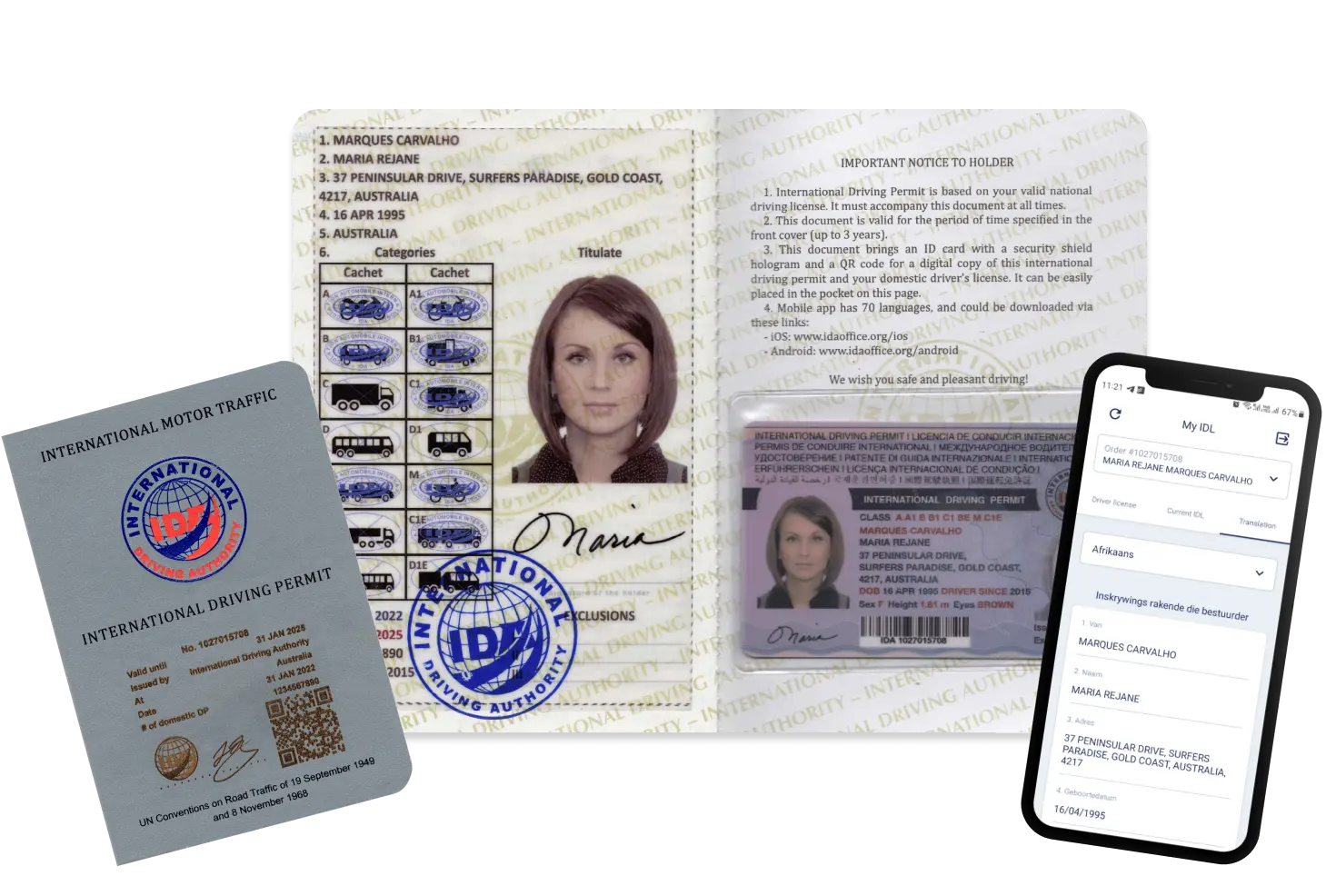
- The United Nations Standard International Driving Permit includes a plastic ID card, a booklet and a mobile application for Android and iOS with the translation into 70 languages (29 in a booklet and all 70 in a mobile app). The IDP is made in compliance with United Nations Conventions on road traffic standards for document size, color, format, etc.
-
Electronic International Driving License
- The Electronic International Driving License or eIDL includes a printable PDF document of a booklet and a mobile application for Android and iOS with the translation into 70 languages.
- De jure, according to the United Nations Convention on road traffic, physical copy of IDL is mandatory, as there is no such notion in the UN Convention as an eIDL yet. De facto we and our clients used digital version many times, and road police and car rentals accept it. However, we advise you to choose the United Nations standard IDP if you have enough time for delivery.
- Cancelation and refund are possible only until your order is not processed. Once an order is processed, and an email with eIDL is submitted to you, our service is completed, and the respective PDF file shall be considered exploited and shall become non-redeemable.

How to get an International Driving Permit in Transnistria?
According to the Vienna Convention of 1968, International Driving Permits (IDPs) are authorized to be issued by national governments or designated organizations. In most countries, this function is carried out by automobile associations affiliated with the AIT/FIA, the police, or other authorized entities. To obtain an International Driving Permit in Transnistria, you must possess a local license and apply to the relevant authorities here (please notify us if the link is not working). The cost and processing time for an IDP vary by country.
If you hold a national license not issued in Transnistria, you must verify if your license permits you to drive and if you require an IDP. If an IDP is necessary, the only option is to order a translation of your driver's license, available either via delivery or as an electronic version (confirm with the rental car company if an electronic version is acceptable), for example, through our services.
For U.S. citizens with only a U.S. driver's license, you can obtain an IDP from AAA, but it must be done before traveling to Transnistria!
FAQ
How to get an International Driving Permit in Transnistria?
expand_more
If you have a local license and want to travel, contact a competent organization. If you are an American and plan to travel in advance, you can get an IDP from AAA. In other cases, you can have your driver's license translated into the required languages so that you can travel with your national license and its translation.
How to apply for International Driving Permit?
expand_more
Our application process is fast and simple. Complete the IDP application form, attach a copy of your valid driver's license, your handwritten signature and a color ID photo, and make the payment. You can apply for an IDP online here.
Do I need an International Driving Permit for Transnistria?
expand_more
Transnistria has not unified its driving license in accordance with the 1968 Vienna Convention. Drivers from other countries need an International Driving License, unless Transnistria and the country that issued your license have an additional agreement on the recognition of driving licenses.
Can I drive in Transnistria with a US license?
expand_more
You can only drive in Transnistria with your driver's license if you have a valid International Driving Permit (IDP). Additional information for traveling U.S. citizens can be found on the government website.
Can an American drive in Transnistria?
expand_more
To drive an American in Transnistria, you must have an International Driving Permit (IDP). Additional information for traveling U.S. citizens can be found on the government website.
What is the International Driver's Document?
expand_more
Our IDD is ideal for travelers visiting multilingual destinations. No test is required, and the IDD is valid for up to three years. This document is used in conjunction with, but does not replace, your valid national license; it is a translation of your driver’s license in three formats.
Can I rent a car with this document?
expand_more
Usually, yes. However, as requirements vary from region to region, you are advised to inquire directly with car rental companies.
Can I purchase car insurance with the IDD?
expand_more
Usually, yes. However, as requirements vary from region to region, you are advised to inquire directly with local insurances companies.
What do you need to know to drive in Transnistria?
🗓 Facts checked against official government guidance for Transnistria and other official sources. Research last updated: . You may copy this information only if you provide a link back to this page.
⚠ This page is general information about driving rules, not legal advice. Rules change, and each authority applies its own — confirm your case with the relevant authority before you drive.
ℹ We are a private company. We are not a government body, a licensing or issuing authority, or a treaty organisation, and we are not affiliated with, endorsed by, or acting for any of them. The International Driver's Document we sell is a translation of your national driving licence: it is not a driving licence, and it is not a government-issued document.
- Driving in Transnistria: key facts
- Do you need an International Driving Permit in Transnistria?
- What side of the road does Transnistria drive on?
- How long can you drive in Transnistria with a foreign licence?
- Is Transnistria a party to the 1949 or 1968 Road Traffic Convention?
- Why acceptance of your licence varies from place to place
- Can you drive in Transnistria with your country's licence?
- Where to get an International Driving Permit
- Moving to Transnistria? Rules for new residents
- Driving rules in Transnistria tourists get fined for
- Read more about driving in Transnistria
- Sources
Driving in Transnistria: key facts
| Question | Answer |
|---|---|
| Side of the road | Right |
| International Driving Permit (IDP) | No established rule was found for any origin licence — check with the authorities before you travel |
| UN Road Traffic Conventions | Party to neither convention |
| Time limit for visitors | The unrecognised de facto authorities' road-traffic law lets a visitor drive on a licence issued by another state until it expires; no visitor period was verified under internationally recognised Moldovan law. |
| Minimum age | 18 to drive (unverified) — Law on Road Traffic Safety of 12 January 2017 of the unrecognised de facto authorities, art. 24; the Moldovan minimum was not verified |
| Alcohol limit | The unrecognised de facto authorities' code counts a driver as drunk with more than 0.16 mg/l of alcohol in exhaled breath or 0.34 per mille or more in blood (art. 12.8, note); the Moldovan limit was not verified. |
| Speed limits | Traffic drives on the right. The traffic rules of the unrecognised de facto authorities set 50 km/h in built-up areas, 20 km/h in residential zones and courtyards, and, for cars, 90 km/h outside built-up areas and 110 km/h on motorways (Rules of the Road of 2 June 2017, points 10.2 and 10.3); no Moldovan figures could be confirmed on 29 July 2026 - obey posted signs. UK government advice for Moldova is that driving standards are poor, roads are of variable quality and there are many traffic accidents, and that you should avoid driving outside urban areas when possible, particularly at night. |
| Emergency number | Transnistria does not run on Moldova's 112. The de facto administration uses the Soviet-legacy short numbers: 101 fire, 102 police, 103 ambulance, 104 gas emergency. Moldova's 112 (ambulance, fire, police) is the number for Moldova-controlled territory and cannot be relied on inside Transnistria because the region is outside Moldovan government control. Consular assistance is severely constrained: the UK advises against all travel to the region. |
Do you need an International Driving Permit in Transnistria?
The de facto Transnistrian authorities, which are not internationally recognised, publish a road-traffic law that lets a visitor drive on a licence issued by another state until that licence expires (Law on Road Traffic Safety of 12 January 2017, art. 30); neither it nor their traffic rules require an International Driving Permit, although the rules ask a driver in international traffic for a licence that conforms to the Convention on Road Traffic, so an IDP is not a legal requirement. But an IDP is the single most useful document to carry here. The de jure basis is Moldova: the territory is internationally part of the Republic of Moldova, which acceded to the 1968 Vienna Convention on Road Traffic on 26 May 1993 and is not a party to the 1949 Geneva Convention. Transnistria itself is unrecognised and therefore cannot be a party to either convention, so no treaty right runs against the authorities who actually control the checkpoints. Carry the original national licence plus a 1968-format IDP; drivers holding only a 1949-format IDP (for example one issued in the United States of America) have no treaty basis even under Moldovan law and should add a Russian translation.
- Tourists and short-term visitors: Transnistria is internationally part of Moldova, a party to the 1968 Convention, but is run by de facto authorities that are not internationally recognised; their road-traffic law lets visitors drive on another state's licence until it expires. Check with the authorities before you travel; the answer below says what is known.
- Car renters: Rental cars are the main practical blocker regardless of your licence. Most Moldovan rental agreements exclude Transnistria, and without the rental company's written permission to take the car into Transnistria the insurance may not respond at all. Get the permission and the insurance territorial scope in writing before crossing.
No specific penalty for driving without the required document was verified from an authoritative source.
What side of the road does Transnistria drive on?
Transnistria drives on the right-hand side of the road, and overtaking is done on the left. Cars in Transnistria are left-hand drive.
How long can you drive in Transnistria with a foreign licence?
The unrecognised de facto authorities' road-traffic law lets a visitor drive on a licence issued by another state until it expires; no visitor period was verified under internationally recognised Moldovan law. Two other clocks apply and must not be confused with it. (1) immigration clock: on entry the de facto authorities issue a migration card, which is stamped instead of the passport and half of which is retained at the crossing; the length of stay, up to 45 days and extendable more than once, and your address are entered on it. Since 1 July 2017 that entry at the crossing registers your stay, so no separate registration is needed; a visitor who does not yet know the address must register within 48 hours. (2) vehicle clock: UK government advice for Moldova is that a foreign-registered vehicle may stay for up to 90 days in a 365-day period without import taxes and must be declared to customs on entry. Neither of these governs how long a foreign licence is honoured. (Law on Road Traffic Safety of 12 January 2017, art. 30; Law on the Legal Status of Foreign Citizens and Stateless Persons of 19 June 2017, art. 5; Law on Migration Registration of Foreign Citizens and Stateless Persons of 19 June 2017, arts. 21 and 27 (all of the unrecognised de facto authorities); Wikivoyage Transnistria (migration card); UK FCDO Moldova safety and security (vehicle customs))
Planning to move to Transnistria? Different rules apply once you become a resident — see the residents section below.
Is Transnistria a party to the 1949 or 1968 Road Traffic Convention?
Transnistria is party to neither the 1949 Geneva Convention nor the 1968 Vienna Convention on Road Traffic, and it is not a generally recognised state. Whether either convention applies here, through a state that claims the territory or otherwise, is not established — check with the authorities before you travel.
Why acceptance of your licence varies from place to place
Whether a foreign country accepts your driving licence hangs on a tangle of variables: three different road-traffic conventions signed decades apart (1926, 1949, 1968) — the oldest predates the United Nations itself, and only the latter two were concluded under it — countries at different stages of joining each (signed vs. accepted vs. ratified), licences printed in alphabets local police can't read, vehicle-category systems that don't line up between countries, document generations that may not meet a convention's format even when the country is a member, bilateral deals between individual states, and local laws that are looser in one place and stricter in the next. The same licence can be fine at one border and rejected at the next — even at the next rental desk. The International Driving Permit exists to cut through most of it: a standardized, multilingual presentation of your existing licence, with harmonized category symbols, that most officials can read at a glance. It doesn't replace your national licence or grant new rights — you carry both — and it doesn't guarantee acceptance: a handful of destinations still require a local permit alongside or instead of it, but for most it meaningfully improves your odds.
Can you drive in Transnistria with your country's licence?
This answer is for tourists and temporary visitors. Moving to Transnistria as a resident? Different rules apply — see the residents section below. Transnistria is an unrecognised de facto republic, internationally part of Moldova but outside Moldovan government control, and the UK advises against all travel there. Two legal layers apply: de jure Moldovan law (Moldova is a 1968 Vienna Convention party, so a 1968-format IDP is the relevant document), and the rules of the unrecognised de facto authorities actually enforced at the checkpoints, whose road-traffic law lets a visitor drive on a licence issued by another state until that licence expires. No treaty right runs against the authorities in control. Whatever your origin country, carry your original national licence plus a 1968 IDP and ideally a Russian translation, and settle rental permission and insurance territorial cover in writing first. Emergency numbers are 101/102/103, not 112. Rules change — confirm with official sources before you travel. Last verified: October 2026.
Legend: "1949" — Geneva Convention on Road Traffic (IDP valid up to 1 year); "1968" — Vienna Convention (IDP valid up to 3 years).
Not established — the record does not settle whether you may drive here on this licence; confirm with the destination's licensing authority before you rely on it. The answer below says what could not be confirmed.
What you need to carry — Check with local authorities before travel
Why — Transnistria is internationally part of Moldova, a party to the 1968 Convention, but is run by de facto authorities that are not internationally recognised; their road-traffic law lets visitors drive on another state's licence until it expires. [1]
Sources and notes for the answer above
Where to get an International Driving Permit
An International Driving Permit must be obtained before you travel, and only certain countries may issue one to you — you cannot buy an official IDP from an unrelated country. Under the 1968 Vienna Convention it may be issued only by the Contracting Party where you normally reside and which issued or recognizes your licence — by that Party's competent authority or by an association it has duly empowered. Under the 1949 Geneva Convention it is issued by the competent authority of a Contracting State, or by an association that authority has duly empowered. Which body that is varies by country: a government agency in some, an authorized motoring club in others.
- Travelling from another country? Ask that country's driving-licence authority which body it authorizes to issue IDPs — a government agency in some countries, an authorized motoring club in others.
Separately, IDA offers a digital International Driver's Document — a translation of your national licence that you carry alongside it. It is not an International Driving Permit issued under the 1949 or 1968 conventions by the body your country authorizes for that purpose, and it is not a certified, sworn or otherwise official translation: no authority certifies it, and where a country requires an official or certified translation by law, our document does not satisfy that requirement. It is a private translation meant to make your national licence readable at rental desks and roadside checks.
Moving to Transnistria? Rules for new residents
Licences issued by the de facto Transnistrian administration are not internationally recognised: the self-declared Pridnestrovian Moldavian Republic is not a party to either road-traffic convention and its documents have no standing abroad or in Moldova proper. Anyone actually resident in the territory who needs a licence usable outside it must go through the Moldovan competent authority.
Driving rules in Transnistria tourists get fined for
- Mandatory equipment: Carry your original national driving licence, passport and the migration card issued at entry. The code of the unrecognised de facto authorities sets a warning or a fine of 2 fine units for driving without the licence, the vehicle's registration documents or, for a foreign-registered car, a Green Card or other recognised insurance policy covering the territory and proof that the vignette (a customs and road charge) was paid (Code of Administrative Offences, art. 12.3). UK government advice for Moldova adds that a vehicle must be declared to customs on entry and that a driver of someone else's vehicle needs the owner's permission, translated and notarised. Carry Transnistrian rubles in cash.
- Drink-driving: The unrecognised de facto authorities' code counts a driver as drunk with more than 0.16 mg/l of alcohol in exhaled breath or 0.34 per mille or more in blood (art. 12.8, note); the Moldovan limit was not verified. UK government advice for Moldova is that a driver tested and found to have more than a third of England's legal limit of alcohol may get a fine and possible imprisonment. The code of the unrecognised de facto authorities fines drink-driving 100 to 200 fine units (RU MZP, units based on the minimum wage) with disqualification for 18 months to two years (Code of Administrative Offences, art. 12.8, para. 1); driving drunk again after such a penalty is a crime punished by a fine, compulsory work or up to two years' imprisonment, each with a ban of up to three years from certain posts or activities and confiscation of the vehicle if the driver owns it (Criminal Code, art. 260-1).
- Speed limits: Traffic drives on the right. The traffic rules of the unrecognised de facto authorities set 50 km/h in built-up areas, 20 km/h in residential zones and courtyards, and, for cars, 90 km/h outside built-up areas and 110 km/h on motorways (Rules of the Road of 2 June 2017, points 10.2 and 10.3); no Moldovan figures could be confirmed on 29 July 2026 - obey posted signs. UK government advice for Moldova is that driving standards are poor, roads are of variable quality and there are many traffic accidents, and that you should avoid driving outside urban areas when possible, particularly at night.
- The UK FCDO advises against all travel to Transnistria. The region is outside the control of the Moldovan government and lies close to military activity in Ukraine; all border crossings between Ukraine and Transnistria are temporarily closed. Entry and exit is therefore effectively only from Moldova-controlled territory.
- Rental cars are the main practical blocker regardless of your licence. Most Moldovan rental agreements exclude Transnistria, and without the rental company's written permission to take the car into Transnistria the insurance may not respond at all. Get the permission and the insurance territorial scope in writing before crossing.
- Expect document checks and delays. On entry you receive a migration card that is stamped instead of your passport. Community reports describe waits of up to an hour at busy times, and describe foreign drivers as targets for informal payment demands by border guards and at police checkpoints. Carry original identity, vehicle registration and insurance documents and follow lawful instructions.
- UK government advice for Moldova is that a driver of a private vehicle owned by someone else needs permission from the owner, translated and notarised, and that a vehicle must be declared to customs on entry. Community reports additionally mention a road tax collected at entry — ask for a receipt for any payment.
- Carry enough Transnistrian rubles in cash. The UK FCDO says ATMs in Transnistrian banks do not accept cards issued outside the region, foreign cards cannot be used for payments, rubles cannot be bought outside the territory, and the self-declared authorities consider paying in any currency other than the ruble illegal, which matters directly if you are asked to settle a roadside penalty. Their customs code does allow the vignette for a foreign-registered vehicle (a combined customs and road charge: 5 US dollars for 7 days to 80 US dollars for 365 days) to be paid in cash in foreign currency.
- UK government advice is to avoid photographing military and government facilities, including airports and power stations.
Read more about driving in Transnistria
Watch what driving in Transnistria looks like
A few minutes of real POV footage is the fastest way to feel confident before your first drive in Transnistria:
Open the video on YouTube if the player does not load.
Sources
- Law on Road Traffic Safety of 12 January 2017, art. 30; Law on the Legal Status of Foreign Citizens and Stateless Persons of 19 June 2017, art. 5; Law on Migration Registration of Foreign Citizens and Stateless Persons of 19 June 2017, arts. 21 and 27 (all of the unrecognised de facto authorities); Wikivoyage Transnistria (migration card); UK FCDO Moldova safety and security (vehicle customs)
- UK FCDO Moldova - licence, vehicle customs, owner permission, drink-driving, Transnistrian currency
- UK FCDO Moldova regional risks - advises against all travel to Transnistria; outside Moldovan government control; Ukraine crossings closed
- UK FCDO Moldova getting help - 112 for Moldova-controlled territory
- UN Treaty Collection - Republic of Moldova acceded to the 1968 Vienna Convention on Road Traffic on 26 May 1993 (primary)
- Emergency numbers - Transnistria 101/102/103 vs Moldova 112 (secondary; corroborates Wikivoyage)
- Transnistrian plates disputed by Moldova; 2018 neutral-design plate with MD sticker for international travel (secondary)
- Transnistria's de facto Supreme Council (not internationally recognised) - Law on Road Traffic Safety of 12 January 2017, current text: a visitor may drive on a licence issued by another state until it expires (art. 30)
- De facto Supreme Council - Code of Administrative Offences (drink-driving threshold and fines, art. 12.8), Criminal Code (art. 260-1) and Customs Code (vehicle vignette, art. 94), current texts
- Rules of the Road of the de facto authorities, approved on 2 June 2017 (ulpmr.ru legal database) - international traffic (point 2.2) and speed limits (points 10.2 and 10.3; 50 km/h in built-up areas from 1 January 2018)
- De facto Supreme Council - Law on the Legal Status of Foreign Citizens and Stateless Persons: a stay of up to 45 days on a migration card, extendable more than once (art. 5)
- De facto Supreme Council - Law on Migration Registration of Foreign Citizens and Stateless Persons: registration at the crossing on the migration card, in force since 1 July 2017 (arts. 21 and 27)
- UN Treaty Collection — 1949 Geneva Convention on Road Traffic
- UN Treaty Collection — 1968 Vienna Convention on Road Traffic
