International Driving Permit in Caribbean Netherlands

International Driving Permit for your travel in Caribbean Netherlands
- Instant approval
- Fast & Easy Process
- Valid from 1 to 3 years
- Drive Legally Overseas
- Translated in 70 Languages
- Recognized in over 150 countries
- Worldwide Express Shipping
Where to get an International Driving Permit in Caribbean Netherlands?
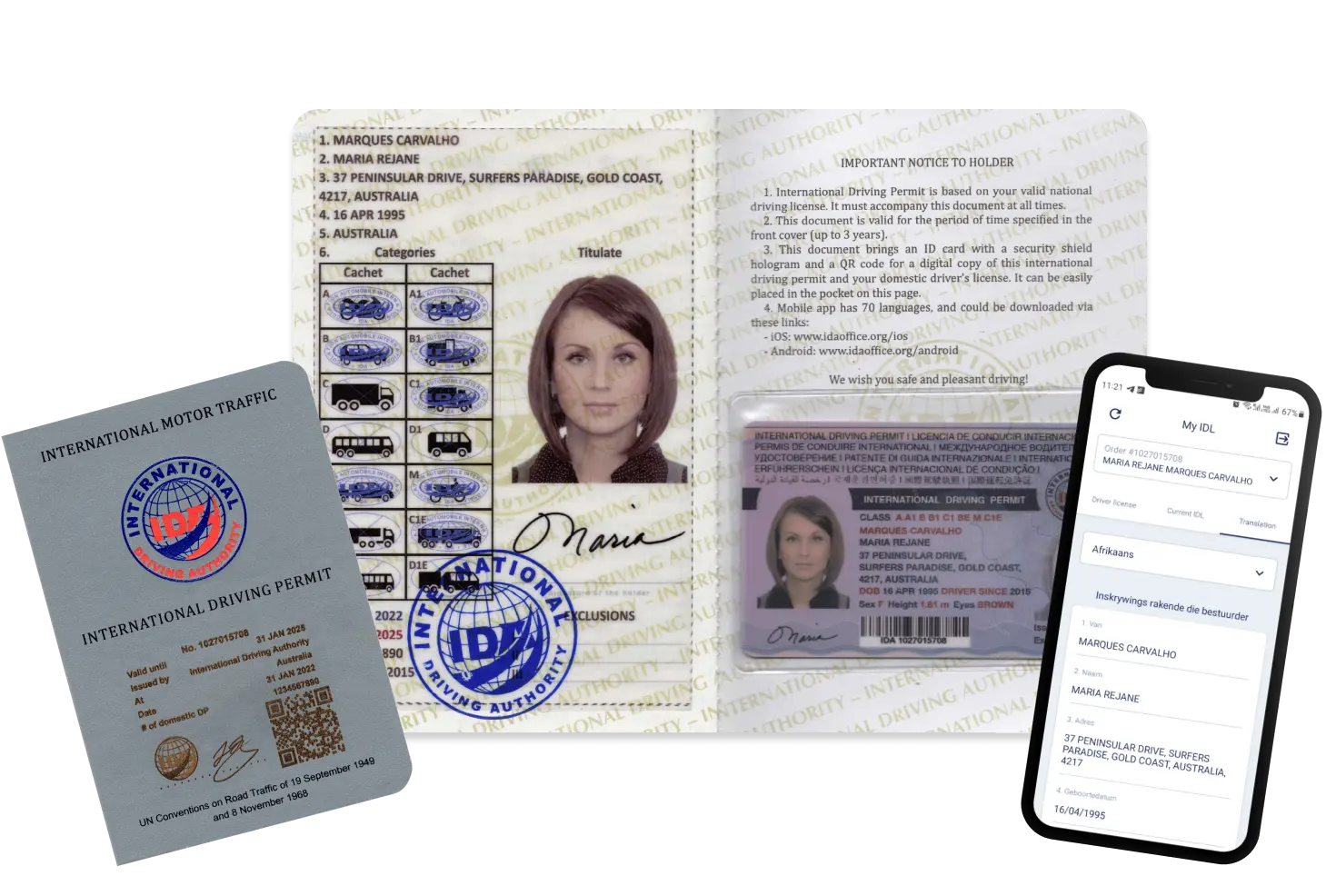
Obtaining an International Driving Permit (IDP) in Caribbean Netherlands is straightforward if you hold a valid Caribbean Netherlands national driver's license. For those planning a visit to Caribbean Netherlands, it is advisable to contact the relevant authority in your home country to secure an IDP before departure. However, if you are already traveling and do not possess the IDP, you may opt to have your national driver's license translated online. This method offers a quicker, more convenient, and efficient way to ensure you can legally drive during your travels.
The International Driving Permit is a translation of the national driving license into many languages. The first ID cards appeared in 1926, after the Paris International Convention relative to Motor Traffic. The International Driving Permit was also influenced by two other conventions in 1949 and 1968. The International Driving Permit is the same as the International Driving License.
We remind you that the IDP works only with a valid national license.

How to obtain an International Driving Permit in Caribbean Netherlands online?
- 1. A photo of your valid domestic driving license
- 2. Your personal data
- 3. A photo of yourself
- 4. Your signature (scan or photo it)
Get an International Driving Permit (IDP) now and travel easily.
International Driving Permit price in Caribbean Netherlands?
7 days money back guarantee!
You may return the documents issued by the International Driving Authority anytime before the delivery or within 7 days after the delivery of the document for a full refund.
-
UN Standard International Driving Permit
- The United Nations Standard International Driving Permit includes a plastic ID card, a booklet and a mobile application for Android and iOS with the translation into 70 languages (29 in a booklet and all 70 in a mobile app). The IDP is made in compliance with United Nations Conventions on road traffic standards for document size, color, format, etc.
-
Electronic International Driving License
- The Electronic International Driving License or eIDL includes a printable PDF document of a booklet and a mobile application for Android and iOS with the translation into 70 languages.
- De jure, according to the United Nations Convention on road traffic, physical copy of IDL is mandatory, as there is no such notion in the UN Convention as an eIDL yet. De facto we and our clients used digital version many times, and road police and car rentals accept it. However, we advise you to choose the United Nations standard IDP if you have enough time for delivery.
- Cancelation and refund are possible only until your order is not processed. Once an order is processed, and an email with eIDL is submitted to you, our service is completed, and the respective PDF file shall be considered exploited and shall become non-redeemable.

How to get an International Driving Permit in Caribbean Netherlands?
According to the Vienna Convention of 1968, International Driving Permits (IDPs) are authorized to be issued by national governments or designated organizations. In most countries, this function is carried out by automobile associations affiliated with the AIT/FIA, the police, or other authorized entities. To obtain an International Driving Permit in Caribbean Netherlands, you must possess a local license and apply to the relevant authorities here (please notify us if the link is not working). The cost and processing time for an IDP vary by country.
If you hold a national license not issued in Caribbean Netherlands, you must verify if your license permits you to drive and if you require an IDP. If an IDP is necessary, the only option is to order a translation of your driver's license, available either via delivery or as an electronic version (confirm with the rental car company if an electronic version is acceptable), for example, through our services.
For U.S. citizens with only a U.S. driver's license, you can obtain an IDP from AAA, but it must be done before traveling to Caribbean Netherlands!
FAQ
How to get an International Driving Permit in Caribbean Netherlands?
expand_more
If you have a local license and want to travel, contact a competent organization. If you are an American and plan to travel in advance, you can get an IDP from AAA. In other cases, you can have your driver's license translated into the required languages so that you can travel with your national license and its translation.
How to apply for International Driving Permit?
expand_more
Our application process is fast and simple. Complete the IDP application form, attach a copy of your valid driver's license, your handwritten signature and a color ID photo, and make the payment. You can apply for an IDP online here.
Do I need an International Driving Permit for Caribbean Netherlands?
expand_more
Caribbean Netherlands has not unified its driving license in accordance with the 1968 Vienna Convention. Drivers from other countries need an International Driving License, unless Caribbean Netherlands and the country that issued your license have an additional agreement on the recognition of driving licenses.
Can I drive in Caribbean Netherlands with a US license?
expand_more
You can only drive in Caribbean Netherlands with your driver's license if you have a valid International Driving Permit (IDP). Additional information for traveling U.S. citizens can be found on the government website.
Can an American drive in Caribbean Netherlands?
expand_more
To drive an American in Caribbean Netherlands, you must have an International Driving Permit (IDP). Additional information for traveling U.S. citizens can be found on the government website.
What is the International Driver's Document?
expand_more
Our IDD is ideal for travelers visiting multilingual destinations. No test is required, and the IDD is valid for up to three years. This document is used in conjunction with, but does not replace, your valid national license; it is a translation of your driver’s license in three formats.
Can I rent a car with this document?
expand_more
Usually, yes. However, as requirements vary from region to region, you are advised to inquire directly with car rental companies.
Can I purchase car insurance with the IDD?
expand_more
Usually, yes. However, as requirements vary from region to region, you are advised to inquire directly with local insurances companies.
What do you need to know to drive in Caribbean Netherlands?
🗓 Facts checked against Caribbean Netherlands's road-traffic law and official sources. Research last updated: . You may copy this information only if you provide a link back to this page.
⚠ This page is general information about driving rules, not legal advice. Rules change, and each authority applies its own — confirm your case with the relevant authority before you drive.
ℹ We are a private company. We are not a government body, a licensing or issuing authority, or a treaty organisation, and we are not affiliated with, endorsed by, or acting for any of them. The International Driver's Document we sell is a translation of your national driving licence: it is not a driving licence, and it is not a government-issued document.
- Driving in Caribbean Netherlands: key facts
- Do you need an International Driving Permit in Caribbean Netherlands?
- What side of the road does Caribbean Netherlands drive on?
- How long can you drive in Caribbean Netherlands with a foreign licence?
- Is Caribbean Netherlands a party to the 1949 or 1968 Road Traffic Convention?
- Why acceptance of your licence varies from place to place
- Can you drive in Caribbean Netherlands with your country's licence?
- Where to get an International Driving Permit
- Moving to Caribbean Netherlands? Rules for new residents
- Driving rules in Caribbean Netherlands tourists get fined for
- Read more about driving in Caribbean Netherlands
- Sources
Driving in Caribbean Netherlands: key facts
| Question | Answer |
|---|---|
| Side of the road | Right |
| International Driving Permit (IDP) | Not required for 4 of the 240 origin licences, 236 of which have no established rule — see the row for your country of issue, in the table below |
| IDP types accepted | 1949 Geneva only (booklet IDP, valid 1 year) |
| UN Road Traffic Conventions | 1949 Geneva — territorial extension 9 May 1957 (via Netherlands) |
| Time limit for visitors | No visitor period is established: the island ordinances name none, and on Bonaire neither the government's 'up to 6 months' nor a 2023 decree counting six months from registration settles a visitor's case. |
| Minimum age | 18 to drive — Wegenverkeersverordening Bonaire art. 102(a); Wegenverkeersverordening Sint Eustatius 2022 art. 98(a); Road Traffic Ordinance Saba art. 102(a) |
| Alcohol limit | On Bonaire and Sint Eustatius it is an offence to drive above 220 micrograms of alcohol per litre of exhaled air or 0.5 mg per millilitre of blood (0.5 g/l); on Saba, above 352 micrograms or 0.8 mg (0.8 g/l). |
| Speed limits | Drive on the right (Bonaire art. 35(1): 'Bestuurders zijn verplicht zoveel mogelijk rechts te houden'; Sint Eustatius art. 32(1) and Saba art. 35(1) set the same rule). Unless signed otherwise, motor vehicles are limited to 40 km/h inside built-up areas and 60 km/h outside on Bonaire (arts. 57 and 58) and Sint Eustatius (arts. 54 and 55), and to 30 km/h inside built-up areas and 60 km/h outside on Saba (arts. 57 and 58). |
| Emergency number | The emergency number on Bonaire, Sint Eustatius and Saba is 911. The Dutch Caribbean Police Force (Korps Politie Caribisch Nederland, KPCN) lists 'Emergency number: 911' and 'Anonymous tip line: 9310'. |
Do you need an International Driving Permit in Caribbean Netherlands?
The islands' own traffic ordinances recognise the 1949 Geneva IDP only. A driver who lives outside the island needs no island licence while driving on a valid international driving permit issued under Article 24 of the Geneva Convention of 19 September 1949 (Bonaire art. 112(1): 'een geldig internationaal rijbewijs ... ingevolge artikel 24 van het Verdrag van Geneve van de 19e september 1949'). Sint Eustatius art. 108(1) and Saba art. 112(1) say the same, and the licence requirement of Bonaire and Saba art. 100(1) and Sint Eustatius art. 96(1) yields to these articles. There is no reference to the 1968 Vienna Convention anywhere in the island law, and the Kingdom of the Netherlands acceded to that convention 'For the Kingdom in Europe' only. The ordinances require no IDP from holders of a national licence issued by a 1949 Geneva party, because Bonaire and Saba art. 112(2) and Sint Eustatius art. 108(2) equate such a licence with an IDP unless the island governor decides otherwise. On Bonaire, the governor's Gezaghebbersbesluit buitenlandse rijbewijzen 2023 departs from art. 112(2): it equates a licence issued outside the Kingdom with an IDP for six months after registration in the population register and does not say what applies to a visitor who never registers, so check with the authorities before you travel if you will drive there without an IDP. Sint Eustatius guidance for new residents adds that an IDP can be required as a translation of a licence not written in Dutch, English or French. An IDP is never a stand-alone entitlement: the Sint Eustatius government-published guidance states that 'solely holding an international driving licence/permit (IDP), even when still valid, offers no legal entitlement to ride or drive any motor vehicle'.
- Tourists and short-term visitors: carry your national licence together with the document named in the row for your country of issue, in the table below — for most origin licences that document is not an IDP, so read your own answer rather than assuming one.
- Car renters: If your licence is from a state that is party only to the 1968 Vienna Convention (and not to the 1949 Geneva Convention), the island ordinances give you no automatic recognition - a 1968 IDP is not the document art. 112(1)/108(1) names. Ask the gezaghebber about the three-month temporary permit under Bonaire or Saba art. 113 or Sint Eustatius art. 109 before you drive, and expect rental firms to be unaware of the distinction.
No specific penalty for driving without the required document was verified from an authoritative source. Official source.
What side of the road does Caribbean Netherlands drive on?
Caribbean Netherlands drives on the right-hand side of the road, and overtaking is done on the left. Bonaire, Sint Eustatius, Saba all drive on the right.
How long can you drive in Caribbean Netherlands with a foreign licence?
No visitor period is established: the island ordinances name none, and on Bonaire neither the government's 'up to 6 months' nor a 2023 decree counting six months from registration settles a visitor's case. Check with the authorities before you travel. Under the ordinances, a visitor who lives outside the island may drive on a valid 1949 Geneva IDP, and a national licence issued by a 1949 Geneva Convention party is equated with an IDP unless the island governor decides otherwise (Bonaire and Saba art. 112(2), Sint Eustatius art. 108(2)). On Bonaire, the governor's Gezaghebbersbesluit buitenlandse rijbewijzen 2023 departs from art. 112(2): it equates a licence issued outside the Kingdom with an IDP for six months after registration in the population register ('voor een periode van zes maanden na inschrijving in de basisadministratie'), while the government's page says such a licence may be used on Bonaire for up to 6 months and gives no start date; neither says what applies to a visitor who never registers. Sint Eustatius' 185 days likewise run 'from the day of being registered as a resident at the Civil Registry's Office'. Separately, Bonaire art. 113, Saba art. 113 and Sint Eustatius art. 109 let the gezaghebber grant a person staying temporarily a permit of at most three months on production of a valid foreign licence - the route for licences the 1949 Convention does not cover. Bonaire and Saba limit this permit to people aged 18 or over (art. 102(a)); Sint Eustatius art. 109 refers to an art. 102(a) that its ordinance does not contain (its age rule is art. 98(a)). (Wegenverkeersverordening Bonaire arts. 112-113; Gezaghebbersbesluit buitenlandse rijbewijzen 2023 point 2; Wegenverkeersverordening Sint Eustatius 2022 arts. 108-109; Sint Eustatius Theory Test Service Document p. 78; Road Traffic Ordinance Saba arts. 112 and 113; Public Entity Bonaire, foreign driver's licences page)
Planning to move to Caribbean Netherlands? Different rules apply once you become a resident — see the residents section below.
Is Caribbean Netherlands a party to the 1949 or 1968 Road Traffic Convention?
Caribbean Netherlands is a Contracting Party to the 1949 Geneva Convention on Road Traffic, but not to the 1968 Vienna Convention.
- 1949 Geneva Convention on Road Traffic: applies via Netherlands (territorial application).
Why acceptance of your licence varies from place to place
Whether a foreign country accepts your driving licence hangs on a tangle of variables: three different road-traffic conventions signed decades apart (1926, 1949, 1968) — the oldest predates the United Nations itself, and only the latter two were concluded under it — countries at different stages of joining each (signed vs. accepted vs. ratified), licences printed in alphabets local police can't read, vehicle-category systems that don't line up between countries, document generations that may not meet a convention's format even when the country is a member, bilateral deals between individual states, and local laws that are looser in one place and stricter in the next. The same licence can be fine at one border and rejected at the next — even at the next rental desk. The International Driving Permit exists to cut through most of it: a standardized, multilingual presentation of your existing licence, with harmonized category symbols, that most officials can read at a glance. It doesn't replace your national licence or grant new rights — you carry both — and it doesn't guarantee acceptance: a handful of destinations still require a local permit alongside or instead of it, but for most it meaningfully improves your odds.
Can you drive in Caribbean Netherlands with your country's licence?
This table is for tourists and temporary visitors. Moving to Caribbean Netherlands as a resident? Different rules apply — see the residents section below. Find your licence's country of issue below. The Caribbean Netherlands - Bonaire, Sint Eustatius and Saba - are Dutch public bodies outside the EU, and their driving rules come from island ordinances, not from EU or European-Netherlands law. Recognition rests on a single instrument: the 1949 Geneva Convention. A licence from any Kingdom of the Netherlands country is treated as a local licence, except that Sint Eustatius' list leaves out Bonaire; a national licence from a 1949 Geneva party is treated as an international driving permit unless the island governor decides otherwise; anything outside that set has no automatic recognition and depends on a discretionary three-month permit from the island governor. On Bonaire, the governor's 2023 decree gives that treatment to a licence issued outside the Kingdom for six months after registration in the population register, and the government says such a licence may be used for up to 6 months; neither says what applies to a visitor who never registers, so for a national licence without an IDP the answer there is not established. A valid 1949 IDP is accepted on all three islands. Sint Eustatius' 185 days run from registration as a resident. Saba's own ordinance, in force since 5 June 2022, follows the same scheme with its own alcohol and speed limits. Rules change — confirm with official sources before you travel. Last verified: October 2026.
Legend: "1949" — Geneva Convention on Road Traffic (IDP valid up to 1 year); "1968" — Vienna Convention (IDP valid up to 3 years).
What the Status column means on this page:
- National licence OK — the destination lets a visitor drive on the national licence itself. The row for your country of issue, in the table below, gives the basis, and any period or condition that qualifies it.
- Not established — the record does not settle whether you may drive here on this licence; confirm with the destination's licensing authority before you rely on it. The row for your country of issue, in the table below, says what could not be confirmed.
Show the full list, all 240
| Country of licence | # |
|---|---|
| Abkhazia | 7 |
| Afghanistan | 8 |
| Albania | 5 |
| Algeria | 5 |
| American Samoa | 5 |
| Andorra | 6 |
| Angola | 7 |
| Antigua and Barbuda | 7 |
| Argentina | 5 |
| Armenia | 6 |
| Aruba | 1 |
| Australia | 5 |
| Austria | 5 |
| Azad Kashmir | 7 |
| Azerbaijan | 6 |
| Bahamas | 6 |
| Bahrain | 5 |
| Bangladesh | 5 |
| Barbados | 5 |
| Belarus | 6 |
| Belgium | 5 |
| Belize | 8 |
| Benin | 5 |
| Bermuda | 9 |
| Bhutan | 8 |
| Bolivia | 8 |
| Bosnia and Herzegovina | 6 |
| Botswana | 5 |
| Brazil | 6 |
| British Virgin Islands | 10 |
| Brunei | 5 |
| Bulgaria | 5 |
| Burkina Faso | 5 |
| Burundi | 8 |
| Cambodia | 5 |
| Cameroon | 8 |
| Canada | 5 |
| Cape Verde | 6 |
| Cayman Islands | 5 |
| Central African Republic | 5 |
| Chad | 8 |
| Chile | 5 |
| China | 7 |
| Colombia | 8 |
| Comoros | 7 |
| Congo (Brazzaville) | 5 |
| Congo (Democratic Rep.) | 5 |
| Cook Islands | 11 |
| Costa Rica | 8 |
| Croatia | 5 |
| Cuba | 5 |
| Curacao | 2 |
| Cyprus | 5 |
| Czech Republic | 5 |
| Denmark | 5 |
| Djibouti | 7 |
| Dominica | 8 |
| Dominican Republic | 5 |
| East Timor | 7 |
| Ecuador | 5 |
| Egypt | 5 |
| El Salvador | 6 |
| Equatorial Guinea | 7 |
| Eritrea | 7 |
| Estonia | 5 |
| Eswatini | 8 |
| Ethiopia | 6 |
| Falkland Islands | 12 |
| Faroe Islands | 5 |
| Fiji | 5 |
| Finland | 5 |
| France | 5 |
| French Guiana | 5 |
| French Polynesia | 5 |
| Gabon | 8 |
| Gambia | 8 |
| Georgia | 5 |
| Germany | 6 |
| Ghana | 5 |
| Gibraltar | 5 |
| Greece | 5 |
| Greenland | 13 |
| Grenada | 7 |
| Guadeloupe | 5 |
| Guam | 5 |
| Guatemala | 5 |
| Guernsey | 5 |
| Guinea | 8 |
| Guinea Bissau | 7 |
| Guyana | 6 |
| Haiti | 5 |
| Honduras | 6 |
| Hong Kong | 5 |
| Hungary | 5 |
| Iceland | 5 |
| India | 5 |
| Indonesia | 8 |
| Iran | 6 |
| Iraq | 6 |
| Ireland | 5 |
| Israel | 5 |
| Italy | 5 |
| Ivory Coast | 5 |
| Jamaica | 5 |
| Japan | 5 |
| Jersey | 5 |
| Jordan | 5 |
| Kazakhstan | 6 |
| Kenya | 6 |
| Kiribati | 7 |
| Kosovo | 8 |
| Kuwait | 6 |
| Kyrgyzstan | 5 |
| Laos | 5 |
| Latvia | 6 |
| Lebanon | 5 |
| Lesotho | 5 |
| Liberia | 6 |
| Libya | 8 |
| Liechtenstein | 5 |
| Lithuania | 5 |
| Luxembourg | 5 |
| Macau | 5 |
| Madagascar | 5 |
| Malawi | 5 |
| Malaysia | 5 |
| Maldives | 6 |
| Mali | 5 |
| Malta | 5 |
| Marshall Islands | 7 |
| Martinique | 5 |
| Mauritania | 7 |
| Mauritius | 8 |
| Mayotte Island | 5 |
| Mexico | 8 |
| Micronesia | 7 |
| Moldova | 6 |
| Monaco | 5 |
| Mongolia | 6 |
| Montenegro | 5 |
| Montserrat | 14 |
| Morocco | 5 |
| Mozambique | 8 |
| Myanmar | 6 |
| Nagorno-Karabakh | 7 |
| Namibia | 5 |
| Nauru | 7 |
| Nepal | 8 |
| Netherlands | 3 |
| New Caledonia | 5 |
| New Zealand | 5 |
| Nicaragua | 8 |
| Niger | 5 |
| Nigeria | 5 |
| Niue | 15 |
| Northern Cyprus | 7 |
| Northern Mariana Islands | 5 |
| North Korea | 7 |
| North Macedonia | 6 |
| Norway | 5 |
| Oman | 6 |
| Pakistan | 6 |
| Palau | 7 |
| Palestine | 6 |
| Panama | 8 |
| Papua New Guinea | 5 |
| Paraguay | 5 |
| Peru | 5 |
| Philippines | 5 |
| Poland | 5 |
| Portugal | 5 |
| Puerto Rico | 5 |
| Qatar | 6 |
| Reunion | 5 |
| Romania | 5 |
| Russian Federation | 5 |
| Rwanda | 5 |
| Sahrawi Republic | 7 |
| Saint Martin | 5 |
| Saint Pierre and Miquelon | 5 |
| Samoa | 7 |
| San Marino | 5 |
| São Tomé and Príncipe | 7 |
| Saudi Arabia | 6 |
| Senegal | 5 |
| Serbia | 5 |
| Seychelles | 6 |
| Sierra Leone | 5 |
| Singapore | 5 |
| Sint Maarten | 4 |
| Slovak Republic | 5 |
| Slovenia | 5 |
| Solomon Islands | 7 |
| Somalia | 7 |
| Somaliland | 7 |
| South Africa | 5 |
| South Korea | 5 |
| South Ossetia | 7 |
| South Sudan | 7 |
| Spain | 5 |
| Sri Lanka | 5 |
| St. Kitts and Nevis | 8 |
| St. Lucia | 8 |
| St. Vincent | 8 |
| Sudan | 8 |
| Suriname | 8 |
| Sweden | 5 |
| Switzerland | 6 |
| Syria | 5 |
| Taiwan | 8 |
| Tajikistan | 6 |
| Tanzania | 8 |
| Thailand | 5 |
| Togo | 5 |
| Tokelau Islands | 16 |
| Tonga | 8 |
| Transnistria | 7 |
| Trinidad and Tobago | 5 |
| Tunisia | 5 |
| Turkey | 5 |
| Turkmenistan | 6 |
| Turks and Caicos Islands | 17 |
| Tuvalu | 7 |
| Uganda | 5 |
| Ukraine | 6 |
| United Arab Emirates | 5 |
| United Kingdom | 5 |
| United States of America | 5 |
| Uruguay | 6 |
| U.S. Virgin Islands | 5 |
| Uzbekistan | 6 |
| Vanuatu | 7 |
| Vatican | 5 |
| Venezuela | 5 |
| Vietnam | 5 |
| Wallis and Futuna | 5 |
| Western Sahara | 7 |
| Yemen | 8 |
| Zambia | 8 |
| Zimbabwe | 5 |
| # | Status | Country of licence | What you need to carry | Why |
|---|---|---|---|---|
| 1 | National licence OK | Aruba (1) | Your national licence | A licence issued in Aruba is not treated as a foreign licence in Caribbean Netherlands — it is recognised on its own [1] |
| 2 | National licence OK | Curacao (1) | Your national licence | A licence issued in Curacao is not treated as a foreign licence in Caribbean Netherlands — it is recognised on its own [1] |
| 3 | National licence OK | Netherlands (1) | Your national licence | A licence issued in Netherlands is not treated as a foreign licence in Caribbean Netherlands — it is recognised on its own [1] |
| 4 | National licence OK | Sint Maarten (1) | Your national licence | A licence issued in Sint Maarten is not treated as a foreign licence in Caribbean Netherlands — it is recognised on its own [1] |
| 5 | Not established | Albania, Algeria, American Samoa, Argentina, Australia, Austria, Bahrain, Bangladesh, Barbados, Belgium, Benin, Botswana, Brunei, Bulgaria, Burkina Faso, Cambodia, Canada, Cayman Islands, Central African Republic, Chile, Congo (Brazzaville), Congo (Democratic Rep.), Croatia, Cuba, Cyprus, Czech Republic, Denmark, Dominican Republic, Ecuador, Egypt, Estonia, Faroe Islands, Fiji, Finland, France, French Guiana, French Polynesia, Georgia, Ghana, Gibraltar, Greece, Guadeloupe, Guam, Guatemala, Guernsey, Haiti, Hong Kong, Hungary, Iceland, India, Ireland, Israel, Italy, Ivory Coast, Jamaica, Japan, Jersey, Jordan, Kyrgyzstan, Laos, Lebanon, Lesotho, Liechtenstein, Lithuania, Luxembourg, Macau, Madagascar, Malawi, Malaysia, Mali, Malta, Martinique, Mayotte Island, Monaco, Montenegro, Morocco, Namibia, New Caledonia, New Zealand, Niger, Nigeria, Northern Mariana Islands, Norway, Papua New Guinea, Paraguay, Peru, Philippines, Poland, Portugal, Puerto Rico, Reunion, Romania, Russian Federation, Rwanda, Saint Martin, Saint Pierre and Miquelon, San Marino, Senegal, Serbia, Sierra Leone, Singapore, Slovak Republic, Slovenia, South Africa, South Korea, Spain, Sri Lanka, Sweden, Syria, Thailand, Togo, Trinidad and Tobago, Tunisia, Turkey, Uganda, United Arab Emirates, United Kingdom, United States of America, U.S. Virgin Islands, Vatican, Venezuela, Vietnam, Wallis and Futuna, Zimbabwe (124) | Check with the authorities before you travel; where your country issues a 1949 IDP, a valid one is accepted by law on all three islands | The ordinances equate your licence with an IDP unless the governor rules otherwise. Bonaire's 2023 decree does so for six months after registration in the population register; neither it nor the government's 'up to 6 months' settles a visitor's case. [2] |
| 6 | Not established | Andorra, Armenia, Azerbaijan, Bahamas, Belarus, Bosnia and Herzegovina, Brazil, Cape Verde, El Salvador, Ethiopia, Germany, Guyana, Honduras, Iran, Iraq, Kazakhstan, Kenya, Kuwait, Latvia, Liberia, Maldives, Moldova, Mongolia, Myanmar, North Macedonia, Oman, Pakistan, Palestine, Qatar, Saudi Arabia, Seychelles, Switzerland, Tajikistan, Turkmenistan, Ukraine, Uruguay, Uzbekistan (37) | Check with local authorities before travel | A 1968 IDP has no treaty basis in Caribbean Netherlands — a party to the 1949 Geneva Convention but not to the 1968 Vienna Convention [3] |
| 7 | Not established | Abkhazia, Angola, Antigua and Barbuda, Azad Kashmir, China, Comoros, Djibouti, East Timor, Equatorial Guinea, Eritrea, Grenada, Guinea Bissau, Kiribati, Marshall Islands, Mauritania, Micronesia, Nagorno-Karabakh, Nauru, Northern Cyprus, North Korea, Palau, Sahrawi Republic, Samoa, São Tomé and Príncipe, Solomon Islands, Somalia, Somaliland, South Ossetia, South Sudan, Transnistria, Tuvalu, Vanuatu, Western Sahara (33) | Check with local authorities before travel | Party to neither road-traffic convention — no official convention IDP can be issued for your licence, and no convention gives it standing at the destination. Whether the destination accepts it, and what must accompany it, is a matter of the destination’s own law — check with the authorities before you travel [3] |
| 8 | Not established | Afghanistan, Belize, Bhutan, Bolivia, Burundi, Cameroon, Chad, Colombia, Costa Rica, Dominica, Eswatini, Gabon, Gambia, Guinea, Indonesia, Kosovo, Libya, Mauritius, Mexico, Mozambique, Nepal, Nicaragua, Panama, St. Kitts and Nevis, St. Lucia, St. Vincent, Sudan, Suriname, Taiwan, Tanzania, Tonga, Yemen, Zambia (33) | Check with local authorities before travel | Party to neither road-traffic convention — no official convention IDP can be issued for your licence, though your own authorities do issue an international driving permit of their own, and no convention gives either document standing at the destination. Whether the destination accepts it, and what must accompany it, is a matter of the destination’s own law — check with the authorities before you travel [3] |
| 9 | Not established | Bermuda (1) | We cannot confirm a convention basis for a Bermuda licence — confirm with Caribbean Netherlands's licensing authority before you travel | The depositary record does not settle whether a road-traffic convention covers Bermuda: the state responsible for its international relations enumerated its 1949 territorial extensions one by one without naming Bermuda, but separately told the depositary that the 1949 Convention continues in force for its Crown Dependencies and Overseas Territories. No convention basis for the licence can be established either way — check with the authorities before you travel [3] |
| 10 | Not established | British Virgin Islands (1) | We cannot confirm a convention basis for a British Virgin Islands licence — confirm with Caribbean Netherlands's licensing authority before you travel | The depositary record does not settle whether a road-traffic convention covers British Virgin Islands: the state responsible for its international relations enumerated its 1949 territorial extensions one by one without naming British Virgin Islands, but separately told the depositary that the 1949 Convention continues in force for its Crown Dependencies and Overseas Territories. No convention basis for the licence can be established either way — check with the authorities before you travel [3] |
| 11 | Not established | Cook Islands (1) | We cannot confirm a convention basis for a Cook Islands licence — confirm with Caribbean Netherlands's licensing authority before you travel | We could not confirm any ratification, accession or territorial extension covering Cook Islands, so no convention basis for the licence can be established — check with the authorities before you travel [3] |
| 12 | Not established | Falkland Islands (1) | We cannot confirm a convention basis for a Falkland Islands licence — confirm with Caribbean Netherlands's licensing authority before you travel | The depositary record does not settle whether a road-traffic convention covers Falkland Islands: the state responsible for its international relations enumerated its 1949 territorial extensions one by one without naming Falkland Islands, but separately told the depositary that the 1949 Convention continues in force for its Crown Dependencies and Overseas Territories. No convention basis for the licence can be established either way — check with the authorities before you travel [3] |
| 13 | Not established | Greenland (1) | We cannot confirm a convention basis for a Greenland licence — confirm with Caribbean Netherlands's licensing authority before you travel | We could not confirm any ratification, accession or territorial extension covering Greenland, so no convention basis for the licence can be established — check with the authorities before you travel [3] |
| 14 | Not established | Montserrat (1) | We cannot confirm a convention basis for a Montserrat licence — confirm with Caribbean Netherlands's licensing authority before you travel | The depositary record does not settle whether a road-traffic convention covers Montserrat: the state responsible for its international relations enumerated its 1949 territorial extensions one by one without naming Montserrat, but separately told the depositary that the 1949 Convention continues in force for its Crown Dependencies and Overseas Territories. No convention basis for the licence can be established either way — check with the authorities before you travel [3] |
| 15 | Not established | Niue (1) | We cannot confirm a convention basis for a Niue licence — confirm with Caribbean Netherlands's licensing authority before you travel | We could not confirm any ratification, accession or territorial extension covering Niue, so no convention basis for the licence can be established — check with the authorities before you travel [3] |
| 16 | Not established | Tokelau Islands (1) | We cannot confirm a convention basis for a Tokelau Islands licence — confirm with Caribbean Netherlands's licensing authority before you travel | We could not confirm any ratification, accession or territorial extension covering Tokelau Islands, so no convention basis for the licence can be established — check with the authorities before you travel [3] |
| 17 | Not established | Turks and Caicos Islands (1) | We cannot confirm a convention basis for a Turks and Caicos Islands licence — confirm with Caribbean Netherlands's licensing authority before you travel | The depositary record does not settle whether a road-traffic convention covers Turks and Caicos Islands: the state responsible for its international relations enumerated its 1949 territorial extensions one by one without naming Turks and Caicos Islands, but separately told the depositary that the 1949 Convention continues in force for its Crown Dependencies and Overseas Territories. No convention basis for the licence can be established either way — check with the authorities before you travel [3] |
Sources and notes for the table above
[1] Wegenverkeersverordening Bonaire art. 112(3); Wegenverkeersverordening Sint Eustatius art. 108(3) — Licences issued elsewhere in the Kingdom of the Netherlands (Netherlands, Aruba, Curacao, Sint Maarten, and the other BES islands) get a stronger, separate status: Bonaire art. 112(3), Saba art. 112(3) and Sint Eustatius art. 108(3) equate them outright with a locally issued licence, with no time limit while valid, except that Sint Eustatius' list leaves out Bonaire.
[3] UN Treaty Collection, Multilateral Treaties Deposited with the Secretary-General — status of the 1949 Geneva Convention on Road Traffic (chapter XI-B-1) and of the 1968 Vienna Convention on Road Traffic (chapter XI-B-19) — XI-B-1, XI-B-19
Where to get an International Driving Permit
An International Driving Permit must be obtained before you travel, and only certain countries may issue one to you — you cannot buy an official IDP from an unrelated country. Under the 1968 Vienna Convention it may be issued only by the Contracting Party where you normally reside and which issued or recognizes your licence — by that Party's competent authority or by an association it has duly empowered. Under the 1949 Geneva Convention it is issued by the competent authority of a Contracting State, or by an association that authority has duly empowered. Which body that is varies by country: a government agency in some, an authorized motoring club in others.
- Travelling from Caribbean Netherlands? We could not identify an authorized IDP issuer for Caribbean Netherlands, so an IDP may have to be obtained elsewhere — check with the licensing authority before you travel.
- Travelling from another country? Ask that country's driving-licence authority which body it authorizes to issue IDPs — a government agency in some countries, an authorized motoring club in others.
Separately, IDA offers a digital International Driver's Document — a translation of your national licence that you carry alongside it. It is not an International Driving Permit issued under the 1949 or 1968 conventions by the body your country authorizes for that purpose, and it is not a certified, sworn or otherwise official translation: no authority certifies it, and where a country requires an official or certified translation by law, our document does not satisfy that requirement. It is a private translation meant to make your national licence readable at rental desks and roadside checks.
Moving to Caribbean Netherlands? Rules for new residents
Each island sets its own rule for residents, and a deadline, where there is one, runs from registration, not from arrival. Bonaire: a licence issued outside the Kingdom counts as an IDP for six months after registration in the population register, then must be exchanged. Sint Eustatius: a 185-day contiguous grace period from the day of registration at the Civil Registry, cut short if the foreign licence expires sooner, evidenced by a one-off 'Grace Period Permit'. Saba: a resident must exchange a licence from the Netherlands, Aruba, Curaçao or Sint Maarten within three months after registration with the Census Office Saba, and a Bonaire or Sint Eustatius licence when it expires; the ordinance sets no deadline for licences from outside the Kingdom (Road Traffic Ordinance Saba art. 112(4) and (5)). Official source.
Driving rules in Caribbean Netherlands tourists get fined for
- Mandatory equipment: Carry the original national licence; on Sint Eustatius, where the licence text is not in Dutch, English or French, the island's guidance says an IDP can be required as a translation, so carry a 1949 Geneva IDP in that case. Carry the passport, plus rental agreement, registration and insurance papers. Seat belts and child restraints apply.
- Drink-driving: On Bonaire and Sint Eustatius it is an offence to drive above 220 micrograms of alcohol per litre of exhaled air or 0.5 mg per millilitre of blood (0.5 g/l); on Saba, above 352 micrograms or 0.8 mg (0.8 g/l). Bonaire art. 28(2), Sint Eustatius 2022 art. 25(2) and Saba art. 28(2) set these figures. Drink-driving is listed among the offences carrying up to three months' detention or a second-category fine (Bonaire art. 131(1) referencing art. 28; Sint Eustatius art. 127(1) referencing art. 25; Saba art. 131(1) referencing art. 28). A second-category fine is at most USD 2,800 (BES Criminal Code, Wetboek van Strafrecht BES, art. 27(4)).
- Speed limits: Drive on the right (Bonaire art. 35(1): 'Bestuurders zijn verplicht zoveel mogelijk rechts te houden'; Sint Eustatius art. 32(1) and Saba art. 35(1) set the same rule). Unless signed otherwise, motor vehicles are limited to 40 km/h inside built-up areas and 60 km/h outside on Bonaire (arts. 57 and 58) and Sint Eustatius (arts. 54 and 55), and to 30 km/h inside built-up areas and 60 km/h outside on Saba (arts. 57 and 58).
- An IDP is only a translation and carries no entitlement on its own - it must accompany the valid national licence. Sint Eustatius guidance is explicit: 'The underlying valid national driving licence is the only legal basis for issuing and using such a document'.
- If your licence is from a state that is party only to the 1968 Vienna Convention (and not to the 1949 Geneva Convention), the island ordinances give you no automatic recognition - a 1968 IDP is not the document art. 112(1)/108(1) names. Ask the gezaghebber about the three-month temporary permit under Bonaire or Saba art. 113 or Sint Eustatius art. 109 before you drive, and expect rental firms to be unaware of the distinction.
- Bonaire's government page says a licence issued outside the Kingdom of the Netherlands may be used on Bonaire for up to 6 months and must then be exchanged; it gives no start date, and it does not limit this to licences from 1949 Geneva Convention states, the only foreign licences the ordinance equates with an IDP. The governor's 2023 decree counts six months from registration in the population register and does not say what applies to a visitor who never registers, so check with the Bonaire authorities before you travel if you plan to drive on a national licence alone. A valid 1949 Geneva IDP is a separate route that the decree leaves untouched: it departs only from art. 112(2), the rule that equates a national licence with an IDP.
- Saba has its own Road Traffic Ordinance, in force since 5 June 2022, and two of its limits differ from Bonaire's and Sint Eustatius': the alcohol limit is 352 micrograms per litre of exhaled air or 0.8 mg per millilitre of blood (art. 28(2)), and the speed limit inside built-up areas is 30 km/h (art. 57). The ordinance is published in English on the national local-regulations portal.
- Island roads are often narrow, steep, poorly lit and shared with cyclists, scooters, pedestrians, goats and donkeys; reduce speed, especially after dark.
Read more about driving in Caribbean Netherlands
Watch what driving in Caribbean Netherlands looks like
A few minutes of real POV footage is the fastest way to feel confident before your first drive in Caribbean Netherlands:
Open the video on YouTube if the player does not load.
Sources
- National road-traffic law
- Wegenverkeersverordening Bonaire arts. 112-113; Gezaghebbersbesluit buitenlandse rijbewijzen 2023 point 2; Wegenverkeersverordening Sint Eustatius 2022 arts. 108-109; Sint Eustatius Theory Test Service Document p. 78; Road Traffic Ordinance Saba arts. 112 and 113; Public Entity Bonaire, foreign driver's licences page
- Resident licence conversion rule
- Wegenverkeersverordening Sint Eustatius 2022 (in force from 28-09-2022) - arts. 96-109 licences, art. 25 alcohol limits, arts. 32, 54 and 55 side and speed, art. 127 penalties
- Wegenverkeersverordening de Bovenwindse Eilanden (Saba copy) - shown as repealed per 05-06-2022 and replaced by the Road Traffic Ordinance Saba
- Uitvoeringsbesluit onderzoek rijvaardigheid Bonaire 2020 - art. 31a, practical-exam-only route for foreign-licence exchange
- Theory Test Service Document for Sint Eustatius, 1st ed. 22 July 2024 (DriveRight International by order of the Executive Council) - 185-day grace period, IDP-as-translation, exchange country list; carries an express legal disclaimer
- UN Treaty Collection - 1949 Geneva Convention on Road Traffic; Kingdom of the Netherlands ratified 19 Sep 1952 and extended it to the Netherlands Antilles by a notification of 9 May 1957
- UN Treaty Collection - 1968 Vienna Convention; Kingdom of the Netherlands acceded 8 Nov 2007 'For the Kingdom in Europe'
- Dutch Caribbean Police Force (Korps Politie Caribisch Nederland, KPCN) - 'Emergency number: 911'
- Government of the Netherlands - governance of Bonaire, Sint Eustatius and Saba as public bodies
- Road Traffic Ordinance Saba (Wegenverkeersverordening Saba, in force from 5 June 2022, published in English) - art. 28 alcohol limits, arts. 35, 57 and 58 side and speed, arts. 100 to 113 licences, art. 131 penalties
- BES Criminal Code (Wetboek van Strafrecht BES), version in force from 1 July 2025 - art. 27(4) fine categories, second category USD 2,800
- UN Treaty Collection — 1949 Geneva Convention on Road Traffic
- UN Treaty Collection — 1968 Vienna Convention on Road Traffic
