International Driving Permit in French Polynesia

International Driving Permit for your travel in French Polynesia
- Instant approval
- Fast & Easy Process
- Valid from 1 to 3 years
- Drive Legally Overseas
- Translated in 70 Languages
- Recognized in over 150 countries
- Worldwide Express Shipping
Where to get an International Driving Permit in French Polynesia?
Obtaining an International Driving Permit (IDP) in French Polynesia is straightforward if you hold a valid French Polynesia national driver's license. For those planning a visit to French Polynesia, it is advisable to contact the relevant authority in your home country to secure an IDP before departure. However, if you are already traveling and do not possess the IDP, you may opt to have your national driver's license translated online. This method offers a quicker, more convenient, and efficient way to ensure you can legally drive during your travels.
The International Driving Permit is a translation of the national driving license into many languages. The first ID cards appeared in 1926, after the Paris International Convention relative to Motor Traffic. The International Driving Permit was also influenced by two other conventions in 1949 and 1968. The International Driving Permit is the same as the International Driving License.
We remind you that the IDP works only with a valid national license.

How to obtain an International Driving Permit in French Polynesia online?
- 1. A photo of your valid domestic driving license
- 2. Your personal data
- 3. A photo of yourself
- 4. Your signature (scan or photo it)
Get an International Driving Permit (IDP) now and travel easily.
International Driving Permit price in French Polynesia?
7 days money back guarantee!
You may return the documents issued by the International Driving Authority anytime before the delivery or within 7 days after the delivery of the document for a full refund.
-
UN Standard International Driving Permit
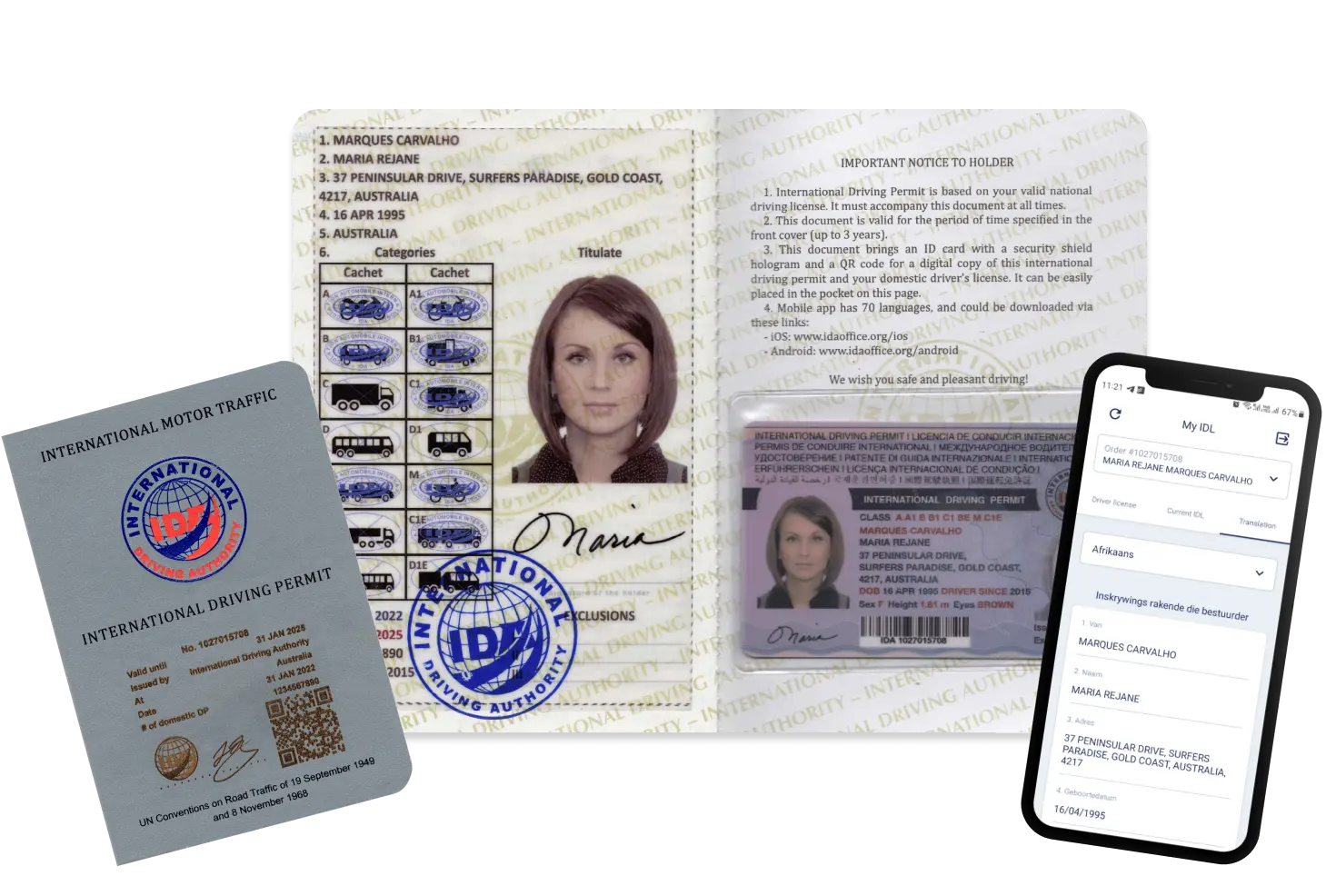
- The United Nations Standard International Driving Permit includes a plastic ID card, a booklet and a mobile application for Android and iOS with the translation into 70 languages (29 in a booklet and all 70 in a mobile app). The IDP is made in compliance with United Nations Conventions on road traffic standards for document size, color, format, etc.
-
Electronic International Driving License
- The Electronic International Driving License or eIDL includes a printable PDF document of a booklet and a mobile application for Android and iOS with the translation into 70 languages.
- De jure, according to the United Nations Convention on road traffic, physical copy of IDL is mandatory, as there is no such notion in the UN Convention as an eIDL yet. De facto we and our clients used digital version many times, and road police and car rentals accept it. However, we advise you to choose the United Nations standard IDP if you have enough time for delivery.
- Cancelation and refund are possible only until your order is not processed. Once an order is processed, and an email with eIDL is submitted to you, our service is completed, and the respective PDF file shall be considered exploited and shall become non-redeemable.

How to get an International Driving Permit in French Polynesia?
According to the Vienna Convention of 1968, International Driving Permits (IDPs) are authorized to be issued by national governments or designated organizations. In most countries, this function is carried out by automobile associations affiliated with the AIT/FIA, the police, or other authorized entities. To obtain an International Driving Permit in French Polynesia, you must possess a local license and apply to the relevant authorities here (please notify us if the link is not working). The cost and processing time for an IDP vary by country.
If you hold a national license not issued in French Polynesia, you must verify if your license permits you to drive and if you require an IDP. If an IDP is necessary, the only option is to order a translation of your driver's license, available either via delivery or as an electronic version (confirm with the rental car company if an electronic version is acceptable), for example, through our services.
For U.S. citizens with only a U.S. driver's license, you can obtain an IDP from AAA, but it must be done before traveling to French Polynesia!
FAQ
How to get an International Driving Permit in French Polynesia?
expand_more
If you have a local license and want to travel, contact a competent organization. If you are an American and plan to travel in advance, you can get an IDP from AAA. In other cases, you can have your driver's license translated into the required languages so that you can travel with your national license and its translation.
How to apply for International Driving Permit?
expand_more
Our application process is fast and simple. Complete the IDP application form, attach a copy of your valid driver's license, your handwritten signature and a color ID photo, and make the payment. You can apply for an IDP online here.
Do I need an International Driving Permit for French Polynesia?
expand_more
French Polynesia has not unified its driving license in accordance with the 1968 Vienna Convention. Drivers from other countries need an International Driving License, unless French Polynesia and the country that issued your license have an additional agreement on the recognition of driving licenses.
Can I drive in French Polynesia with a US license?
expand_more
You can only drive in French Polynesia with your driver's license if you have a valid International Driving Permit (IDP). Additional information for traveling U.S. citizens can be found on the government website.
Can an American drive in French Polynesia?
expand_more
To drive an American in French Polynesia, you must have an International Driving Permit (IDP). Additional information for traveling U.S. citizens can be found on the government website.
What is the International Driver's Document?
expand_more
Our IDD is ideal for travelers visiting multilingual destinations. No test is required, and the IDD is valid for up to three years. This document is used in conjunction with, but does not replace, your valid national license; it is a translation of your driver’s license in three formats.
Can I rent a car with this document?
expand_more
Usually, yes. However, as requirements vary from region to region, you are advised to inquire directly with car rental companies.
Can I purchase car insurance with the IDD?
expand_more
Usually, yes. However, as requirements vary from region to region, you are advised to inquire directly with local insurances companies.
What do you need to know to drive in French Polynesia?
🗓 Facts checked against French Polynesia's road-traffic law and official sources. Research last updated: . You may copy this information only if you provide a link back to this page.
⚠ This page is general information about driving rules, not legal advice. Rules change, and each authority applies its own — confirm your case with the relevant authority before you drive.
ℹ We are a private company. We are not a government body, a licensing or issuing authority, or a treaty organisation, and we are not affiliated with, endorsed by, or acting for any of them. The International Driver's Document we sell is a translation of your national driving licence: it is not a driving licence, and it is not a government-issued document.
- Driving in French Polynesia: key facts
- Do you need an International Driving Permit in French Polynesia?
- What side of the road does French Polynesia drive on?
- How long can you drive in French Polynesia with a foreign licence?
- Is French Polynesia a party to the 1949 or 1968 Road Traffic Convention?
- Why acceptance of your licence varies from place to place
- Can you drive in French Polynesia with your country's licence?
- Where to get an International Driving Permit
- Moving to French Polynesia? Rules for new residents
- Driving rules in French Polynesia tourists get fined for
- Read more about driving in French Polynesia
- Sources
Driving in French Polynesia: key facts
| Question | Answer |
|---|---|
| Side of the road | Right |
| International Driving Permit (IDP) | Accepted for 99 of the 240 origin licences, 109 of which have no established rule — see the row for your country of issue, in the table below, for what each one accepts alongside it, and on what basis |
| UN Road Traffic Conventions | 1949 Geneva — territorial extension 29 Oct 1952 (via France); 1968 Vienna — territorial extension (via France) |
| Time limit for visitors | A valid foreign national licence covers an ordinary tourist stay. |
| EU / EEA licences | Fully valid, no formality (DTT FAQ, "Comment convertir mon permis en permis polynésien ?" (updated 2026) and DTT notice of 14 March 2025) |
| Minimum age | 18 to drive — Code de la route de la Polynésie française, art. 131-9 A: 18 on the day of the test for categories A, B, C and E(B), and 17 for category B candidates in early supervised learning (the DTT FAQ says the test is taken from 18 in that case too); 16 for A1 and B1; 21 for D, E(D) and E(C) |
| Alcohol limit | The limit is 0.5 g/l of alcohol in the blood or 0.25 mg/l in exhaled breath, set for French Polynesia by the national French Code de la route (art. R. 244-1). |
| Speed limits | Drive on the right. Speed limits are set by the authority holding traffic police powers and must be signposted; in built-up areas the limit is 60 km/h unless that authority decides otherwise, and in rain every limit is lowered by 20 km/h where it is above 60 km/h and by 10 km/h where it is 60 km/h or below (Code de la route de la Polynésie française, art. 313-2). The code makes those limits maximums for good conditions only (art. 313-9), and Tahiti's narrow, winding coastal roads, unlit sections and roaming dogs make the posted figure an upper bound rather than a target. Road-death rates in French Polynesia remain high enough that the territory ran a dedicated prevention campaign, "A HO‘I MAI I TE FARE", through to January 2026. |
| Emergency number | Ambulance / urgent medical help: 15, or 40 48 59 06 from a landline. Police: 17. Fire: 18. 112 also routes to emergency services from mobiles in most of the territory. |
Do you need an International Driving Permit in French Polynesia?
No article of French Polynesia's Code de la route requires an IDP. The code recognises a licence issued outside the EU and the EEA, valid in the country that issued it, while you stay temporarily, on conditions it leaves to an arrêté (order) of the President of French Polynesia (art. 131-18); that arrêté was not found, so what must accompany your licence is not established — check with the Direction des Transports Terrestres before you travel. Government of Canada advice for French Polynesia is: "If your licence is not in French, you must provide an official translation or have an international driving permit." France extended the 1949 Geneva Convention, under which the 1949 IDP is issued, to all its overseas territories in 1952. For the 1968 Vienna Convention the UN depositary records no extension under its Article 46; its only mention of the overseas territories is a note, "Also applicable to the overseas territories", on France's entry in its table of distinguishing signs for vehicles. That note does not settle whether the Convention itself applies in French Polynesia, so whether a 1968 IDP has a treaty basis there is not established. The UK nonetheless tells its licence holders to carry the 1968 version, and the gov.uk IDP table lists French Polynesia as "1968"; UK government advice adds that hire companies often require an IDP.
- Tourists and short-term visitors: carry your national licence together with the document named in the row for your country of issue, in the table below — for most origin licences that document is not an IDP, so read your own answer rather than assuming one.
- Car renters: Carry your original national licence at all times, with your passport, the vehicle registration and the rental and insurance papers. Government of Canada advice is to add an official translation or an IDP if the licence is not in French.
- EU / EEA licence holders: no IDP needed — EU/EEA licences are valid in French Polynesia, which treats metropolitan French, DOM-COM and EU licences as a privileged class.
No specific penalty for driving without the required document was verified from an authoritative source. Official source.
What side of the road does French Polynesia drive on?
French Polynesia drives on the right-hand side of the road, and overtaking is done on the left. Cars in French Polynesia are left-hand drive.
How long can you drive in French Polynesia with a foreign licence?
A valid foreign national licence covers an ordinary tourist stay. The one-year limit is a residence clock, not a tourist clock: the territorial code recognises a licence from outside the EU and the EEA while you stay temporarily and, once you take up normal residence (living in French Polynesia for at least 185 days in a calendar year), only until one year after that date, when it is no longer recognised (Code de la route de la Polynésie française, art. 131-18 and 130-1). The Government of Canada gives the same figure: "You can drive for up to 1 year with a valid Canadian driver's licence... After 1 year, you must obtain a French Polynesian driver's licence." A short holiday never reaches it; someone settling in French Polynesia does. (Government of Canada travel advice (French Polynesia); Code de la route de la Polynésie française, art. 131-18 and 130-1)
Planning to move to French Polynesia? Different rules apply once you become a resident — see the residents section below.
Is French Polynesia a party to the 1949 or 1968 Road Traffic Convention?
French Polynesia is a Contracting Party to both United Nations Conventions on Road Traffic — the Geneva Convention of 19 September 1949 and the Vienna Convention of 8 November 1968. International Driving Permits of both the 1949 and the 1968 type are therefore issued against its framework; which types French Polynesia accepts from visitors is shown in the table above.
- 1949 Geneva Convention on Road Traffic: applies via France (territorial application).
- 1968 Vienna Convention on Road Traffic: applies via France (territorial application).
Why acceptance of your licence varies from place to place
Whether a foreign country accepts your driving licence hangs on a tangle of variables: three different road-traffic conventions signed decades apart (1926, 1949, 1968) — the oldest predates the United Nations itself, and only the latter two were concluded under it — countries at different stages of joining each (signed vs. accepted vs. ratified), licences printed in alphabets local police can't read, vehicle-category systems that don't line up between countries, document generations that may not meet a convention's format even when the country is a member, bilateral deals between individual states, and local laws that are looser in one place and stricter in the next. The same licence can be fine at one border and rejected at the next — even at the next rental desk. The International Driving Permit exists to cut through most of it: a standardized, multilingual presentation of your existing licence, with harmonized category symbols, that most officials can read at a glance. It doesn't replace your national licence or grant new rights — you carry both — and it doesn't guarantee acceptance: a handful of destinations still require a local permit alongside or instead of it, but for most it meaningfully improves your odds.
Can you drive in French Polynesia with your country's licence?
This table is for tourists and temporary visitors. Moving to French Polynesia as a resident? Different rules apply — see the residents section below. Find your licence's country of issue below. French Polynesia is a French overseas collectivity that writes its own code de la route. The code recognises a licence issued outside the EU and the EEA for a temporary stay, on conditions set by an arrêté that was not found; Government of Canada advice is that a licence not written in French must be carried with an official translation or an International Driving Permit. EU/EEA licences are recognised in their own right. Scooters are the real trap — category A1 must be printed on the licence itself, because French Polynesia recognises neither automatic B-to-A1 equivalence nor 125 cm3 training certificates issued elsewhere. Rules change — confirm with official sources before you travel. Last verified: October 2026.
Legend: "1949" — Geneva Convention on Road Traffic (IDP valid up to 1 year); "1968" — Vienna Convention (IDP valid up to 3 years).
What the Status column means on this page:
- National licence OK — the destination lets a visitor drive on the national licence itself. The row for your country of issue, in the table below, gives the basis, and any period or condition that qualifies it.
- Treaty recognises licence — IDP advised — the 1949 Geneva Convention obliges this destination to recognise your national licence, and separately allows a destination to require a 1949-type IDP; this row states the treaty position and does not settle which of the two this destination chose, so carrying an IDP is advised. The row for your country of issue, in the table below, gives the basis.
- Treaty recognises licence + IDP — advised — the 1968 Vienna Convention obliges this destination to recognise a national licence conforming to Annex 6 of that Convention, and separately an IDP presented together with the national licence it belongs to; this row does not record whether your own licence conforms to Annex 6, and the licence-and-IDP pair is recognised either way, so carrying both is advised. The row for your country of issue, in the table below, gives the basis.
- Not established — the record does not settle whether you may drive here on this licence; confirm with the destination's licensing authority before you rely on it. The row for your country of issue, in the table below, says what could not be confirmed.
| Country of licence | Status | What you need to carry | Why |
|---|---|---|---|
| Abkhazia | Not established | Check with local authorities before travel | Party to neither road-traffic convention — no official convention IDP can be issued for your licence, and no convention gives it standing at the destination. Whether the destination accepts it, and what must accompany it, is a matter of the destination’s own law — check with the authorities before you travel [2] |
| Afghanistan | Not established | Check with local authorities before travel | Party to neither road-traffic convention — no official convention IDP can be issued for your licence, though your own authorities do issue an international driving permit of their own, and no convention gives either document standing at the destination. Whether the destination accepts it, and what must accompany it, is a matter of the destination’s own law — check with the authorities before you travel [2] |
| Albania | Treaty recognises licence + IDP — advised | Your national licence; an IDP (1968 type) is strongly advised and works only alongside it | Convention party (1949+1968) — the 1968 Vienna Convention has a national licence recognised where it conforms to Annex 6, and an IDP recognised only when presented with the licence it belongs to; whether your licence conforms to Annex 6 is not recorded here, so the licence-and-IDP pair is what this row can stand behind [2] |
| Algeria | Treaty recognises licence — IDP advised | Your national licence; an IDP (1949 type) is strongly advised | Convention party (1949) — the Geneva Convention has your national licence recognised and lets the destination require a 1949-type IDP; the Convention provides no translation route [2] |
| American Samoa | Treaty recognises licence — IDP advised | Your national licence; an IDP (1949 type) is strongly advised | Convention party (1949) — the Geneva Convention has your national licence recognised and lets the destination require a 1949-type IDP; the Convention provides no translation route (via United States of America — territorial application) [2] |
| Andorra | Not established | Check with local authorities before travel | Your licence's country is party only to the 1968 Vienna Convention; the UN depositary records no extension of it to French Polynesia, only a note on France's distinguishing sign, and the arrêté on conditions for foreign licences was not found. [1] |
| Angola | Not established | Check with local authorities before travel | Party to neither road-traffic convention — no official convention IDP can be issued for your licence, and no convention gives it standing at the destination. Whether the destination accepts it, and what must accompany it, is a matter of the destination’s own law — check with the authorities before you travel [2] |
| Antigua and Barbuda | Not established | Check with local authorities before travel | Party to neither road-traffic convention — no official convention IDP can be issued for your licence, and no convention gives it standing at the destination. Whether the destination accepts it, and what must accompany it, is a matter of the destination’s own law — check with the authorities before you travel [2] |
| Argentina | Treaty recognises licence — IDP advised | Your national licence; an IDP (1949 type) is strongly advised | Convention party (1949) — the Geneva Convention has your national licence recognised and lets the destination require a 1949-type IDP; the Convention provides no translation route [2] |
| Armenia | Not established | Check with local authorities before travel | Your licence's country is party only to the 1968 Vienna Convention; the UN depositary records no extension of it to French Polynesia, only a note on France's distinguishing sign, and the arrêté on conditions for foreign licences was not found. [1] |
| Aruba | Treaty recognises licence — IDP advised | Your national licence; an IDP (1949 type) is strongly advised | Convention party (1949) — the Geneva Convention has your national licence recognised and lets the destination require a 1949-type IDP; the Convention provides no translation route (via Netherlands — territorial application) [2] |
| Australia | Treaty recognises licence — IDP advised | Your national licence; an IDP (1949 type) is strongly advised | Convention party (1949) — the Geneva Convention has your national licence recognised and lets the destination require a 1949-type IDP; the Convention provides no translation route [2] |
| Austria | National licence OK | Your EU/EEA licence | EU/EEA mutual recognition |
| Azad Kashmir | Not established | Check with local authorities before travel | Party to neither road-traffic convention — no official convention IDP can be issued for your licence, and no convention gives it standing at the destination. Whether the destination accepts it, and what must accompany it, is a matter of the destination’s own law — check with the authorities before you travel [2] |
| Azerbaijan | Not established | Check with local authorities before travel | Your licence's country is party only to the 1968 Vienna Convention; the UN depositary records no extension of it to French Polynesia, only a note on France's distinguishing sign, and the arrêté on conditions for foreign licences was not found. [1] |
| Bahamas | Not established | Check with local authorities before travel | Your licence's country is party only to the 1968 Vienna Convention; the UN depositary records no extension of it to French Polynesia, only a note on France's distinguishing sign, and the arrêté on conditions for foreign licences was not found. [1] |
| Bahrain | Treaty recognises licence + IDP — advised | Your national licence; an IDP (1968 type) is strongly advised and works only alongside it | Convention party (1949+1968) — the 1968 Vienna Convention has a national licence recognised where it conforms to Annex 6, and an IDP recognised only when presented with the licence it belongs to; whether your licence conforms to Annex 6 is not recorded here, so the licence-and-IDP pair is what this row can stand behind [2] |
| Bangladesh | Treaty recognises licence — IDP advised | Your national licence; an IDP (1949 type) is strongly advised | Convention party (1949) — the Geneva Convention has your national licence recognised and lets the destination require a 1949-type IDP; the Convention provides no translation route [2] |
| Barbados | Treaty recognises licence — IDP advised | Your national licence; an IDP (1949 type) is strongly advised | Convention party (1949) — the Geneva Convention has your national licence recognised and lets the destination require a 1949-type IDP; the Convention provides no translation route [2] |
| Belarus | Not established | Check with local authorities before travel | Your licence's country is party only to the 1968 Vienna Convention; the UN depositary records no extension of it to French Polynesia, only a note on France's distinguishing sign, and the arrêté on conditions for foreign licences was not found. [1] |
| Belgium | National licence OK | Your EU/EEA licence | EU/EEA mutual recognition |
| Belize | Not established | Check with local authorities before travel | Party to neither road-traffic convention — no official convention IDP can be issued for your licence, though your own authorities do issue an international driving permit of their own, and no convention gives either document standing at the destination. Whether the destination accepts it, and what must accompany it, is a matter of the destination’s own law — check with the authorities before you travel [2] |
| Benin | Treaty recognises licence + IDP — advised | Your national licence; an IDP (1968 type) is strongly advised and works only alongside it | Convention party (1949+1968) — the 1968 Vienna Convention has a national licence recognised where it conforms to Annex 6, and an IDP recognised only when presented with the licence it belongs to; whether your licence conforms to Annex 6 is not recorded here, so the licence-and-IDP pair is what this row can stand behind [2] |
| Bermuda | Not established | We cannot confirm a convention basis for a Bermuda licence — confirm with French Polynesia's licensing authority before you travel | The depositary record does not settle whether a road-traffic convention covers Bermuda: the state responsible for its international relations enumerated its 1949 territorial extensions one by one without naming Bermuda, but separately told the depositary that the 1949 Convention continues in force for its Crown Dependencies and Overseas Territories. No convention basis for the licence can be established either way — check with the authorities before you travel [2] |
| Bhutan | Not established | Check with local authorities before travel | Party to neither road-traffic convention — no official convention IDP can be issued for your licence, though your own authorities do issue an international driving permit of their own, and no convention gives either document standing at the destination. Whether the destination accepts it, and what must accompany it, is a matter of the destination’s own law — check with the authorities before you travel [2] |
| Bolivia | Not established | Check with local authorities before travel | Party to neither road-traffic convention — no official convention IDP can be issued for your licence, though your own authorities do issue an international driving permit of their own, and no convention gives either document standing at the destination. Whether the destination accepts it, and what must accompany it, is a matter of the destination’s own law — check with the authorities before you travel [2] |
| Bosnia and Herzegovina | Not established | Check with local authorities before travel | Your licence's country is party only to the 1968 Vienna Convention; the UN depositary records no extension of it to French Polynesia, only a note on France's distinguishing sign, and the arrêté on conditions for foreign licences was not found. [1] |
| Botswana | Treaty recognises licence — IDP advised | Your national licence; an IDP (1949 type) is strongly advised | Convention party (1949) — the Geneva Convention has your national licence recognised and lets the destination require a 1949-type IDP; the Convention provides no translation route [2] |
| Brazil | Not established | Check with local authorities before travel | Your licence's country is party only to the 1968 Vienna Convention; the UN depositary records no extension of it to French Polynesia, only a note on France's distinguishing sign, and the arrêté on conditions for foreign licences was not found. [1] |
| British Virgin Islands | Not established | We cannot confirm a convention basis for a British Virgin Islands licence — confirm with French Polynesia's licensing authority before you travel | The depositary record does not settle whether a road-traffic convention covers British Virgin Islands: the state responsible for its international relations enumerated its 1949 territorial extensions one by one without naming British Virgin Islands, but separately told the depositary that the 1949 Convention continues in force for its Crown Dependencies and Overseas Territories. No convention basis for the licence can be established either way — check with the authorities before you travel [2] |
| Brunei | Treaty recognises licence — IDP advised | Your national licence; an IDP (1949 type) is strongly advised | Convention party (1949) — the Geneva Convention has your national licence recognised and lets the destination require a 1949-type IDP; the Convention provides no translation route [2] |
| Bulgaria | National licence OK | Your EU/EEA licence | EU/EEA mutual recognition |
| Burkina Faso | Treaty recognises licence — IDP advised | Your national licence; an IDP (1949 type) is strongly advised | Convention party (1949) — the Geneva Convention has your national licence recognised and lets the destination require a 1949-type IDP; the Convention provides no translation route [2] |
| Burundi | Not established | Check with local authorities before travel | Party to neither road-traffic convention — no official convention IDP can be issued for your licence, though your own authorities do issue an international driving permit of their own, and no convention gives either document standing at the destination. Whether the destination accepts it, and what must accompany it, is a matter of the destination’s own law — check with the authorities before you travel [2] |
| Cambodia | Treaty recognises licence — IDP advised | Your national licence; an IDP (1949 type) is strongly advised | Convention party (1949) — the Geneva Convention has your national licence recognised and lets the destination require a 1949-type IDP; the Convention provides no translation route [2] |
| Cameroon | Not established | Check with local authorities before travel | Party to neither road-traffic convention — no official convention IDP can be issued for your licence, though your own authorities do issue an international driving permit of their own, and no convention gives either document standing at the destination. Whether the destination accepts it, and what must accompany it, is a matter of the destination’s own law — check with the authorities before you travel [2] |
| Canada | Treaty recognises licence — IDP advised | Your national licence; an IDP (1949 type) is strongly advised | Convention party (1949) — the Geneva Convention has your national licence recognised and lets the destination require a 1949-type IDP; the Convention provides no translation route [2] |
| Cape Verde | Not established | Check with local authorities before travel | Your licence's country is party only to the 1968 Vienna Convention; the UN depositary records no extension of it to French Polynesia, only a note on France's distinguishing sign, and the arrêté on conditions for foreign licences was not found. [1] |
| Caribbean Netherlands | Treaty recognises licence — IDP advised | Your national licence; an IDP (1949 type) is strongly advised | Convention party (1949) — the Geneva Convention has your national licence recognised and lets the destination require a 1949-type IDP; the Convention provides no translation route (via Netherlands — territorial application) [2] |
| Cayman Islands | Treaty recognises licence — IDP advised | Your national licence; an IDP (1949 type) is strongly advised | Convention party (1949) — the Geneva Convention has your national licence recognised and lets the destination require a 1949-type IDP; the Convention provides no translation route (via United Kingdom — territorial application) [2] |
| Central African Republic | Treaty recognises licence + IDP — advised | Your national licence; an IDP (1968 type) is strongly advised and works only alongside it | Convention party (1949+1968) — the 1968 Vienna Convention has a national licence recognised where it conforms to Annex 6, and an IDP recognised only when presented with the licence it belongs to; whether your licence conforms to Annex 6 is not recorded here, so the licence-and-IDP pair is what this row can stand behind [2] |
| Chad | Not established | Check with local authorities before travel | Party to neither road-traffic convention — no official convention IDP can be issued for your licence, though your own authorities do issue an international driving permit of their own, and no convention gives either document standing at the destination. Whether the destination accepts it, and what must accompany it, is a matter of the destination’s own law — check with the authorities before you travel [2] |
| Chile | Treaty recognises licence — IDP advised | Your national licence; an IDP (1949 type) is strongly advised | Convention party (1949) — the Geneva Convention has your national licence recognised and lets the destination require a 1949-type IDP; the Convention provides no translation route [2] |
| China | Not established | Check with local authorities before travel | Party to neither road-traffic convention — no official convention IDP can be issued for your licence, and no convention gives it standing at the destination. Whether the destination accepts it, and what must accompany it, is a matter of the destination’s own law — check with the authorities before you travel [2] |
| Colombia | Not established | Check with local authorities before travel | Party to neither road-traffic convention — no official convention IDP can be issued for your licence, though your own authorities do issue an international driving permit of their own, and no convention gives either document standing at the destination. Whether the destination accepts it, and what must accompany it, is a matter of the destination’s own law — check with the authorities before you travel [2] |
| Comoros | Not established | Check with local authorities before travel | Party to neither road-traffic convention — no official convention IDP can be issued for your licence, and no convention gives it standing at the destination. Whether the destination accepts it, and what must accompany it, is a matter of the destination’s own law — check with the authorities before you travel [2] |
| Congo (Brazzaville) | Treaty recognises licence — IDP advised | Your national licence; an IDP (1949 type) is strongly advised | Convention party (1949) — the Geneva Convention has your national licence recognised and lets the destination require a 1949-type IDP; the Convention provides no translation route [2] |
| Congo (Democratic Rep.) | Treaty recognises licence + IDP — advised | Your national licence; an IDP (1968 type) is strongly advised and works only alongside it | Convention party (1949+1968) — the 1968 Vienna Convention has a national licence recognised where it conforms to Annex 6, and an IDP recognised only when presented with the licence it belongs to; whether your licence conforms to Annex 6 is not recorded here, so the licence-and-IDP pair is what this row can stand behind [2] |
| Cook Islands | Not established | We cannot confirm a convention basis for a Cook Islands licence — confirm with French Polynesia's licensing authority before you travel | We could not confirm any ratification, accession or territorial extension covering Cook Islands, so no convention basis for the licence can be established — check with the authorities before you travel [2] |
| Costa Rica | Not established | Check with local authorities before travel | Party to neither road-traffic convention — no official convention IDP can be issued for your licence, though your own authorities do issue an international driving permit of their own, and no convention gives either document standing at the destination. Whether the destination accepts it, and what must accompany it, is a matter of the destination’s own law — check with the authorities before you travel [2] |
| Croatia | National licence OK | Your EU/EEA licence | EU/EEA mutual recognition |
| Cuba | Treaty recognises licence + IDP — advised | Your national licence; an IDP (1968 type) is strongly advised and works only alongside it | Convention party (1949+1968) — the 1968 Vienna Convention has a national licence recognised where it conforms to Annex 6, and an IDP recognised only when presented with the licence it belongs to; whether your licence conforms to Annex 6 is not recorded here, so the licence-and-IDP pair is what this row can stand behind [2] |
| Curacao | Treaty recognises licence — IDP advised | Your national licence; an IDP (1949 type) is strongly advised | Convention party (1949) — the Geneva Convention has your national licence recognised and lets the destination require a 1949-type IDP; the Convention provides no translation route (via Netherlands — territorial application) [2] |
| Cyprus | National licence OK | Your EU/EEA licence | EU/EEA mutual recognition |
| Czech Republic | National licence OK | Your EU/EEA licence | EU/EEA mutual recognition |
| Denmark | National licence OK | Your EU/EEA licence | EU/EEA mutual recognition |
| Djibouti | Not established | Check with local authorities before travel | Party to neither road-traffic convention — no official convention IDP can be issued for your licence, and no convention gives it standing at the destination. Whether the destination accepts it, and what must accompany it, is a matter of the destination’s own law — check with the authorities before you travel [2] |
| Dominica | Not established | Check with local authorities before travel | Party to neither road-traffic convention — no official convention IDP can be issued for your licence, though your own authorities do issue an international driving permit of their own, and no convention gives either document standing at the destination. Whether the destination accepts it, and what must accompany it, is a matter of the destination’s own law — check with the authorities before you travel [2] |
| Dominican Republic | Treaty recognises licence — IDP advised | Your national licence; an IDP (1949 type) is strongly advised | Convention party (1949) — the Geneva Convention has your national licence recognised and lets the destination require a 1949-type IDP; the Convention provides no translation route [2] |
| East Timor | Not established | Check with local authorities before travel | Party to neither road-traffic convention — no official convention IDP can be issued for your licence, and no convention gives it standing at the destination. Whether the destination accepts it, and what must accompany it, is a matter of the destination’s own law — check with the authorities before you travel [2] |
| Ecuador | Treaty recognises licence — IDP advised | Your national licence; an IDP (1949 type) is strongly advised | Convention party (1949) — the Geneva Convention has your national licence recognised and lets the destination require a 1949-type IDP; the Convention provides no translation route [2] |
| Egypt | Treaty recognises licence + IDP — advised | Your national licence; an IDP (1968 type) is strongly advised and works only alongside it | Convention party (1949+1968) — the 1968 Vienna Convention has a national licence recognised where it conforms to Annex 6, and an IDP recognised only when presented with the licence it belongs to; whether your licence conforms to Annex 6 is not recorded here, so the licence-and-IDP pair is what this row can stand behind [2] |
| El Salvador | Not established | Check with local authorities before travel | Your licence's country is party only to the 1968 Vienna Convention; the UN depositary records no extension of it to French Polynesia, only a note on France's distinguishing sign, and the arrêté on conditions for foreign licences was not found. [1] |
| Equatorial Guinea | Not established | Check with local authorities before travel | Party to neither road-traffic convention — no official convention IDP can be issued for your licence, and no convention gives it standing at the destination. Whether the destination accepts it, and what must accompany it, is a matter of the destination’s own law — check with the authorities before you travel [2] |
| Eritrea | Not established | Check with local authorities before travel | Party to neither road-traffic convention — no official convention IDP can be issued for your licence, and no convention gives it standing at the destination. Whether the destination accepts it, and what must accompany it, is a matter of the destination’s own law — check with the authorities before you travel [2] |
| Estonia | National licence OK | Your EU/EEA licence | EU/EEA mutual recognition |
| Eswatini | Not established | Check with local authorities before travel | Party to neither road-traffic convention — no official convention IDP can be issued for your licence, though your own authorities do issue an international driving permit of their own, and no convention gives either document standing at the destination. Whether the destination accepts it, and what must accompany it, is a matter of the destination’s own law — check with the authorities before you travel [2] |
| Ethiopia | Not established | Check with local authorities before travel | Your licence's country is party only to the 1968 Vienna Convention; the UN depositary records no extension of it to French Polynesia, only a note on France's distinguishing sign, and the arrêté on conditions for foreign licences was not found. [1] |
| Falkland Islands | Not established | We cannot confirm a convention basis for a Falkland Islands licence — confirm with French Polynesia's licensing authority before you travel | The depositary record does not settle whether a road-traffic convention covers Falkland Islands: the state responsible for its international relations enumerated its 1949 territorial extensions one by one without naming Falkland Islands, but separately told the depositary that the 1949 Convention continues in force for its Crown Dependencies and Overseas Territories. No convention basis for the licence can be established either way — check with the authorities before you travel [2] |
| Faroe Islands | Treaty recognises licence — IDP advised | Your national licence; an IDP (1949 type) is strongly advised | Convention party (1949) — the Geneva Convention has your national licence recognised and lets the destination require a 1949-type IDP; the Convention provides no translation route (via Denmark — territorial application) [2] |
| Fiji | Treaty recognises licence — IDP advised | Your national licence; an IDP (1949 type) is strongly advised | Convention party (1949) — the Geneva Convention has your national licence recognised and lets the destination require a 1949-type IDP; the Convention provides no translation route [2] |
| Finland | National licence OK | Your EU/EEA licence | EU/EEA mutual recognition |
| France | National licence OK | Your EU/EEA licence | EU/EEA mutual recognition |
| French Guiana | Treaty recognises licence + IDP — advised | Your national licence; an IDP (1968 type) is strongly advised and works only alongside it | Convention party (1949+1968) — the 1968 Vienna Convention has a national licence recognised where it conforms to Annex 6, and an IDP recognised only when presented with the licence it belongs to; whether your licence conforms to Annex 6 is not recorded here, so the licence-and-IDP pair is what this row can stand behind [2] |
| Gabon | Not established | Check with local authorities before travel | Party to neither road-traffic convention — no official convention IDP can be issued for your licence, though your own authorities do issue an international driving permit of their own, and no convention gives either document standing at the destination. Whether the destination accepts it, and what must accompany it, is a matter of the destination’s own law — check with the authorities before you travel [2] |
| Gambia | Not established | Check with local authorities before travel | Party to neither road-traffic convention — no official convention IDP can be issued for your licence, though your own authorities do issue an international driving permit of their own, and no convention gives either document standing at the destination. Whether the destination accepts it, and what must accompany it, is a matter of the destination’s own law — check with the authorities before you travel [2] |
| Georgia | Treaty recognises licence + IDP — advised | Your national licence; an IDP (1968 type) is strongly advised and works only alongside it | Convention party (1949+1968) — the 1968 Vienna Convention has a national licence recognised where it conforms to Annex 6, and an IDP recognised only when presented with the licence it belongs to; whether your licence conforms to Annex 6 is not recorded here, so the licence-and-IDP pair is what this row can stand behind [2] |
| Germany | National licence OK | Your EU/EEA licence | EU/EEA mutual recognition |
| Ghana | Treaty recognises licence — IDP advised | Your national licence; an IDP (1949 type) is strongly advised | Convention party (1949) — the Geneva Convention has your national licence recognised and lets the destination require a 1949-type IDP; the Convention provides no translation route [2] |
| Gibraltar | Treaty recognises licence + IDP — advised | Your national licence; an IDP (1968 type) is strongly advised and works only alongside it | Convention party (1949+1968) — the 1968 Vienna Convention has a national licence recognised where it conforms to Annex 6, and an IDP recognised only when presented with the licence it belongs to; whether your licence conforms to Annex 6 is not recorded here, so the licence-and-IDP pair is what this row can stand behind (via United Kingdom — territorial application) [2] |
| Greece | National licence OK | Your EU/EEA licence | EU/EEA mutual recognition |
| Greenland | Not established | We cannot confirm a convention basis for a Greenland licence — confirm with French Polynesia's licensing authority before you travel | We could not confirm any ratification, accession or territorial extension covering Greenland, so no convention basis for the licence can be established — check with the authorities before you travel [2] |
| Grenada | Not established | Check with local authorities before travel | Party to neither road-traffic convention — no official convention IDP can be issued for your licence, and no convention gives it standing at the destination. Whether the destination accepts it, and what must accompany it, is a matter of the destination’s own law — check with the authorities before you travel [2] |
| Guadeloupe | Treaty recognises licence + IDP — advised | Your national licence; an IDP (1968 type) is strongly advised and works only alongside it | Convention party (1949+1968) — the 1968 Vienna Convention has a national licence recognised where it conforms to Annex 6, and an IDP recognised only when presented with the licence it belongs to; whether your licence conforms to Annex 6 is not recorded here, so the licence-and-IDP pair is what this row can stand behind [2] |
| Guam | Treaty recognises licence — IDP advised | Your national licence; an IDP (1949 type) is strongly advised | Convention party (1949) — the Geneva Convention has your national licence recognised and lets the destination require a 1949-type IDP; the Convention provides no translation route (via United States of America — territorial application) [2] |
| Guatemala | Treaty recognises licence — IDP advised | Your national licence; an IDP (1949 type) is strongly advised | Convention party (1949) — the Geneva Convention has your national licence recognised and lets the destination require a 1949-type IDP; the Convention provides no translation route [2] |
| Guernsey | Treaty recognises licence + IDP — advised | Your national licence; an IDP (1968 type) is strongly advised and works only alongside it | Convention party (1949+1968) — the 1968 Vienna Convention has a national licence recognised where it conforms to Annex 6, and an IDP recognised only when presented with the licence it belongs to; whether your licence conforms to Annex 6 is not recorded here, so the licence-and-IDP pair is what this row can stand behind (via United Kingdom — territorial application) [2] |
| Guinea | Not established | Check with local authorities before travel | Party to neither road-traffic convention — no official convention IDP can be issued for your licence, though your own authorities do issue an international driving permit of their own, and no convention gives either document standing at the destination. Whether the destination accepts it, and what must accompany it, is a matter of the destination’s own law — check with the authorities before you travel [2] |
| Guinea Bissau | Not established | Check with local authorities before travel | Party to neither road-traffic convention — no official convention IDP can be issued for your licence, and no convention gives it standing at the destination. Whether the destination accepts it, and what must accompany it, is a matter of the destination’s own law — check with the authorities before you travel [2] |
| Guyana | Not established | Check with local authorities before travel | Your licence's country is party only to the 1968 Vienna Convention; the UN depositary records no extension of it to French Polynesia, only a note on France's distinguishing sign, and the arrêté on conditions for foreign licences was not found. [1] |
| Haiti | Treaty recognises licence — IDP advised | Your national licence; an IDP (1949 type) is strongly advised | Convention party (1949) — the Geneva Convention has your national licence recognised and lets the destination require a 1949-type IDP; the Convention provides no translation route [2] |
| Honduras | Not established | Check with local authorities before travel | Your licence's country is party only to the 1968 Vienna Convention; the UN depositary records no extension of it to French Polynesia, only a note on France's distinguishing sign, and the arrêté on conditions for foreign licences was not found. [1] |
| Hong Kong | Treaty recognises licence — IDP advised | Your national licence; an IDP (1949 type) is strongly advised | Convention party (1949) — the Geneva Convention has your national licence recognised and lets the destination require a 1949-type IDP; the Convention provides no translation route (1949 Geneva continued application to Hong Kong SAR; HK issues 1949 IDPs) [2] |
| Hungary | National licence OK | Your EU/EEA licence | EU/EEA mutual recognition |
| Iceland | National licence OK | Your EU/EEA licence | EU/EEA mutual recognition |
| India | Treaty recognises licence — IDP advised | Your national licence; an IDP (1949 type) is strongly advised | Convention party (1949) — the Geneva Convention has your national licence recognised and lets the destination require a 1949-type IDP; the Convention provides no translation route [2] |
| Indonesia | Not established | Check with local authorities before travel | Party to neither road-traffic convention — no official convention IDP can be issued for your licence, though your own authorities do issue an international driving permit of their own, and no convention gives either document standing at the destination. Whether the destination accepts it, and what must accompany it, is a matter of the destination’s own law — check with the authorities before you travel [2] |
| Iran | Not established | Check with local authorities before travel | Your licence's country is party only to the 1968 Vienna Convention; the UN depositary records no extension of it to French Polynesia, only a note on France's distinguishing sign, and the arrêté on conditions for foreign licences was not found. [1] |
| Iraq | Not established | Check with local authorities before travel | Your licence's country is party only to the 1968 Vienna Convention; the UN depositary records no extension of it to French Polynesia, only a note on France's distinguishing sign, and the arrêté on conditions for foreign licences was not found. [1] |
| Ireland | National licence OK | Your EU/EEA licence | EU/EEA mutual recognition |
| Israel | Treaty recognises licence + IDP — advised | Your national licence; an IDP (1968 type) is strongly advised and works only alongside it | Convention party (1949+1968) — the 1968 Vienna Convention has a national licence recognised where it conforms to Annex 6, and an IDP recognised only when presented with the licence it belongs to; whether your licence conforms to Annex 6 is not recorded here, so the licence-and-IDP pair is what this row can stand behind [2] |
| Italy | National licence OK | Your EU/EEA licence | EU/EEA mutual recognition |
| Ivory Coast | Treaty recognises licence + IDP — advised | Your national licence; an IDP (1968 type) is strongly advised and works only alongside it | Convention party (1949+1968) — the 1968 Vienna Convention has a national licence recognised where it conforms to Annex 6, and an IDP recognised only when presented with the licence it belongs to; whether your licence conforms to Annex 6 is not recorded here, so the licence-and-IDP pair is what this row can stand behind [2] |
| Jamaica | Treaty recognises licence — IDP advised | Your national licence; an IDP (1949 type) is strongly advised | Convention party (1949) — the Geneva Convention has your national licence recognised and lets the destination require a 1949-type IDP; the Convention provides no translation route [2] |
| Japan | Treaty recognises licence — IDP advised | Your national licence; an IDP (1949 type) is strongly advised | Convention party (1949) — the Geneva Convention has your national licence recognised and lets the destination require a 1949-type IDP; the Convention provides no translation route [2] |
| Jersey | Treaty recognises licence + IDP — advised | Your national licence; an IDP (1968 type) is strongly advised and works only alongside it | Convention party (1949+1968) — the 1968 Vienna Convention has a national licence recognised where it conforms to Annex 6, and an IDP recognised only when presented with the licence it belongs to; whether your licence conforms to Annex 6 is not recorded here, so the licence-and-IDP pair is what this row can stand behind (via United Kingdom — territorial application) [2] |
| Jordan | Treaty recognises licence — IDP advised | Your national licence; an IDP (1949 type) is strongly advised | Convention party (1949) — the Geneva Convention has your national licence recognised and lets the destination require a 1949-type IDP; the Convention provides no translation route [2] |
| Kazakhstan | Not established | Check with local authorities before travel | Your licence's country is party only to the 1968 Vienna Convention; the UN depositary records no extension of it to French Polynesia, only a note on France's distinguishing sign, and the arrêté on conditions for foreign licences was not found. [1] |
| Kenya | Not established | Check with local authorities before travel | Your licence's country is party only to the 1968 Vienna Convention; the UN depositary records no extension of it to French Polynesia, only a note on France's distinguishing sign, and the arrêté on conditions for foreign licences was not found. [1] |
| Kiribati | Not established | Check with local authorities before travel | Party to neither road-traffic convention — no official convention IDP can be issued for your licence, and no convention gives it standing at the destination. Whether the destination accepts it, and what must accompany it, is a matter of the destination’s own law — check with the authorities before you travel [2] |
| Kosovo | Not established | Check with local authorities before travel | Party to neither road-traffic convention — no official convention IDP can be issued for your licence, though your own authorities do issue an international driving permit of their own, and no convention gives either document standing at the destination. Whether the destination accepts it, and what must accompany it, is a matter of the destination’s own law — check with the authorities before you travel [2] |
| Kuwait | Not established | Check with local authorities before travel | Your licence's country is party only to the 1968 Vienna Convention; the UN depositary records no extension of it to French Polynesia, only a note on France's distinguishing sign, and the arrêté on conditions for foreign licences was not found. [1] |
| Kyrgyzstan | Treaty recognises licence + IDP — advised | Your national licence; an IDP (1968 type) is strongly advised and works only alongside it | Convention party (1949+1968) — the 1968 Vienna Convention has a national licence recognised where it conforms to Annex 6, and an IDP recognised only when presented with the licence it belongs to; whether your licence conforms to Annex 6 is not recorded here, so the licence-and-IDP pair is what this row can stand behind [2] |
| Laos | Treaty recognises licence — IDP advised | Your national licence; an IDP (1949 type) is strongly advised | Convention party (1949) — the Geneva Convention has your national licence recognised and lets the destination require a 1949-type IDP; the Convention provides no translation route [2] |
| Latvia | National licence OK | Your EU/EEA licence | EU/EEA mutual recognition |
| Lebanon | Treaty recognises licence — IDP advised | Your national licence; an IDP (1949 type) is strongly advised | Convention party (1949) — the Geneva Convention has your national licence recognised and lets the destination require a 1949-type IDP; the Convention provides no translation route [2] |
| Lesotho | Treaty recognises licence — IDP advised | Your national licence; an IDP (1949 type) is strongly advised | Convention party (1949) — the Geneva Convention has your national licence recognised and lets the destination require a 1949-type IDP; the Convention provides no translation route [2] |
| Liberia | Not established | Check with local authorities before travel | Your licence's country is party only to the 1968 Vienna Convention; the UN depositary records no extension of it to French Polynesia, only a note on France's distinguishing sign, and the arrêté on conditions for foreign licences was not found. [1] |
| Libya | Not established | Check with local authorities before travel | Party to neither road-traffic convention — no official convention IDP can be issued for your licence, though your own authorities do issue an international driving permit of their own, and no convention gives either document standing at the destination. Whether the destination accepts it, and what must accompany it, is a matter of the destination’s own law — check with the authorities before you travel [2] |
| Liechtenstein | National licence OK | Your EU/EEA licence | EU/EEA mutual recognition |
| Lithuania | National licence OK | Your EU/EEA licence | EU/EEA mutual recognition |
| Luxembourg | National licence OK | Your EU/EEA licence | EU/EEA mutual recognition |
| Macau | Treaty recognises licence — IDP advised | Your national licence; an IDP (1949 type) is strongly advised | Convention party (1949) — the Geneva Convention has your national licence recognised and lets the destination require a 1949-type IDP; the Convention provides no translation route (1949 continued application to Macau SAR) [2] |
| North Macedonia | Not established | Check with local authorities before travel | Your licence's country is party only to the 1968 Vienna Convention; the UN depositary records no extension of it to French Polynesia, only a note on France's distinguishing sign, and the arrêté on conditions for foreign licences was not found. [1] |
| Madagascar | Treaty recognises licence — IDP advised | Your national licence; an IDP (1949 type) is strongly advised | Convention party (1949) — the Geneva Convention has your national licence recognised and lets the destination require a 1949-type IDP; the Convention provides no translation route [2] |
| Malawi | Treaty recognises licence — IDP advised | Your national licence; an IDP (1949 type) is strongly advised | Convention party (1949) — the Geneva Convention has your national licence recognised and lets the destination require a 1949-type IDP; the Convention provides no translation route [2] |
| Malaysia | Treaty recognises licence — IDP advised | Your national licence; an IDP (1949 type) is strongly advised | Convention party (1949) — the Geneva Convention has your national licence recognised and lets the destination require a 1949-type IDP; the Convention provides no translation route [2] |
| Maldives | Not established | Check with local authorities before travel | Your licence's country is party only to the 1968 Vienna Convention; the UN depositary records no extension of it to French Polynesia, only a note on France's distinguishing sign, and the arrêté on conditions for foreign licences was not found. [1] |
| Mali | Treaty recognises licence — IDP advised | Your national licence; an IDP (1949 type) is strongly advised | Convention party (1949) — the Geneva Convention has your national licence recognised and lets the destination require a 1949-type IDP; the Convention provides no translation route [2] |
| Malta | National licence OK | Your EU/EEA licence | EU/EEA mutual recognition |
| Marshall Islands | Not established | Check with local authorities before travel | Party to neither road-traffic convention — no official convention IDP can be issued for your licence, and no convention gives it standing at the destination. Whether the destination accepts it, and what must accompany it, is a matter of the destination’s own law — check with the authorities before you travel [2] |
| Martinique | Treaty recognises licence + IDP — advised | Your national licence; an IDP (1968 type) is strongly advised and works only alongside it | Convention party (1949+1968) — the 1968 Vienna Convention has a national licence recognised where it conforms to Annex 6, and an IDP recognised only when presented with the licence it belongs to; whether your licence conforms to Annex 6 is not recorded here, so the licence-and-IDP pair is what this row can stand behind [2] |
| Mauritania | Not established | Check with local authorities before travel | Party to neither road-traffic convention — no official convention IDP can be issued for your licence, and no convention gives it standing at the destination. Whether the destination accepts it, and what must accompany it, is a matter of the destination’s own law — check with the authorities before you travel [2] |
| Mauritius | Not established | Check with local authorities before travel | Party to neither road-traffic convention — no official convention IDP can be issued for your licence, though your own authorities do issue an international driving permit of their own, and no convention gives either document standing at the destination. Whether the destination accepts it, and what must accompany it, is a matter of the destination’s own law — check with the authorities before you travel [2] |
| Mayotte Island | Treaty recognises licence + IDP — advised | Your national licence; an IDP (1968 type) is strongly advised and works only alongside it | Convention party (1949+1968) — the 1968 Vienna Convention has a national licence recognised where it conforms to Annex 6, and an IDP recognised only when presented with the licence it belongs to; whether your licence conforms to Annex 6 is not recorded here, so the licence-and-IDP pair is what this row can stand behind (via France — territorial application) [2] |
| Mexico | Not established | Check with local authorities before travel | Party to neither road-traffic convention — no official convention IDP can be issued for your licence, though your own authorities do issue an international driving permit of their own, and no convention gives either document standing at the destination. Whether the destination accepts it, and what must accompany it, is a matter of the destination’s own law — check with the authorities before you travel [2] |
| Micronesia | Not established | Check with local authorities before travel | Party to neither road-traffic convention — no official convention IDP can be issued for your licence, and no convention gives it standing at the destination. Whether the destination accepts it, and what must accompany it, is a matter of the destination’s own law — check with the authorities before you travel [2] |
| Moldova | Not established | Check with local authorities before travel | Your licence's country is party only to the 1968 Vienna Convention; the UN depositary records no extension of it to French Polynesia, only a note on France's distinguishing sign, and the arrêté on conditions for foreign licences was not found. [1] |
| Monaco | Treaty recognises licence + IDP — advised | Your national licence; an IDP (1968 type) is strongly advised and works only alongside it | Convention party (1949+1968) — the 1968 Vienna Convention has a national licence recognised where it conforms to Annex 6, and an IDP recognised only when presented with the licence it belongs to; whether your licence conforms to Annex 6 is not recorded here, so the licence-and-IDP pair is what this row can stand behind [2] |
| Mongolia | Not established | Check with local authorities before travel | Your licence's country is party only to the 1968 Vienna Convention; the UN depositary records no extension of it to French Polynesia, only a note on France's distinguishing sign, and the arrêté on conditions for foreign licences was not found. [1] |
| Montenegro | Treaty recognises licence + IDP — advised | Your national licence; an IDP (1968 type) is strongly advised and works only alongside it | Convention party (1949+1968) — the 1968 Vienna Convention has a national licence recognised where it conforms to Annex 6, and an IDP recognised only when presented with the licence it belongs to; whether your licence conforms to Annex 6 is not recorded here, so the licence-and-IDP pair is what this row can stand behind [2] |
| Montserrat | Not established | We cannot confirm a convention basis for a Montserrat licence — confirm with French Polynesia's licensing authority before you travel | The depositary record does not settle whether a road-traffic convention covers Montserrat: the state responsible for its international relations enumerated its 1949 territorial extensions one by one without naming Montserrat, but separately told the depositary that the 1949 Convention continues in force for its Crown Dependencies and Overseas Territories. No convention basis for the licence can be established either way — check with the authorities before you travel [2] |
| Morocco | Treaty recognises licence + IDP — advised | Your national licence; an IDP (1968 type) is strongly advised and works only alongside it | Convention party (1949+1968) — the 1968 Vienna Convention has a national licence recognised where it conforms to Annex 6, and an IDP recognised only when presented with the licence it belongs to; whether your licence conforms to Annex 6 is not recorded here, so the licence-and-IDP pair is what this row can stand behind [2] |
| Mozambique | Not established | Check with local authorities before travel | Party to neither road-traffic convention — no official convention IDP can be issued for your licence, though your own authorities do issue an international driving permit of their own, and no convention gives either document standing at the destination. Whether the destination accepts it, and what must accompany it, is a matter of the destination’s own law — check with the authorities before you travel [2] |
| Myanmar | Not established | Check with local authorities before travel | Your licence's country is party only to the 1968 Vienna Convention; the UN depositary records no extension of it to French Polynesia, only a note on France's distinguishing sign, and the arrêté on conditions for foreign licences was not found. [1] |
| Namibia | Treaty recognises licence — IDP advised | Your national licence; an IDP (1949 type) is strongly advised | Convention party (1949) — the Geneva Convention has your national licence recognised and lets the destination require a 1949-type IDP; the Convention provides no translation route [2] |
| Nauru | Not established | Check with local authorities before travel | Party to neither road-traffic convention — no official convention IDP can be issued for your licence, and no convention gives it standing at the destination. Whether the destination accepts it, and what must accompany it, is a matter of the destination’s own law — check with the authorities before you travel [2] |
| Nepal | Not established | Check with local authorities before travel | Party to neither road-traffic convention — no official convention IDP can be issued for your licence, though your own authorities do issue an international driving permit of their own, and no convention gives either document standing at the destination. Whether the destination accepts it, and what must accompany it, is a matter of the destination’s own law — check with the authorities before you travel [2] |
| Netherlands | National licence OK | Your EU/EEA licence | EU/EEA mutual recognition |
| New Caledonia | Treaty recognises licence + IDP — advised | Your national licence; an IDP (1968 type) is strongly advised and works only alongside it | Convention party (1949+1968) — the 1968 Vienna Convention has a national licence recognised where it conforms to Annex 6, and an IDP recognised only when presented with the licence it belongs to; whether your licence conforms to Annex 6 is not recorded here, so the licence-and-IDP pair is what this row can stand behind (via France — territorial application) [2] |
| New Zealand | Treaty recognises licence — IDP advised | Your national licence; an IDP (1949 type) is strongly advised | Convention party (1949) — the Geneva Convention has your national licence recognised and lets the destination require a 1949-type IDP; the Convention provides no translation route [2] |
| Nicaragua | Not established | Check with local authorities before travel | Party to neither road-traffic convention — no official convention IDP can be issued for your licence, though your own authorities do issue an international driving permit of their own, and no convention gives either document standing at the destination. Whether the destination accepts it, and what must accompany it, is a matter of the destination’s own law — check with the authorities before you travel [2] |
| Niger | Treaty recognises licence + IDP — advised | Your national licence; an IDP (1968 type) is strongly advised and works only alongside it | Convention party (1949+1968) — the 1968 Vienna Convention has a national licence recognised where it conforms to Annex 6, and an IDP recognised only when presented with the licence it belongs to; whether your licence conforms to Annex 6 is not recorded here, so the licence-and-IDP pair is what this row can stand behind [2] |
| Nigeria | Treaty recognises licence + IDP — advised | Your national licence; an IDP (1968 type) is strongly advised and works only alongside it | Convention party (1949+1968) — the 1968 Vienna Convention has a national licence recognised where it conforms to Annex 6, and an IDP recognised only when presented with the licence it belongs to; whether your licence conforms to Annex 6 is not recorded here, so the licence-and-IDP pair is what this row can stand behind [2] |
| Niue | Not established | We cannot confirm a convention basis for a Niue licence — confirm with French Polynesia's licensing authority before you travel | We could not confirm any ratification, accession or territorial extension covering Niue, so no convention basis for the licence can be established — check with the authorities before you travel [2] |
| North Korea | Not established | Check with local authorities before travel | Party to neither road-traffic convention — no official convention IDP can be issued for your licence, and no convention gives it standing at the destination. Whether the destination accepts it, and what must accompany it, is a matter of the destination’s own law — check with the authorities before you travel [2] |
| Northern Cyprus | Not established | Check with local authorities before travel | Party to neither road-traffic convention — no official convention IDP can be issued for your licence, and no convention gives it standing at the destination. Whether the destination accepts it, and what must accompany it, is a matter of the destination’s own law — check with the authorities before you travel [2] |
| Northern Mariana Islands | Treaty recognises licence — IDP advised | Your national licence; an IDP (1949 type) is strongly advised | Convention party (1949) — the Geneva Convention has your national licence recognised and lets the destination require a 1949-type IDP; the Convention provides no translation route (via United States of America — territorial application) [2] |
| Norway | National licence OK | Your EU/EEA licence | EU/EEA mutual recognition |
| Oman | Not established | Check with local authorities before travel | Your licence's country is party only to the 1968 Vienna Convention; the UN depositary records no extension of it to French Polynesia, only a note on France's distinguishing sign, and the arrêté on conditions for foreign licences was not found. [1] |
| Pakistan | Not established | Check with local authorities before travel | Your licence's country is party only to the 1968 Vienna Convention; the UN depositary records no extension of it to French Polynesia, only a note on France's distinguishing sign, and the arrêté on conditions for foreign licences was not found. [1] |
| Palau | Not established | Check with local authorities before travel | Party to neither road-traffic convention — no official convention IDP can be issued for your licence, and no convention gives it standing at the destination. Whether the destination accepts it, and what must accompany it, is a matter of the destination’s own law — check with the authorities before you travel [2] |
| Palestine | Not established | Check with local authorities before travel | Your licence's country is party only to the 1968 Vienna Convention; the UN depositary records no extension of it to French Polynesia, only a note on France's distinguishing sign, and the arrêté on conditions for foreign licences was not found. [1] |
| Panama | Not established | Check with local authorities before travel | Party to neither road-traffic convention — no official convention IDP can be issued for your licence, though your own authorities do issue an international driving permit of their own, and no convention gives either document standing at the destination. Whether the destination accepts it, and what must accompany it, is a matter of the destination’s own law — check with the authorities before you travel [2] |
| Papua New Guinea | Treaty recognises licence — IDP advised | Your national licence; an IDP (1949 type) is strongly advised | Convention party (1949) — the Geneva Convention has your national licence recognised and lets the destination require a 1949-type IDP; the Convention provides no translation route [2] |
| Paraguay | Treaty recognises licence — IDP advised | Your national licence; an IDP (1949 type) is strongly advised | Convention party (1949) — the Geneva Convention has your national licence recognised and lets the destination require a 1949-type IDP; the Convention provides no translation route [2] |
| Peru | Treaty recognises licence + IDP — advised | Your national licence; an IDP (1968 type) is strongly advised and works only alongside it | Convention party (1949+1968) — the 1968 Vienna Convention has a national licence recognised where it conforms to Annex 6, and an IDP recognised only when presented with the licence it belongs to; whether your licence conforms to Annex 6 is not recorded here, so the licence-and-IDP pair is what this row can stand behind [2] |
| Philippines | Treaty recognises licence + IDP — advised | Your national licence; an IDP (1968 type) is strongly advised and works only alongside it | Convention party (1949+1968) — the 1968 Vienna Convention has a national licence recognised where it conforms to Annex 6, and an IDP recognised only when presented with the licence it belongs to; whether your licence conforms to Annex 6 is not recorded here, so the licence-and-IDP pair is what this row can stand behind [2] |
| Poland | National licence OK | Your EU/EEA licence | EU/EEA mutual recognition |
| Portugal | National licence OK | Your EU/EEA licence | EU/EEA mutual recognition |
| Puerto Rico | Treaty recognises licence — IDP advised | Your national licence; an IDP (1949 type) is strongly advised | Convention party (1949) — the Geneva Convention has your national licence recognised and lets the destination require a 1949-type IDP; the Convention provides no translation route (via United States of America — territorial application) [2] |
| Qatar | Not established | Check with local authorities before travel | Your licence's country is party only to the 1968 Vienna Convention; the UN depositary records no extension of it to French Polynesia, only a note on France's distinguishing sign, and the arrêté on conditions for foreign licences was not found. [1] |
| Nagorno-Karabakh | Not established | Check with local authorities before travel | Party to neither road-traffic convention — no official convention IDP can be issued for your licence, and no convention gives it standing at the destination. Whether the destination accepts it, and what must accompany it, is a matter of the destination’s own law — check with the authorities before you travel [2] |
| Reunion | Treaty recognises licence + IDP — advised | Your national licence; an IDP (1968 type) is strongly advised and works only alongside it | Convention party (1949+1968) — the 1968 Vienna Convention has a national licence recognised where it conforms to Annex 6, and an IDP recognised only when presented with the licence it belongs to; whether your licence conforms to Annex 6 is not recorded here, so the licence-and-IDP pair is what this row can stand behind [2] |
| Romania | National licence OK | Your EU/EEA licence | EU/EEA mutual recognition |
| Russian Federation | Treaty recognises licence + IDP — advised | Your national licence; an IDP (1968 type) is strongly advised and works only alongside it | Convention party (1949+1968) — the 1968 Vienna Convention has a national licence recognised where it conforms to Annex 6, and an IDP recognised only when presented with the licence it belongs to; whether your licence conforms to Annex 6 is not recorded here, so the licence-and-IDP pair is what this row can stand behind [2] |
| Rwanda | Treaty recognises licence — IDP advised | Your national licence; an IDP (1949 type) is strongly advised | Convention party (1949) — the Geneva Convention has your national licence recognised and lets the destination require a 1949-type IDP; the Convention provides no translation route [2] |
| Sahrawi Republic | Not established | Check with local authorities before travel | Party to neither road-traffic convention — no official convention IDP can be issued for your licence, and no convention gives it standing at the destination. Whether the destination accepts it, and what must accompany it, is a matter of the destination’s own law — check with the authorities before you travel [2] |
| Saint Martin | Treaty recognises licence + IDP — advised | Your national licence; an IDP (1968 type) is strongly advised and works only alongside it | Convention party (1949+1968) — the 1968 Vienna Convention has a national licence recognised where it conforms to Annex 6, and an IDP recognised only when presented with the licence it belongs to; whether your licence conforms to Annex 6 is not recorded here, so the licence-and-IDP pair is what this row can stand behind [2] |
| Saint Pierre and Miquelon | Treaty recognises licence + IDP — advised | Your national licence; an IDP (1968 type) is strongly advised and works only alongside it | Convention party (1949+1968) — the 1968 Vienna Convention has a national licence recognised where it conforms to Annex 6, and an IDP recognised only when presented with the licence it belongs to; whether your licence conforms to Annex 6 is not recorded here, so the licence-and-IDP pair is what this row can stand behind (via France — territorial application) [2] |
| Samoa | Not established | Check with local authorities before travel | Party to neither road-traffic convention — no official convention IDP can be issued for your licence, and no convention gives it standing at the destination. Whether the destination accepts it, and what must accompany it, is a matter of the destination’s own law — check with the authorities before you travel [2] |
| San Marino | Treaty recognises licence + IDP — advised | Your national licence; an IDP (1968 type) is strongly advised and works only alongside it | Convention party (1949+1968) — the 1968 Vienna Convention has a national licence recognised where it conforms to Annex 6, and an IDP recognised only when presented with the licence it belongs to; whether your licence conforms to Annex 6 is not recorded here, so the licence-and-IDP pair is what this row can stand behind [2] |
| São Tomé and Príncipe | Not established | Check with local authorities before travel | Party to neither road-traffic convention — no official convention IDP can be issued for your licence, and no convention gives it standing at the destination. Whether the destination accepts it, and what must accompany it, is a matter of the destination’s own law — check with the authorities before you travel [2] |
| Saudi Arabia | Not established | Check with local authorities before travel | Your licence's country is party only to the 1968 Vienna Convention; the UN depositary records no extension of it to French Polynesia, only a note on France's distinguishing sign, and the arrêté on conditions for foreign licences was not found. [1] |
| Senegal | Treaty recognises licence + IDP — advised | Your national licence; an IDP (1968 type) is strongly advised and works only alongside it | Convention party (1949+1968) — the 1968 Vienna Convention has a national licence recognised where it conforms to Annex 6, and an IDP recognised only when presented with the licence it belongs to; whether your licence conforms to Annex 6 is not recorded here, so the licence-and-IDP pair is what this row can stand behind [2] |
| Serbia | Treaty recognises licence + IDP — advised | Your national licence; an IDP (1968 type) is strongly advised and works only alongside it | Convention party (1949+1968) — the 1968 Vienna Convention has a national licence recognised where it conforms to Annex 6, and an IDP recognised only when presented with the licence it belongs to; whether your licence conforms to Annex 6 is not recorded here, so the licence-and-IDP pair is what this row can stand behind [2] |
| Seychelles | Not established | Check with local authorities before travel | Your licence's country is party only to the 1968 Vienna Convention; the UN depositary records no extension of it to French Polynesia, only a note on France's distinguishing sign, and the arrêté on conditions for foreign licences was not found. [1] |
| Sierra Leone | Treaty recognises licence — IDP advised | Your national licence; an IDP (1949 type) is strongly advised | Convention party (1949) — the Geneva Convention has your national licence recognised and lets the destination require a 1949-type IDP; the Convention provides no translation route [2] |
| Singapore | Treaty recognises licence — IDP advised | Your national licence; an IDP (1949 type) is strongly advised | Convention party (1949) — the Geneva Convention has your national licence recognised and lets the destination require a 1949-type IDP; the Convention provides no translation route [2] |
| Sint Maarten | Treaty recognises licence — IDP advised | Your national licence; an IDP (1949 type) is strongly advised | Convention party (1949) — the Geneva Convention has your national licence recognised and lets the destination require a 1949-type IDP; the Convention provides no translation route (via Netherlands — territorial application) [2] |
| Slovak Republic | National licence OK | Your EU/EEA licence | EU/EEA mutual recognition |
| Slovenia | National licence OK | Your EU/EEA licence | EU/EEA mutual recognition |
| Solomon Islands | Not established | Check with local authorities before travel | Party to neither road-traffic convention — no official convention IDP can be issued for your licence, and no convention gives it standing at the destination. Whether the destination accepts it, and what must accompany it, is a matter of the destination’s own law — check with the authorities before you travel [2] |
| Somalia | Not established | Check with local authorities before travel | Party to neither road-traffic convention — no official convention IDP can be issued for your licence, and no convention gives it standing at the destination. Whether the destination accepts it, and what must accompany it, is a matter of the destination’s own law — check with the authorities before you travel [2] |
| Somaliland | Not established | Check with local authorities before travel | Party to neither road-traffic convention — no official convention IDP can be issued for your licence, and no convention gives it standing at the destination. Whether the destination accepts it, and what must accompany it, is a matter of the destination’s own law — check with the authorities before you travel [2] |
| South Africa | Treaty recognises licence + IDP — advised | Your national licence; an IDP (1968 type) is strongly advised and works only alongside it | Convention party (1949+1968) — the 1968 Vienna Convention has a national licence recognised where it conforms to Annex 6, and an IDP recognised only when presented with the licence it belongs to; whether your licence conforms to Annex 6 is not recorded here, so the licence-and-IDP pair is what this row can stand behind [2] |
| South Korea | Treaty recognises licence — IDP advised | Your national licence; an IDP (1949 type) is strongly advised | Convention party (1949) — the Geneva Convention has your national licence recognised and lets the destination require a 1949-type IDP; the Convention provides no translation route [2] |
| South Ossetia | Not established | Check with local authorities before travel | Party to neither road-traffic convention — no official convention IDP can be issued for your licence, and no convention gives it standing at the destination. Whether the destination accepts it, and what must accompany it, is a matter of the destination’s own law — check with the authorities before you travel [2] |
| South Sudan | Not established | Check with local authorities before travel | Party to neither road-traffic convention — no official convention IDP can be issued for your licence, and no convention gives it standing at the destination. Whether the destination accepts it, and what must accompany it, is a matter of the destination’s own law — check with the authorities before you travel [2] |
| Spain | National licence OK | Your EU/EEA licence | EU/EEA mutual recognition |
| Sri Lanka | Treaty recognises licence — IDP advised | Your national licence; an IDP (1949 type) is strongly advised | Convention party (1949) — the Geneva Convention has your national licence recognised and lets the destination require a 1949-type IDP; the Convention provides no translation route [2] |
| St. Kitts and Nevis | Not established | Check with local authorities before travel | Party to neither road-traffic convention — no official convention IDP can be issued for your licence, though your own authorities do issue an international driving permit of their own, and no convention gives either document standing at the destination. Whether the destination accepts it, and what must accompany it, is a matter of the destination’s own law — check with the authorities before you travel [2] |
| St. Lucia | Not established | Check with local authorities before travel | Party to neither road-traffic convention — no official convention IDP can be issued for your licence, though your own authorities do issue an international driving permit of their own, and no convention gives either document standing at the destination. Whether the destination accepts it, and what must accompany it, is a matter of the destination’s own law — check with the authorities before you travel [2] |
| St. Vincent | Not established | Check with local authorities before travel | Party to neither road-traffic convention — no official convention IDP can be issued for your licence, though your own authorities do issue an international driving permit of their own, and no convention gives either document standing at the destination. Whether the destination accepts it, and what must accompany it, is a matter of the destination’s own law — check with the authorities before you travel [2] |
| Sudan | Not established | Check with local authorities before travel | Party to neither road-traffic convention — no official convention IDP can be issued for your licence, though your own authorities do issue an international driving permit of their own, and no convention gives either document standing at the destination. Whether the destination accepts it, and what must accompany it, is a matter of the destination’s own law — check with the authorities before you travel [2] |
| Suriname | Not established | Check with local authorities before travel | Party to neither road-traffic convention — no official convention IDP can be issued for your licence, though your own authorities do issue an international driving permit of their own, and no convention gives either document standing at the destination. Whether the destination accepts it, and what must accompany it, is a matter of the destination’s own law — check with the authorities before you travel [2] |
| Sweden | National licence OK | Your EU/EEA licence | EU/EEA mutual recognition |
| Switzerland | National licence OK | Your Swiss licence | CH–EU mutual recognition (guidance) |
| Syria | Treaty recognises licence — IDP advised | Your national licence; an IDP (1949 type) is strongly advised | Convention party (1949) — the Geneva Convention has your national licence recognised and lets the destination require a 1949-type IDP; the Convention provides no translation route [2] |
| Taiwan | Not established | Check with local authorities before travel | Party to neither road-traffic convention — no official convention IDP can be issued for your licence, though your own authorities do issue an international driving permit of their own, and no convention gives either document standing at the destination. Whether the destination accepts it, and what must accompany it, is a matter of the destination’s own law — check with the authorities before you travel [2] |
| Tajikistan | Not established | Check with local authorities before travel | Your licence's country is party only to the 1968 Vienna Convention; the UN depositary records no extension of it to French Polynesia, only a note on France's distinguishing sign, and the arrêté on conditions for foreign licences was not found. [1] |
| Tanzania | Not established | Check with local authorities before travel | Party to neither road-traffic convention — no official convention IDP can be issued for your licence, though your own authorities do issue an international driving permit of their own, and no convention gives either document standing at the destination. Whether the destination accepts it, and what must accompany it, is a matter of the destination’s own law — check with the authorities before you travel [2] |
| Thailand | Treaty recognises licence + IDP — advised | Your national licence; an IDP (1968 type) is strongly advised and works only alongside it | Convention party (1949+1968) — the 1968 Vienna Convention has a national licence recognised where it conforms to Annex 6, and an IDP recognised only when presented with the licence it belongs to; whether your licence conforms to Annex 6 is not recorded here, so the licence-and-IDP pair is what this row can stand behind [2] |
| Togo | Treaty recognises licence — IDP advised | Your national licence; an IDP (1949 type) is strongly advised | Convention party (1949) — the Geneva Convention has your national licence recognised and lets the destination require a 1949-type IDP; the Convention provides no translation route [2] |
| Tokelau Islands | Not established | We cannot confirm a convention basis for a Tokelau Islands licence — confirm with French Polynesia's licensing authority before you travel | We could not confirm any ratification, accession or territorial extension covering Tokelau Islands, so no convention basis for the licence can be established — check with the authorities before you travel [2] |
| Tonga | Not established | Check with local authorities before travel | Party to neither road-traffic convention — no official convention IDP can be issued for your licence, though your own authorities do issue an international driving permit of their own, and no convention gives either document standing at the destination. Whether the destination accepts it, and what must accompany it, is a matter of the destination’s own law — check with the authorities before you travel [2] |
| Transnistria | Not established | Check with local authorities before travel | Party to neither road-traffic convention — no official convention IDP can be issued for your licence, and no convention gives it standing at the destination. Whether the destination accepts it, and what must accompany it, is a matter of the destination’s own law — check with the authorities before you travel [2] |
| Trinidad and Tobago | Treaty recognises licence — IDP advised | Your national licence; an IDP (1949 type) is strongly advised | Convention party (1949) — the Geneva Convention has your national licence recognised and lets the destination require a 1949-type IDP; the Convention provides no translation route [2] |
| Tunisia | Treaty recognises licence + IDP — advised | Your national licence; an IDP (1968 type) is strongly advised and works only alongside it | Convention party (1949+1968) — the 1968 Vienna Convention has a national licence recognised where it conforms to Annex 6, and an IDP recognised only when presented with the licence it belongs to; whether your licence conforms to Annex 6 is not recorded here, so the licence-and-IDP pair is what this row can stand behind [2] |
| Turkey | Treaty recognises licence + IDP — advised | Your national licence; an IDP (1968 type) is strongly advised and works only alongside it | Convention party (1949+1968) — the 1968 Vienna Convention has a national licence recognised where it conforms to Annex 6, and an IDP recognised only when presented with the licence it belongs to; whether your licence conforms to Annex 6 is not recorded here, so the licence-and-IDP pair is what this row can stand behind [2] |
| Turkmenistan | Not established | Check with local authorities before travel | Your licence's country is party only to the 1968 Vienna Convention; the UN depositary records no extension of it to French Polynesia, only a note on France's distinguishing sign, and the arrêté on conditions for foreign licences was not found. [1] |
| Turks and Caicos Islands | Not established | We cannot confirm a convention basis for a Turks and Caicos Islands licence — confirm with French Polynesia's licensing authority before you travel | The depositary record does not settle whether a road-traffic convention covers Turks and Caicos Islands: the state responsible for its international relations enumerated its 1949 territorial extensions one by one without naming Turks and Caicos Islands, but separately told the depositary that the 1949 Convention continues in force for its Crown Dependencies and Overseas Territories. No convention basis for the licence can be established either way — check with the authorities before you travel [2] |
| Tuvalu | Not established | Check with local authorities before travel | Party to neither road-traffic convention — no official convention IDP can be issued for your licence, and no convention gives it standing at the destination. Whether the destination accepts it, and what must accompany it, is a matter of the destination’s own law — check with the authorities before you travel [2] |
| U.S. Virgin Islands | Treaty recognises licence — IDP advised | Your national licence; an IDP (1949 type) is strongly advised | Convention party (1949) — the Geneva Convention has your national licence recognised and lets the destination require a 1949-type IDP; the Convention provides no translation route (via United States of America — territorial application) [2] |
| Uganda | Treaty recognises licence + IDP — advised | Your national licence; an IDP (1968 type) is strongly advised and works only alongside it | Convention party (1949+1968) — the 1968 Vienna Convention has a national licence recognised where it conforms to Annex 6, and an IDP recognised only when presented with the licence it belongs to; whether your licence conforms to Annex 6 is not recorded here, so the licence-and-IDP pair is what this row can stand behind [2] |
| Ukraine | Not established | Check with local authorities before travel | Your licence's country is party only to the 1968 Vienna Convention; the UN depositary records no extension of it to French Polynesia, only a note on France's distinguishing sign, and the arrêté on conditions for foreign licences was not found. [1] |
| United Arab Emirates | Treaty recognises licence + IDP — advised | Your national licence; an IDP (1968 type) is strongly advised and works only alongside it | Convention party (1949+1968) — the 1968 Vienna Convention has a national licence recognised where it conforms to Annex 6, and an IDP recognised only when presented with the licence it belongs to; whether your licence conforms to Annex 6 is not recorded here, so the licence-and-IDP pair is what this row can stand behind [2] |
| United Kingdom | National licence OK | Your UK photocard licence | UK photocard accepted in the EU zone (gov.uk guidance) |
| United States of America | Treaty recognises licence — IDP advised | Your national licence; an IDP (1949 type) is strongly advised | Convention party (1949) — the Geneva Convention has your national licence recognised and lets the destination require a 1949-type IDP; the Convention provides no translation route [2] |
| Uruguay | Not established | Check with local authorities before travel | Your licence's country is party only to the 1968 Vienna Convention; the UN depositary records no extension of it to French Polynesia, only a note on France's distinguishing sign, and the arrêté on conditions for foreign licences was not found. [1] |
| Uzbekistan | Not established | Check with local authorities before travel | Your licence's country is party only to the 1968 Vienna Convention; the UN depositary records no extension of it to French Polynesia, only a note on France's distinguishing sign, and the arrêté on conditions for foreign licences was not found. [1] |
| Vanuatu | Not established | Check with local authorities before travel | Party to neither road-traffic convention — no official convention IDP can be issued for your licence, and no convention gives it standing at the destination. Whether the destination accepts it, and what must accompany it, is a matter of the destination’s own law — check with the authorities before you travel [2] |
| Vatican | Treaty recognises licence — IDP advised | Your national licence; an IDP (1949 type) is strongly advised | Convention party (1949) — the Geneva Convention has your national licence recognised and lets the destination require a 1949-type IDP; the Convention provides no translation route [2] |
| Venezuela | Treaty recognises licence — IDP advised | Your national licence; an IDP (1949 type) is strongly advised | Convention party (1949) — the Geneva Convention has your national licence recognised and lets the destination require a 1949-type IDP; the Convention provides no translation route [2] |
| Vietnam | Treaty recognises licence + IDP — advised | Your national licence; an IDP (1968 type) is strongly advised and works only alongside it | Convention party (1949+1968) — the 1968 Vienna Convention has a national licence recognised where it conforms to Annex 6, and an IDP recognised only when presented with the licence it belongs to; whether your licence conforms to Annex 6 is not recorded here, so the licence-and-IDP pair is what this row can stand behind [2] |
| Wallis and Futuna | Treaty recognises licence + IDP — advised | Your national licence; an IDP (1968 type) is strongly advised and works only alongside it | Convention party (1949+1968) — the 1968 Vienna Convention has a national licence recognised where it conforms to Annex 6, and an IDP recognised only when presented with the licence it belongs to; whether your licence conforms to Annex 6 is not recorded here, so the licence-and-IDP pair is what this row can stand behind (via France — territorial application) [2] |
| Western Sahara | Not established | Check with local authorities before travel | Party to neither road-traffic convention — no official convention IDP can be issued for your licence, and no convention gives it standing at the destination. Whether the destination accepts it, and what must accompany it, is a matter of the destination’s own law — check with the authorities before you travel [2] |
| Yemen | Not established | Check with local authorities before travel | Party to neither road-traffic convention — no official convention IDP can be issued for your licence, though your own authorities do issue an international driving permit of their own, and no convention gives either document standing at the destination. Whether the destination accepts it, and what must accompany it, is a matter of the destination’s own law — check with the authorities before you travel [2] |
| Zambia | Not established | Check with local authorities before travel | Party to neither road-traffic convention — no official convention IDP can be issued for your licence, though your own authorities do issue an international driving permit of their own, and no convention gives either document standing at the destination. Whether the destination accepts it, and what must accompany it, is a matter of the destination’s own law — check with the authorities before you travel [2] |
| Zimbabwe | Treaty recognises licence + IDP — advised | Your national licence; an IDP (1968 type) is strongly advised and works only alongside it | Convention party (1949+1968) — the 1968 Vienna Convention has a national licence recognised where it conforms to Annex 6, and an IDP recognised only when presented with the licence it belongs to; whether your licence conforms to Annex 6 is not recorded here, so the licence-and-IDP pair is what this row can stand behind [2] |
Sources and notes for the table above
[2] UN Treaty Collection, Multilateral Treaties Deposited with the Secretary-General — status of the 1949 Geneva Convention on Road Traffic (chapter XI-B-1) and of the 1968 Vienna Convention on Road Traffic (chapter XI-B-19) — XI-B-1, XI-B-19
Where to get an International Driving Permit
An International Driving Permit must be obtained before you travel, and only certain countries may issue one to you — you cannot buy an official IDP from an unrelated country. Under the 1968 Vienna Convention it may be issued only by the Contracting Party where you normally reside and which issued or recognizes your licence — by that Party's competent authority or by an association it has duly empowered. Under the 1949 Geneva Convention it is issued by the competent authority of a Contracting State, or by an association that authority has duly empowered. Which body that is varies by country: a government agency in some, an authorized motoring club in others.
- Travelling from French Polynesia? French Polynesia's official IDPs are issued by Automobile Club de Tahiti.
- Travelling from another country? Ask that country's driving-licence authority which body it authorizes to issue IDPs — a government agency in some countries, an authorized motoring club in others.
Separately, IDA offers a digital International Driver's Document — a translation of your national licence that you carry alongside it. It is not an International Driving Permit issued under the 1949 or 1968 conventions by the body your country authorizes for that purpose, and it is not a certified, sworn or otherwise official translation: no authority certifies it, and where a country requires an official or certified translation by law, our document does not satisfy that requirement. It is a private translation meant to make your national licence readable at rental desks and roadside checks.
Moving to French Polynesia? Rules for new residents
Settling in French Polynesia moves you onto a different track: you exchange your foreign licence for a Polynesian one at the Direction des Transports Terrestres, or, if you are ineligible, you sit the Polynesian examination. Official source.
Driving rules in French Polynesia tourists get fined for
- Mandatory equipment: Seat belts and approved child restraints are compulsory. An approved, correctly fastened helmet is compulsory not only on motorcycles but also on electrically assisted bicycles, motorised personal transporters (e-scooters, two-wheeled self-balancing transporters, unicycles) and sub-50 cm3 mopeds — a broader helmet rule than most visitors expect, enforced by fine and with insurance consequences after a crash. Helmets, seat belts and child seats bought online and imported need the DTT's prior approval before they are declared at customs.
- Drink-driving: The limit is 0.5 g/l of alcohol in the blood or 0.25 mg/l in exhaled breath, set for French Polynesia by the national French Code de la route (art. R. 244-1). Bus and coach drivers, learner drivers, drivers in their probationary period and drivers restricted to vehicles fitted with an alcohol interlock are held to 0.2 g/l in the blood or 0.1 mg/l in the breath. The penalties are national French law: driving over the limit is punished by a fourth-class contravention fine and can bring a licence suspension of up to three years (art. R. 244-1), and from 0.8 g/l in the blood or 0.4 mg/l in the breath it is a criminal offence punishable by up to three years' imprisonment and a fine of up to €9,000 (art. L. 244-1, in the wording given by Law No. 2026-798 of 18 August 2026). The DTT confirms that a suspension longer than one month, or one following drug-driving, requires an approved-doctor medical fitness check before the licence is returned, and that the case also goes before a judge who may impose a judicial suspension.
- Speed limits: Drive on the right. Speed limits are set by the authority holding traffic police powers and must be signposted; in built-up areas the limit is 60 km/h unless that authority decides otherwise, and in rain every limit is lowered by 20 km/h where it is above 60 km/h and by 10 km/h where it is 60 km/h or below (Code de la route de la Polynésie française, art. 313-2). The code makes those limits maximums for good conditions only (art. 313-9), and Tahiti's narrow, winding coastal roads, unlit sections and roaming dogs make the posted figure an upper bound rather than a target. Road-death rates in French Polynesia remain high enough that the territory ran a dedicated prevention campaign, "A HO‘I MAI I TE FARE", through to January 2026.
- Carry your original national licence at all times, with your passport, the vehicle registration and the rental and insurance papers. Government of Canada advice is to add an official translation or an IDP if the licence is not in French.
- Scooters and light motorcycles are the single biggest trap here. A 125 cm3 needs category A1 printed on your licence. French Polynesia does not grant A1 by automatic equivalence from category B on a foreign licence, and it does not recognise 125 cm3 training certificates: "les attestations de formation ne sont pas reconnues par le code de la route de Polynésie française". Some local insurers will still write the policy — the DTT warns that in a police check or after a crash the courts will nonetheless treat it as driving without a licence.
- The UK government warns: "Hire car companies often have stricter requirements for their customers, such as a year of driving experience, a higher minimum age and holding an IDP." Expect the rental desk, not the police, to be the party that actually demands your IDP.
- Get your IDP before you travel. In French Polynesia the Automobile Club de Tahiti is the only body authorised to issue the international permit, and the UK tells its own licence holders: "You cannot buy an IDP outside the UK, so get one before you travel".
Read more about driving in French Polynesia
Watch what driving in French Polynesia looks like
A few minutes of real POV footage is the fastest way to feel confident before your first drive in French Polynesia:
Open the video on YouTube if the player does not load.
Sources
- National road-traffic law
- Government of Canada travel advice (French Polynesia); Code de la route de la Polynésie française, art. 131-18 and 130-1
- Resident licence conversion rule
- UK FCDO French Polynesia travel advice — road travel; UK licence + 1968 IDP, IDP must be bought before travel, hire firms stricter
- UK IDP table — row "French Polynesia | 1968" (the UK's own mapping of which IDP it issues, not a territorial requirement)
- DTT FAQ (current 2026) — exchange residence thresholds 6 months EU / 12 months non-EU; helmet rules; rental-operator obligations
- DTT information sheet for foreign licence holders (State services in French Polynesia) — the one-year exchange deadline wording; undated and points at the retired transports-terrestres.pf domain, treat as possibly stale
- UK FCDO — ambulance on 15, or 40 48 59 06 from a landline
- UN Treaty Collection — 1968 Vienna Convention on Road Traffic: France ratified 9 Dec 1971; no territorial extension is recorded, only the note "Also applicable to the overseas territories" on France's entry in the table of distinguishing signs
- UN Treaty Collection — 1949 Geneva Convention on Road Traffic: France ratified 15 Sep 1950, extended to "all French Overseas Territories" by notification of 29 Oct 1952
- Code de la route de la Polynésie française (LEXPOL) — art. 130-1 normal residence, 131-9 minimum ages, 131-17 and 131-18 recognition of licences issued elsewhere
- French national Code de la route (Légifrance) — art. R. 244-1 and L. 244-1, the alcohol limits and penalties applicable in French Polynesia
- UN Treaty Collection — 1949 Geneva Convention on Road Traffic
- UN Treaty Collection — 1968 Vienna Convention on Road Traffic
