International Driving Permit in Mauritania

International Driving Permit for your travel in Mauritania
- Instant approval
- Fast & Easy Process
- Valid from 1 to 3 years
- Drive Legally Overseas
- Translated in 70 Languages
- Recognized in over 150 countries
- Worldwide Express Shipping
Where to get an International Driving Permit in Mauritania?
Obtaining an International Driving Permit (IDP) in Mauritania is straightforward if you hold a valid Mauritania national driver's license. For those planning a visit to Mauritania, it is advisable to contact the relevant authority in your home country to secure an IDP before departure. However, if you are already traveling and do not possess the IDP, you may opt to have your national driver's license translated online. This method offers a quicker, more convenient, and efficient way to ensure you can legally drive during your travels.
The International Driving Permit is a translation of the national driving license into many languages. The first ID cards appeared in 1926, after the Paris International Convention relative to Motor Traffic. The International Driving Permit was also influenced by two other conventions in 1949 and 1968. The International Driving Permit is the same as the International Driving License.
We remind you that the IDP works only with a valid national license.

How to obtain an International Driving Permit in Mauritania online?
- 1. A photo of your valid domestic driving license
- 2. Your personal data
- 3. A photo of yourself
- 4. Your signature (scan or photo it)
Get an International Driving Permit (IDP) now and travel easily.
International Driving Permit price in Mauritania?
7 days money back guarantee!
You may return the documents issued by the International Driving Authority anytime before the delivery or within 7 days after the delivery of the document for a full refund.
-
UN Standard International Driving Permit
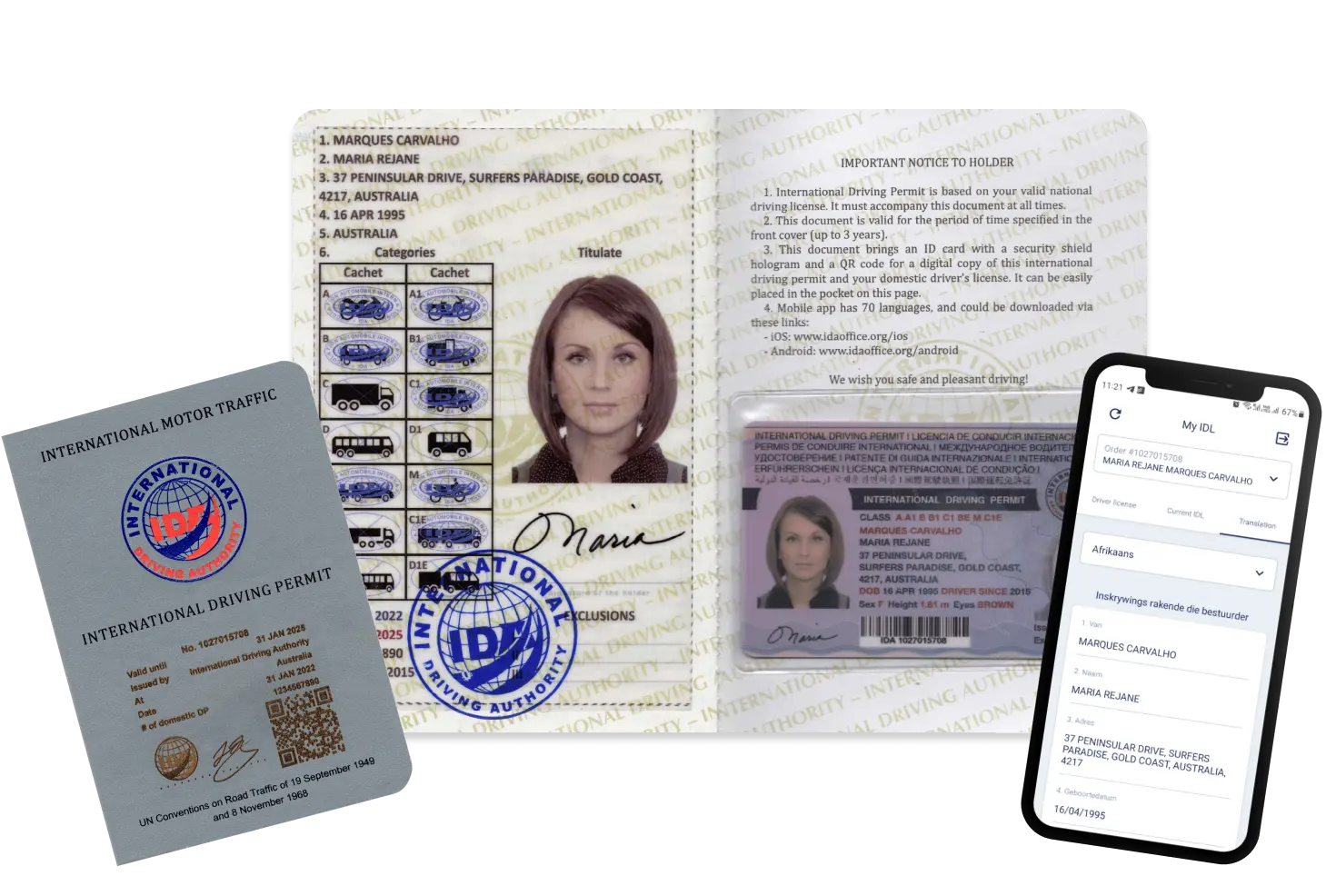
- The United Nations Standard International Driving Permit includes a plastic ID card, a booklet and a mobile application for Android and iOS with the translation into 70 languages (29 in a booklet and all 70 in a mobile app). The IDP is made in compliance with United Nations Conventions on road traffic standards for document size, color, format, etc.
-
Electronic International Driving License
- The Electronic International Driving License or eIDL includes a printable PDF document of a booklet and a mobile application for Android and iOS with the translation into 70 languages.
- De jure, according to the United Nations Convention on road traffic, physical copy of IDL is mandatory, as there is no such notion in the UN Convention as an eIDL yet. De facto we and our clients used digital version many times, and road police and car rentals accept it. However, we advise you to choose the United Nations standard IDP if you have enough time for delivery.
- Cancelation and refund are possible only until your order is not processed. Once an order is processed, and an email with eIDL is submitted to you, our service is completed, and the respective PDF file shall be considered exploited and shall become non-redeemable.

How to get an International Driving Permit in Mauritania?
According to the Vienna Convention of 1968, International Driving Permits (IDPs) are authorized to be issued by national governments or designated organizations. In most countries, this function is carried out by automobile associations affiliated with the AIT/FIA, the police, or other authorized entities. To obtain an International Driving Permit in Mauritania, you must possess a local license and apply to the relevant authorities here (please notify us if the link is not working). The cost and processing time for an IDP vary by country.
If you hold a national license not issued in Mauritania, you must verify if your license permits you to drive and if you require an IDP. If an IDP is necessary, the only option is to order a translation of your driver's license, available either via delivery or as an electronic version (confirm with the rental car company if an electronic version is acceptable), for example, through our services.
For U.S. citizens with only a U.S. driver's license, you can obtain an IDP from AAA, but it must be done before traveling to Mauritania!
FAQ
How to get an International Driving Permit in Mauritania?
expand_more
If you have a local license and want to travel, contact a competent organization. If you are an American and plan to travel in advance, you can get an IDP from AAA. In other cases, you can have your driver's license translated into the required languages so that you can travel with your national license and its translation.
How to apply for International Driving Permit?
expand_more
Our application process is fast and simple. Complete the IDP application form, attach a copy of your valid driver's license, your handwritten signature and a color ID photo, and make the payment. You can apply for an IDP online here.
Do I need an International Driving Permit for Mauritania?
expand_more
Mauritania has not unified its driving license in accordance with the 1968 Vienna Convention. Drivers from other countries need an International Driving License, unless Mauritania and the country that issued your license have an additional agreement on the recognition of driving licenses.
Can I drive in Mauritania with a US license?
expand_more
You can only drive in Mauritania with your driver's license if you have a valid International Driving Permit (IDP). Additional information for traveling U.S. citizens can be found on the government website.
Can an American drive in Mauritania?
expand_more
To drive an American in Mauritania, you must have an International Driving Permit (IDP). Additional information for traveling U.S. citizens can be found on the government website.
What is the International Driver's Document?
expand_more
Our IDD is ideal for travelers visiting multilingual destinations. No test is required, and the IDD is valid for up to three years. This document is used in conjunction with, but does not replace, your valid national license; it is a translation of your driver’s license in three formats.
Can I rent a car with this document?
expand_more
Usually, yes. However, as requirements vary from region to region, you are advised to inquire directly with car rental companies.
Can I purchase car insurance with the IDD?
expand_more
Usually, yes. However, as requirements vary from region to region, you are advised to inquire directly with local insurances companies.
What do you need to know to drive in Mauritania?
🗓 Facts checked against Mauritania's road-traffic law and official sources. Research last updated: . You may copy this information only if you provide a link back to this page.
⚠ This page is general information about driving rules, not legal advice. Rules change, and each authority applies its own — confirm your case with the relevant authority before you drive.
ℹ We are a private company. We are not a government body, a licensing or issuing authority, or a treaty organisation, and we are not affiliated with, endorsed by, or acting for any of them. The International Driver's Document we sell is a translation of your national driving licence: it is not a driving licence, and it is not a government-issued document.
- Driving in Mauritania: key facts
- Do you need an International Driving Permit in Mauritania?
- What side of the road does Mauritania drive on?
- How long can you drive in Mauritania with a foreign licence?
- Is Mauritania a party to the 1949 or 1968 Road Traffic Convention?
- Why acceptance of your licence varies from place to place
- Can you drive in Mauritania with your country's licence?
- Where to get an International Driving Permit
- Moving to Mauritania? Rules for new residents
- Driving rules in Mauritania tourists get fined for
- Read more about driving in Mauritania
- Sources
Driving in Mauritania: key facts
| Question | Answer |
|---|---|
| Side of the road | Right |
| International Driving Permit (IDP) | No established rule was found for any origin licence — check with the authorities before you travel |
| UN Road Traffic Conventions | Party to neither convention |
| Time limit for visitors | The decree implementing Mauritania's code de la route names no visitor period for a non-resident driving on an international driving permit or on a licence from a state that grants reciprocity. |
| Minimum age | 18 to drive — Decree No. 2007-006 of 5 January 2007, art. 182: 18 full years to sit the test for a category B or F licence; the decree does not say whether this age applies to holders of foreign licences |
| Alcohol limit | No numeric blood-alcohol limit is set: a driver must not drive after using any substance that can impair physical or mental capacity, so drive with no alcohol at all. |
| Speed limits | Traffic drives on the right. Private cars seating fewer than 10 people are limited to 100 km/h on motorways and national roads and 80 km/h on other roads (Decree No. 2007-006, art. 18), and to 60 km/h in urban areas (Decree No. 2017-044, art. 4); lower limits set by the authorities still apply. FCDO warns 'traffic rules are rarely respected and paved roads are generally in poor condition.' |
| Emergency number | Ambulance: 101; Fire: 118; Police: 117. FCDO warns that 'The Mauritania authorities may not answer calls to these numbers' - if you are travelling with a guide or rental operator, use their contact as the primary emergency channel. |
Do you need an International Driving Permit in Mauritania?
Mauritania is not a party to the 1949 (Geneva) or 1968 (Vienna) road-traffic conventions: it does not appear in the UN Treaty Collection participant tables for either, unlike Morocco and neighbouring Algeria, Mali and Senegal. No convention therefore obliges Mauritania to recognise an IDP or a foreign national licence, and recognition rests on Mauritanian law. The decree implementing the code de la route (Decree No. 2007-006 of 5 January 2007) requires a Mauritanian driving licence (art. 179), and art. 180 sets out exceptions, among them: a licence issued by a state that grants the same treatment to holders of Mauritanian licences, and an international driving permit issued to a person not resident in Mauritania, are both valid and can be converted into a Mauritanian licence, subject to a check of their authenticity by the transport ministry. No list of the states that grant reciprocity is published, so whether your licence is enough on its own is not established: check with the licensing authority (DGTT) before you travel. UK FCDO states 'You can use a UK photocard driving licence to drive in Mauritania. If you still have a paper driving licence, you may need to update it to a photocard licence.' That is advice to UK nationals, not a statement of Mauritanian law. Whatever the country of your licence, the decree accepts an IDP issued to a non-resident, although it names no IDP model; its French pages give police checkpoints and rental desks a version of the licence they can read. Carry your home national licence with it.
- Tourists and short-term visitors: Mauritania's road-code decree declares valid a licence from a state that grants holders of Mauritanian licences the same treatment, and an international driving permit issued to a non-resident; it lists no such state and names no IDP model. Check with the authorities before you travel; the answer below says what is known.
- Car renters: Carry your home national licence, passport, vehicle registration, rental agreement and insurance papers at all times, plus photocopies. Police checkpoints are routine once you leave Nouakchott.
No specific penalty for driving without the required document was verified from an authoritative source. Official source.
What side of the road does Mauritania drive on?
Mauritania drives on the right-hand side of the road, and overtaking is done on the left. Cars in Mauritania are left-hand drive.
How long can you drive in Mauritania with a foreign licence?
The decree implementing Mauritania's code de la route names no visitor period for a non-resident driving on an international driving permit or on a licence from a state that grants reciprocity. Treat the entitlement as lasting only while you hold lawful short-stay immigration status and the licence or IDP you drive on remains valid. A foreigner who takes up residence may drive on the foreign licence for one year, according to the licensing authority (see the residents section below). (Decree No. 2007-006 of 5 January 2007 implementing Ordinance No. 2006-047 (code de la route), art. 180; DGTT licensing information page (resident foreigners))
Planning to move to Mauritania? Different rules apply once you become a resident — see the residents section below.
Is Mauritania a party to the 1949 or 1968 Road Traffic Convention?
Mauritania is party to neither the 1949 Geneva Convention nor the 1968 Vienna Convention on Road Traffic. An official convention IDP cannot be issued in Mauritania, and convention rules do not bind it — licence acceptance is governed purely by local law and bilateral arrangements.
Why acceptance of your licence varies from place to place
Whether a foreign country accepts your driving licence hangs on a tangle of variables: three different road-traffic conventions signed decades apart (1926, 1949, 1968) — the oldest predates the United Nations itself, and only the latter two were concluded under it — countries at different stages of joining each (signed vs. accepted vs. ratified), licences printed in alphabets local police can't read, vehicle-category systems that don't line up between countries, document generations that may not meet a convention's format even when the country is a member, bilateral deals between individual states, and local laws that are looser in one place and stricter in the next. The same licence can be fine at one border and rejected at the next — even at the next rental desk. The International Driving Permit exists to cut through most of it: a standardized, multilingual presentation of your existing licence, with harmonized category symbols, that most officials can read at a glance. It doesn't replace your national licence or grant new rights — you carry both — and it doesn't guarantee acceptance: a handful of destinations still require a local permit alongside or instead of it, but for most it meaningfully improves your odds.
Can you drive in Mauritania with your country's licence?
This answer is for tourists and temporary visitors. Moving to Mauritania as a resident? Different rules apply — see the residents section below. Mauritania is not a party to the 1949 Geneva or 1968 Vienna road-traffic conventions, so no International Driving Permit edition has treaty force there and no convention obliges Mauritania to recognise foreign licences. Mauritania's own decree implementing the code de la route (Decree No. 2007-006, art. 180) accepts a licence issued by a state that grants the same treatment to Mauritanian licence holders, and an international driving permit issued to a non-resident. No list of the states that grant reciprocity is published, so whether your licence is enough on its own is not established: check with the licensing authority (DGTT) before you travel. The decree accepts an IDP from any non-resident, whatever the country of the licence, though it names no IDP model. UK government advice is that a UK photocard licence may be used. Because Arabic is the official language and French the administrative one, a licence in neither Arabic nor Latin script may be hard for checkpoint officers to read; art. 180 does not mention a translation, and an IDP is also the simplest document to hand a checkpoint officer. Note that most visitor driving here is in hired 4WDs, often with a driver, and that large parts of the country are under FCDO advice against travel. Rules change — confirm with official sources before you travel. Last verified: October 2026.
Legend: "1949" — Geneva Convention on Road Traffic (IDP valid up to 1 year); "1968" — Vienna Convention (IDP valid up to 3 years).
Not established — the record does not settle whether you may drive here on this licence; confirm with the destination's licensing authority before you rely on it. The answer below says what could not be confirmed.
What you need to carry — Check with local authorities before travel
Why — Mauritania's road-code decree declares valid a licence from a state that grants holders of Mauritanian licences the same treatment, and an international driving permit issued to a non-resident; it lists no such state and names no IDP model [1]
Sources and notes for the answer above
Where to get an International Driving Permit
An International Driving Permit must be obtained before you travel, and only certain countries may issue one to you — you cannot buy an official IDP from an unrelated country. Under the 1968 Vienna Convention it may be issued only by the Contracting Party where you normally reside and which issued or recognizes your licence — by that Party's competent authority or by an association it has duly empowered. Under the 1949 Geneva Convention it is issued by the competent authority of a Contracting State, or by an association that authority has duly empowered. Which body that is varies by country: a government agency in some, an authorized motoring club in others.
- Travelling from another country? Ask that country's driving-licence authority which body it authorizes to issue IDPs — a government agency in some countries, an authorized motoring club in others.
Separately, IDA offers a digital International Driver's Document — a translation of your national licence that you carry alongside it. It is not an International Driving Permit issued under the 1949 or 1968 conventions by the body your country authorizes for that purpose, and it is not a certified, sworn or otherwise official translation: no authority certifies it, and where a country requires an official or certified translation by law, our document does not satisfy that requirement. It is a private translation meant to make your national licence readable at rental desks and roadside checks.
Moving to Mauritania? Rules for new residents
A foreigner who takes up residence may drive on the foreign licence for one year, according to Mauritania's licensing authority (DGTT), and converts it with an application, four photos, the residence card and the original licence; the DGTT does not say whether a test is required. Decree No. 2007-006, art. 180, makes a licence from a state that grants reciprocity, and an international driving permit issued to a non-resident, convertible into a Mauritanian licence once the transport ministry has checked that it is genuine. The decree itself sets a one-year period only for Mauritanians who lived abroad, from the date they take up residence in Mauritania (art. 180(2)), and states no such period for foreign residents: confirm the rule with the DGTT before you rely on it.
Driving rules in Mauritania tourists get fined for
- Mandatory equipment: Every motor vehicle must carry two warning triangles (Decree No. 2007-006, art. 87). Seat belts must be worn by the driver and front passenger in urban areas and, outside urban areas, by everyone in the front and rear seats of a vehicle fitted with them (art. 120); children under ten may not ride in the front seat (art. 121). The fire extinguishers and first-aid kit the decree lists are required in public passenger-transport vehicles (art. 123), not in private cars. Practically, for the desert and coastal routes that make up most driving here, also carry spare tyres, a jack and tools, a tow rope and recovery boards, hi-vis, extended water and fuel, and a satellite phone or other off-network communications.
- Drink-driving: No numeric blood-alcohol limit is set: a driver must not drive after using any substance that can impair physical or mental capacity, so drive with no alcohol at all. That is the rule in art. 8 of Decree No. 2007-006, which implements the road code. Separately, Penal Code art. 341 (Ordinance No. 83-162 of 9 July 1983) punishes any adult Muslim who knowingly drinks alcohol, and anyone who serves alcohol to a Muslim or invites a Muslim to drink; UK FCDO advises 'It is illegal for Muslims and non-Muslims to import or consume alcohol and pork products in Mauritania'. Ordinance No. 2006-047 (the code de la route), art. 10, punishes driving or attempting to drive under the influence of substances that reduce physical or mental capacity with 11 days to 3 months' imprisonment, a fine of 6,000 to 40,000 ouguiyas, or both; the courts may annul the licence (art. 22) and, for a repeat offence, confiscate a vehicle the driver owns (art. 20). These amounts are in the old ouguiya, which a re-based ouguiya replaced on 1 January 2018. In November 2021 the National Assembly adopted a bill changing the code's road-safety penalties; its text could not be obtained, so the current figures may differ.
- Speed limits: Traffic drives on the right. Private cars seating fewer than 10 people are limited to 100 km/h on motorways and national roads and 80 km/h on other roads (Decree No. 2007-006, art. 18), and to 60 km/h in urban areas (Decree No. 2017-044, art. 4); lower limits set by the authorities still apply. FCDO warns 'traffic rules are rarely respected and paved roads are generally in poor condition'.
- Carry your home national licence, passport, vehicle registration, rental agreement and insurance papers at all times, plus photocopies. Police checkpoints are routine once you leave Nouakchott.
- Use a 4-wheel-drive vehicle, avoid driving at night, do a maintenance check before setting out, check tide times on coastal routes, and carry enough water and fuel for long journeys.
- Travel in convoy with an experienced guide when leaving urban areas, including to the desert tourist sites at Chinguetti and Tichit.
- Expect poor road conditions and poor driving standards - drive defensively and allow far more time than distances suggest.
- Check FCDO regional advice before planning any route: as of 24 March 2026 the FCDO advises against all travel to eastern Mauritania and to within 25km of the Mali border, and against all but essential travel to within 25km of the Western Sahara border (except the Nouakchott-Nouadhibou road and the city of Nouadhibou), to the rest of Tiris Zemmour, Assaba, Hodh el Gharbi, Gorgol and Guidimaka provinces, and to parts of Adrar and Tagant provinces, with some roads and towns excepted. Insurance and rental cover typically lapse in advise-against zones.
Read more about driving in Mauritania
Watch what driving in Mauritania looks like
A few minutes of real POV footage is the fastest way to feel confident before your first drive in Mauritania:
Open the video on YouTube if the player does not load.
Sources
- National road-traffic law
- UN Treaty Collection - status of the 1949 Geneva Convention on Road Traffic (Mauritania absent from the participant list)
- UN Treaty Collection - status of the 1968 Vienna Convention on Road Traffic (Mauritania absent from the participant list)
- UK FCDO Mauritania travel advice - Safety and security (driving licences, road travel, alcohol, checkpoints)
- UK FCDO Mauritania travel advice - Getting help (emergency service numbers)
- UK FCDO Mauritania travel advice - warnings and advise-against-travel regions (updated 24 March 2026)
- Ministry of Equipment and Transport - Ordonnance n° 2006-047 du 6 décembre 2006 portant Code de la Route, as published in Official Journal no. 1136 of 31 January 2007 (articles 10, 20 and 22)
- Directorate General of Land Transport (DGTT) - road code compilation in Arabic: Decree No. 2007-006 of 5 January 2007 (Official Journal no. 1137 bis, 15 February 2007), articles 8, 18, 87, 120, 121, 123 and 179 to 182, and Decree No. 2017-044 of 20 April 2017 (Arabic and French)
- Directorate General of Land Transport (DGTT) - licence categories and minimum ages, and the one-year rule for resident foreigners (in French)
- Penal Code (Ordinance No. 83-162 of 9 July 1983), article 341 on alcohol - copy on ecoi.net (in French)
- UN Treaty Collection — 1949 Geneva Convention on Road Traffic
- UN Treaty Collection — 1968 Vienna Convention on Road Traffic
