International Driving Permit in Haiti

International Driving Permit for your travel in Haiti
- Instant approval
- Fast & Easy Process
- Valid from 1 to 3 years
- Drive Legally Overseas
- Translated in 70 Languages
- Recognized in over 150 countries
- Worldwide Express Shipping
Where to get an International Driving Permit in Haiti?
Obtaining an International Driving Permit (IDP) in Haiti is straightforward if you hold a valid Haiti national driver's license. For those planning a visit to Haiti, it is advisable to contact the relevant authority in your home country to secure an IDP before departure. However, if you are already traveling and do not possess the IDP, you may opt to have your national driver's license translated online. This method offers a quicker, more convenient, and efficient way to ensure you can legally drive during your travels.
The International Driving Permit is a translation of the national driving license into many languages. The first ID cards appeared in 1926, after the Paris International Convention relative to Motor Traffic. The International Driving Permit was also influenced by two other conventions in 1949 and 1968. The International Driving Permit is the same as the International Driving License.
We remind you that the IDP works only with a valid national license.

How to obtain an International Driving Permit in Haiti online?
- 1. A photo of your valid domestic driving license
- 2. Your personal data
- 3. A photo of yourself
- 4. Your signature (scan or photo it)
Get an International Driving Permit (IDP) now and travel easily.
International Driving Permit price in Haiti?
7 days money back guarantee!
You may return the documents issued by the International Driving Authority anytime before the delivery or within 7 days after the delivery of the document for a full refund.
-
UN Standard International Driving Permit
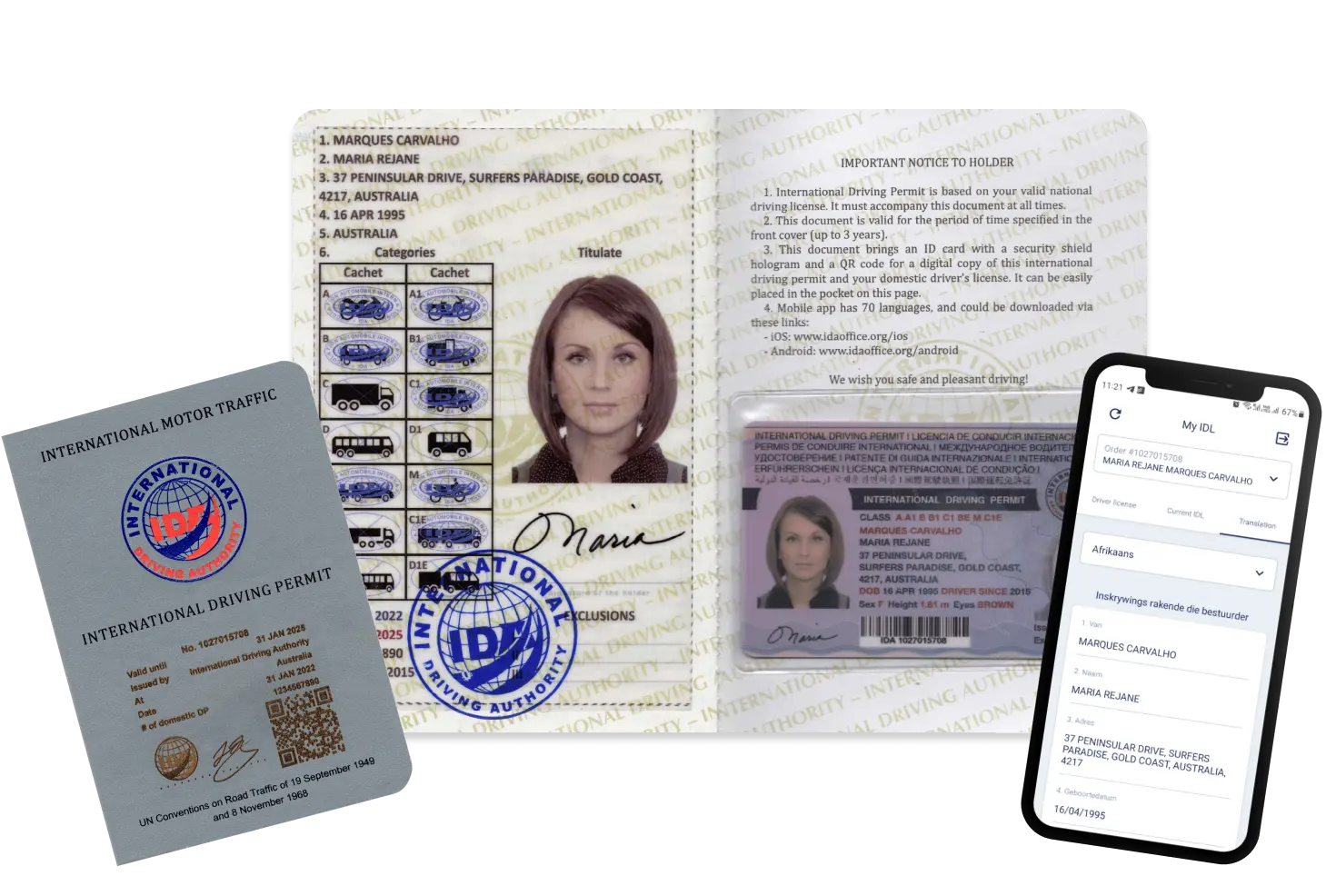
- The United Nations Standard International Driving Permit includes a plastic ID card, a booklet and a mobile application for Android and iOS with the translation into 70 languages (29 in a booklet and all 70 in a mobile app). The IDP is made in compliance with United Nations Conventions on road traffic standards for document size, color, format, etc.
-
Electronic International Driving License
- The Electronic International Driving License or eIDL includes a printable PDF document of a booklet and a mobile application for Android and iOS with the translation into 70 languages.
- De jure, according to the United Nations Convention on road traffic, physical copy of IDL is mandatory, as there is no such notion in the UN Convention as an eIDL yet. De facto we and our clients used digital version many times, and road police and car rentals accept it. However, we advise you to choose the United Nations standard IDP if you have enough time for delivery.
- Cancelation and refund are possible only until your order is not processed. Once an order is processed, and an email with eIDL is submitted to you, our service is completed, and the respective PDF file shall be considered exploited and shall become non-redeemable.

How to get an International Driving Permit in Haiti?
According to the Vienna Convention of 1968, International Driving Permits (IDPs) are authorized to be issued by national governments or designated organizations. In most countries, this function is carried out by automobile associations affiliated with the AIT/FIA, the police, or other authorized entities. To obtain an International Driving Permit in Haiti, you must possess a local license and apply to the relevant authorities here (please notify us if the link is not working). The cost and processing time for an IDP vary by country.
If you hold a national license not issued in Haiti, you must verify if your license permits you to drive and if you require an IDP. If an IDP is necessary, the only option is to order a translation of your driver's license, available either via delivery or as an electronic version (confirm with the rental car company if an electronic version is acceptable), for example, through our services.
For U.S. citizens with only a U.S. driver's license, you can obtain an IDP from AAA, but it must be done before traveling to Haiti!
FAQ
How to get an International Driving Permit in Haiti?
expand_more
If you have a local license and want to travel, contact a competent organization. If you are an American and plan to travel in advance, you can get an IDP from AAA. In other cases, you can have your driver's license translated into the required languages so that you can travel with your national license and its translation.
How to apply for International Driving Permit?
expand_more
Our application process is fast and simple. Complete the IDP application form, attach a copy of your valid driver's license, your handwritten signature and a color ID photo, and make the payment. You can apply for an IDP online here.
Do I need an International Driving Permit for Haiti?
expand_more
Haiti has not unified its driving license in accordance with the 1968 Vienna Convention. Drivers from other countries need an International Driving License, unless Haiti and the country that issued your license have an additional agreement on the recognition of driving licenses.
Can I drive in Haiti with a US license?
expand_more
You can only drive in Haiti with your driver's license if you have a valid International Driving Permit (IDP). Additional information for traveling U.S. citizens can be found on the government website.
Can an American drive in Haiti?
expand_more
To drive an American in Haiti, you must have an International Driving Permit (IDP). Additional information for traveling U.S. citizens can be found on the government website.
What is the International Driver's Document?
expand_more
Our IDD is ideal for travelers visiting multilingual destinations. No test is required, and the IDD is valid for up to three years. This document is used in conjunction with, but does not replace, your valid national license; it is a translation of your driver’s license in three formats.
Can I rent a car with this document?
expand_more
Usually, yes. However, as requirements vary from region to region, you are advised to inquire directly with car rental companies.
Can I purchase car insurance with the IDD?
expand_more
Usually, yes. However, as requirements vary from region to region, you are advised to inquire directly with local insurances companies.
What do you need to know to drive in Haiti?
🗓 Facts checked against official government guidance for Haiti and other official sources. Research last updated: . You may copy this information only if you provide a link back to this page.
⚠ This page is general information about driving rules, not legal advice. Rules change, and each authority applies its own — confirm your case with the relevant authority before you drive.
ℹ We are a private company. We are not a government body, a licensing or issuing authority, or a treaty organisation, and we are not affiliated with, endorsed by, or acting for any of them. The International Driver's Document we sell is a translation of your national driving licence: it is not a driving licence, and it is not a government-issued document.
- Driving in Haiti: key facts
- Do you need an International Driving Permit in Haiti?
- What side of the road does Haiti drive on?
- How long can you drive in Haiti with a foreign licence?
- Is Haiti a party to the 1949 or 1968 Road Traffic Convention?
- Why acceptance of your licence varies from place to place
- Can you drive in Haiti with your country's licence?
- Where to get an International Driving Permit
- Moving to Haiti? Rules for new residents
- Driving rules in Haiti tourists get fined for
- Read more about driving in Haiti
- Sources
Driving in Haiti: key facts
| Question | Answer |
|---|---|
| Side of the road | Right |
| International Driving Permit (IDP) | Accepted for 128 of the 240 origin licences, 112 of which have no established rule — see the row for your country of issue, in the table below, for what each one accepts alongside it, and on what basis |
| IDP types accepted | 1949 Geneva only (booklet IDP, valid 1 year) |
| UN Road Traffic Conventions | 1949 Geneva — accession 12 Feb 1958 |
| Time limit for visitors | Up to 90 days driving on your own national licence; after 90 days a 1949 IDP is required alongside it. |
| Minimum age | 18 to drive — the age the 1949 Geneva Convention on Road Traffic sets for driving on a foreign licence, Annex 8 (verbatim: 'The minimum age for driving a motor vehicle under the conditions set out in article 24 of the Convention shall be eighteen years.'); Haiti acceded 12 Feb 1958. Haiti's own licences start younger: a car licence from 16 with the express authorisation of the traffic directorate, a motorcycle licence from 15, and heavy-vehicle and construction-machinery licences only to adults (Décret relatif à l'immatriculation et à la circulation des véhicules, 2006, art. 53) |
| Alcohol limit | Haitian law sets no numeric alcohol limit: it punishes only driving while visibly drunk, as the police judge it from outward signs, so treat the limit as zero. |
| Speed limits | Traffic drives on the right. In towns and built-up areas the limit is 50 km/h, and drivers must slow down further when the road, the traffic or poor visibility calls for it; outside towns there is no general limit, only limits posted on signs, though you must keep your vehicle under control at all times (Décret relatif à l'immatriculation et à la circulation des véhicules, 2006, arts. 82 and 83). The MTPTC's 2015 national road-safety strategy notes that this makes speed impossible to enforce on roads without signs and proposes limits set by class of road. Road and security conditions routinely make posted limits irrelevant. |
| Emergency number | Ambulance: 116. Fire: 115. Police: 122. UK FCDO notes that 'Due to the security situation in Haiti, emergency services may be unable to respond or face long delays in reaching you.' In-person consular assistance is severely limited; there are no British consular officials in Haiti. |
Do you need an International Driving Permit in Haiti?
Haiti acceded to the 1949 Geneva Convention on 12 February 1958 and is not a party to the 1968 Vienna Convention, so the 1949 IDP is the only form Haiti is treaty-bound to accept. For a short visit an IDP is not a legal precondition: current UK FCDO guidance states verbatim that 'You can use a UK photocard driving licence to drive in Haiti for up to 90 days' and 'After 90 days you'll need an IDP.' The IDP never replaces the national licence - carry both, plus your passport and entry stamp.
- Tourists and short-term visitors: carry your national licence together with the document named in the row for your country of issue, in the table below — for most non-exempt licences that is an IDP.
- Car renters: If you drive despite the warning, carry the original national licence, a genuine 1949 IDP where required, passport and entry evidence, vehicle registration, rental contract and proof of insurance. Paper-only licences should be upgraded to a photocard or paired with an IDP.
No specific penalty for driving without the required document was verified from an authoritative source.
What side of the road does Haiti drive on?
Haiti drives on the right-hand side of the road, and overtaking is done on the left. Cars in Haiti are left-hand drive.
How long can you drive in Haiti with a foreign licence?
Up to 90 days driving on your own national licence; after 90 days a 1949 IDP is required alongside it. This 90-day figure is documented by UK FCDO guidance for UK photocard holders; Haiti's own consolidated law was not located, and immigration status, licence validity, rental terms and insurance can end your authority to drive sooner. (UK FCDO Haiti travel advice, Safety and security - Road travel (verbatim: 'You can use a UK photocard driving licence to drive in Haiti for up to 90 days ... After 90 days you'll need an IDP.'), last updated 10 December 2025)
Planning to move to Haiti? Different rules apply once you become a resident — see the residents section below.
Is Haiti a party to the 1949 or 1968 Road Traffic Convention?
Haiti is a Contracting Party to the 1949 Geneva Convention on Road Traffic, but not to the 1968 Vienna Convention.
- 1949 Geneva Convention on Road Traffic: accession on 12 Feb 1958.
Why acceptance of your licence varies from place to place
Whether a foreign country accepts your driving licence hangs on a tangle of variables: three different road-traffic conventions signed decades apart (1926, 1949, 1968) — the oldest predates the United Nations itself, and only the latter two were concluded under it — countries at different stages of joining each (signed vs. accepted vs. ratified), licences printed in alphabets local police can't read, vehicle-category systems that don't line up between countries, document generations that may not meet a convention's format even when the country is a member, bilateral deals between individual states, and local laws that are looser in one place and stricter in the next. The same licence can be fine at one border and rejected at the next — even at the next rental desk. The International Driving Permit exists to cut through most of it: a standardized, multilingual presentation of your existing licence, with harmonized category symbols, that most officials can read at a glance. It doesn't replace your national licence or grant new rights — you carry both — and it doesn't guarantee acceptance: a handful of destinations still require a local permit alongside or instead of it, but for most it meaningfully improves your odds.
Can you drive in Haiti with your country's licence?
This table is for tourists and temporary visitors. Moving to Haiti as a resident? Different rules apply — see the residents section below. Find your licence's country of issue below. Haiti has been a party to the 1949 Geneva Convention since 1958 and is not a 1968 party, so the 1949 IDP is the only form it is bound to accept. A national licence from a 1949 contracting state is recognised in its own right - UK guidance documents 90 days on the licence alone, with an IDP needed after that. The overriding issue is safety: current advice warns against all travel, and road and emergency conditions can make self-driving untenable. Rules change — confirm with official sources before you travel. Last verified: October 2026.
Legend: "1949" — Geneva Convention on Road Traffic (IDP valid up to 1 year); "1968" — Vienna Convention (IDP valid up to 3 years).
What the Status column means on this page:
- Treaty recognises licence — IDP advised — the 1949 Geneva Convention obliges this destination to recognise your national licence, and separately allows a destination to require a 1949-type IDP; this row states the treaty position and does not settle which of the two this destination chose, so carrying an IDP is advised. The row for your country of issue, in the table below, gives the basis.
- Not established — the record does not settle whether you may drive here on this licence; confirm with the destination's licensing authority before you rely on it. The row for your country of issue, in the table below, says what could not be confirmed.
Show the full list, all 240
| Country of licence | # |
|---|---|
| Abkhazia | 12 |
| Afghanistan | 13 |
| Albania | 1 |
| Algeria | 2 |
| American Samoa | 3 |
| Andorra | 11 |
| Angola | 12 |
| Antigua and Barbuda | 12 |
| Argentina | 2 |
| Armenia | 11 |
| Aruba | 5 |
| Australia | 2 |
| Austria | 1 |
| Azad Kashmir | 12 |
| Azerbaijan | 11 |
| Bahamas | 11 |
| Bahrain | 1 |
| Bangladesh | 2 |
| Barbados | 2 |
| Belarus | 11 |
| Belgium | 1 |
| Belize | 13 |
| Benin | 1 |
| Bermuda | 14 |
| Bhutan | 13 |
| Bolivia | 13 |
| Bosnia and Herzegovina | 11 |
| Botswana | 2 |
| Brazil | 11 |
| British Virgin Islands | 15 |
| Brunei | 2 |
| Bulgaria | 1 |
| Burkina Faso | 2 |
| Burundi | 13 |
| Cambodia | 2 |
| Cameroon | 13 |
| Canada | 2 |
| Cape Verde | 11 |
| Caribbean Netherlands | 5 |
| Cayman Islands | 7 |
| Central African Republic | 1 |
| Chad | 13 |
| Chile | 2 |
| China | 12 |
| Colombia | 13 |
| Comoros | 12 |
| Congo (Brazzaville) | 2 |
| Congo (Democratic Rep.) | 1 |
| Cook Islands | 16 |
| Costa Rica | 13 |
| Croatia | 1 |
| Cuba | 1 |
| Curacao | 5 |
| Cyprus | 2 |
| Czech Republic | 1 |
| Denmark | 1 |
| Djibouti | 12 |
| Dominica | 13 |
| Dominican Republic | 2 |
| East Timor | 12 |
| Ecuador | 2 |
| Egypt | 1 |
| El Salvador | 11 |
| Equatorial Guinea | 12 |
| Eritrea | 12 |
| Estonia | 1 |
| Eswatini | 13 |
| Ethiopia | 11 |
| Falkland Islands | 17 |
| Faroe Islands | 8 |
| Fiji | 2 |
| Finland | 1 |
| France | 1 |
| French Guiana | 1 |
| French Polynesia | 4 |
| Gabon | 13 |
| Gambia | 13 |
| Georgia | 1 |
| Germany | 11 |
| Ghana | 2 |
| Gibraltar | 6 |
| Greece | 1 |
| Greenland | 18 |
| Grenada | 12 |
| Guadeloupe | 1 |
| Guam | 3 |
| Guatemala | 2 |
| Guernsey | 6 |
| Guinea | 13 |
| Guinea Bissau | 12 |
| Guyana | 11 |
| Honduras | 11 |
| Hong Kong | 9 |
| Hungary | 1 |
| Iceland | 2 |
| India | 2 |
| Indonesia | 13 |
| Iran | 11 |
| Iraq | 11 |
| Ireland | 2 |
| Israel | 1 |
| Italy | 1 |
| Ivory Coast | 1 |
| Jamaica | 2 |
| Japan | 2 |
| Jersey | 6 |
| Jordan | 2 |
| Kazakhstan | 11 |
| Kenya | 11 |
| Kiribati | 12 |
| Kosovo | 13 |
| Kuwait | 11 |
| Kyrgyzstan | 1 |
| Laos | 2 |
| Latvia | 11 |
| Lebanon | 2 |
| Lesotho | 2 |
| Liberia | 11 |
| Libya | 13 |
| Liechtenstein | 1 |
| Lithuania | 1 |
| Luxembourg | 1 |
| Macau | 10 |
| Madagascar | 2 |
| Malawi | 2 |
| Malaysia | 2 |
| Maldives | 11 |
| Mali | 2 |
| Malta | 2 |
| Marshall Islands | 12 |
| Martinique | 1 |
| Mauritania | 12 |
| Mauritius | 13 |
| Mayotte Island | 4 |
| Mexico | 13 |
| Micronesia | 12 |
| Moldova | 11 |
| Monaco | 1 |
| Mongolia | 11 |
| Montenegro | 1 |
| Montserrat | 19 |
| Morocco | 1 |
| Mozambique | 13 |
| Myanmar | 11 |
| Nagorno-Karabakh | 12 |
| Namibia | 2 |
| Nauru | 12 |
| Nepal | 13 |
| Netherlands | 1 |
| New Caledonia | 4 |
| New Zealand | 2 |
| Nicaragua | 13 |
| Niger | 1 |
| Nigeria | 1 |
| Niue | 20 |
| Northern Cyprus | 12 |
| Northern Mariana Islands | 3 |
| North Korea | 12 |
| North Macedonia | 11 |
| Norway | 1 |
| Oman | 11 |
| Pakistan | 11 |
| Palau | 12 |
| Palestine | 11 |
| Panama | 13 |
| Papua New Guinea | 2 |
| Paraguay | 2 |
| Peru | 1 |
| Philippines | 1 |
| Poland | 1 |
| Portugal | 1 |
| Puerto Rico | 3 |
| Qatar | 11 |
| Reunion | 1 |
| Romania | 1 |
| Russian Federation | 1 |
| Rwanda | 2 |
| Sahrawi Republic | 12 |
| Saint Martin | 1 |
| Saint Pierre and Miquelon | 4 |
| Samoa | 12 |
| San Marino | 1 |
| São Tomé and Príncipe | 12 |
| Saudi Arabia | 11 |
| Senegal | 1 |
| Serbia | 1 |
| Seychelles | 11 |
| Sierra Leone | 2 |
| Singapore | 2 |
| Sint Maarten | 5 |
| Slovak Republic | 1 |
| Slovenia | 1 |
| Solomon Islands | 12 |
| Somalia | 12 |
| Somaliland | 12 |
| South Africa | 1 |
| South Korea | 2 |
| South Ossetia | 12 |
| South Sudan | 12 |
| Spain | 2 |
| Sri Lanka | 2 |
| St. Kitts and Nevis | 13 |
| St. Lucia | 13 |
| St. Vincent | 13 |
| Sudan | 13 |
| Suriname | 13 |
| Sweden | 1 |
| Switzerland | 11 |
| Syria | 2 |
| Taiwan | 13 |
| Tajikistan | 11 |
| Tanzania | 13 |
| Thailand | 1 |
| Togo | 2 |
| Tokelau Islands | 21 |
| Tonga | 13 |
| Transnistria | 12 |
| Trinidad and Tobago | 2 |
| Tunisia | 1 |
| Turkey | 1 |
| Turkmenistan | 11 |
| Turks and Caicos Islands | 22 |
| Tuvalu | 12 |
| Uganda | 1 |
| Ukraine | 11 |
| United Arab Emirates | 1 |
| United Kingdom | 1 |
| United States of America | 2 |
| Uruguay | 11 |
| U.S. Virgin Islands | 3 |
| Uzbekistan | 11 |
| Vanuatu | 12 |
| Vatican | 2 |
| Venezuela | 2 |
| Vietnam | 1 |
| Wallis and Futuna | 4 |
| Western Sahara | 12 |
| Yemen | 13 |
| Zambia | 13 |
| Zimbabwe | 1 |
| # | Status | Country of licence | What you need to carry | Why |
|---|---|---|---|---|
| 1 | Treaty recognises licence — IDP advised | Albania, Austria, Bahrain, Belgium, Benin, Bulgaria, Central African Republic, Congo (Democratic Rep.), Croatia, Cuba, Czech Republic, Denmark, Egypt, Estonia, Finland, France, French Guiana, Georgia, Greece, Guadeloupe, Hungary, Israel, Italy, Ivory Coast, Kyrgyzstan, Liechtenstein, Lithuania, Luxembourg, Martinique, Monaco, Montenegro, Morocco, Netherlands, Niger, Nigeria, Norway, Peru, Philippines, Poland, Portugal, Reunion, Romania, Russian Federation, Saint Martin, San Marino, Senegal, Serbia, Slovak Republic, Slovenia, South Africa, Sweden, Thailand, Tunisia, Turkey, Uganda, United Arab Emirates, United Kingdom, Vietnam, Zimbabwe (59) | Your national licence; an IDP (1949 type) is strongly advised | Convention party (1949) — the Geneva Convention has your national licence recognised and lets the destination require a 1949-type IDP; the Convention provides no translation route (1968 IDP not valid here) [1] |
| 2 | Treaty recognises licence — IDP advised | Algeria, Argentina, Australia, Bangladesh, Barbados, Botswana, Brunei, Burkina Faso, Cambodia, Canada, Chile, Congo (Brazzaville), Cyprus, Dominican Republic, Ecuador, Fiji, Ghana, Guatemala, Iceland, India, Ireland, Jamaica, Japan, Jordan, Laos, Lebanon, Lesotho, Madagascar, Malawi, Malaysia, Mali, Malta, Namibia, New Zealand, Papua New Guinea, Paraguay, Rwanda, Sierra Leone, Singapore, South Korea, Spain, Sri Lanka, Syria, Togo, Trinidad and Tobago, United States of America, Vatican, Venezuela (48) | Your national licence; an IDP (1949 type) is strongly advised | Convention party (1949) — the Geneva Convention has your national licence recognised and lets the destination require a 1949-type IDP; the Convention provides no translation route [1] |
| 3 | Treaty recognises licence — IDP advised | American Samoa, Guam, Northern Mariana Islands, Puerto Rico, U.S. Virgin Islands (5) | Your national licence; an IDP (1949 type) is strongly advised | Convention party (1949) — the Geneva Convention has your national licence recognised and lets the destination require a 1949-type IDP; the Convention provides no translation route (via United States of America — territorial application) [1] |
| 4 | Treaty recognises licence — IDP advised | French Polynesia, Mayotte Island, New Caledonia, Saint Pierre and Miquelon, Wallis and Futuna (5) | Your national licence; an IDP (1949 type) is strongly advised | Convention party (1949) — the Geneva Convention has your national licence recognised and lets the destination require a 1949-type IDP; the Convention provides no translation route (1968 IDP not valid here) (via France — territorial application) [1] |
| 5 | Treaty recognises licence — IDP advised | Aruba, Caribbean Netherlands, Curacao, Sint Maarten (4) | Your national licence; an IDP (1949 type) is strongly advised | Convention party (1949) — the Geneva Convention has your national licence recognised and lets the destination require a 1949-type IDP; the Convention provides no translation route (via Netherlands — territorial application) [1] |
| 6 | Treaty recognises licence — IDP advised | Gibraltar, Guernsey, Jersey (3) | Your national licence; an IDP (1949 type) is strongly advised | Convention party (1949) — the Geneva Convention has your national licence recognised and lets the destination require a 1949-type IDP; the Convention provides no translation route (1968 IDP not valid here) (via United Kingdom — territorial application) [1] |
| 7 | Treaty recognises licence — IDP advised | Cayman Islands (1) | Your national licence; an IDP (1949 type) is strongly advised | Convention party (1949) — the Geneva Convention has your national licence recognised and lets the destination require a 1949-type IDP; the Convention provides no translation route (via United Kingdom — territorial application) [1] |
| 8 | Treaty recognises licence — IDP advised | Faroe Islands (1) | Your national licence; an IDP (1949 type) is strongly advised | Convention party (1949) — the Geneva Convention has your national licence recognised and lets the destination require a 1949-type IDP; the Convention provides no translation route (via Denmark — territorial application) [1] |
| 9 | Treaty recognises licence — IDP advised | Hong Kong (1) | Your national licence; an IDP (1949 type) is strongly advised | Convention party (1949) — the Geneva Convention has your national licence recognised and lets the destination require a 1949-type IDP; the Convention provides no translation route (1949 Geneva continued application to Hong Kong SAR; HK issues 1949 IDPs) [1] |
| 10 | Treaty recognises licence — IDP advised | Macau (1) | Your national licence; an IDP (1949 type) is strongly advised | Convention party (1949) — the Geneva Convention has your national licence recognised and lets the destination require a 1949-type IDP; the Convention provides no translation route (1949 continued application to Macau SAR) [1] |
| 11 | Not established | Andorra, Armenia, Azerbaijan, Bahamas, Belarus, Bosnia and Herzegovina, Brazil, Cape Verde, El Salvador, Ethiopia, Germany, Guyana, Honduras, Iran, Iraq, Kazakhstan, Kenya, Kuwait, Latvia, Liberia, Maldives, Moldova, Mongolia, Myanmar, North Macedonia, Oman, Pakistan, Palestine, Qatar, Saudi Arabia, Seychelles, Switzerland, Tajikistan, Turkmenistan, Ukraine, Uruguay, Uzbekistan (37) | Check with local authorities before travel | A 1968 IDP has no treaty basis in Haiti — a party to the 1949 Geneva Convention but not to the 1968 Vienna Convention [1] |
| 12 | Not established | Abkhazia, Angola, Antigua and Barbuda, Azad Kashmir, China, Comoros, Djibouti, East Timor, Equatorial Guinea, Eritrea, Grenada, Guinea Bissau, Kiribati, Marshall Islands, Mauritania, Micronesia, Nagorno-Karabakh, Nauru, Northern Cyprus, North Korea, Palau, Sahrawi Republic, Samoa, São Tomé and Príncipe, Solomon Islands, Somalia, Somaliland, South Ossetia, South Sudan, Transnistria, Tuvalu, Vanuatu, Western Sahara (33) | Check with local authorities before travel | Party to neither road-traffic convention — no official convention IDP can be issued for your licence, and no convention gives it standing at the destination. Whether the destination accepts it, and what must accompany it, is a matter of the destination’s own law — check with the authorities before you travel [1] |
| 13 | Not established | Afghanistan, Belize, Bhutan, Bolivia, Burundi, Cameroon, Chad, Colombia, Costa Rica, Dominica, Eswatini, Gabon, Gambia, Guinea, Indonesia, Kosovo, Libya, Mauritius, Mexico, Mozambique, Nepal, Nicaragua, Panama, St. Kitts and Nevis, St. Lucia, St. Vincent, Sudan, Suriname, Taiwan, Tanzania, Tonga, Yemen, Zambia (33) | Check with local authorities before travel | Party to neither road-traffic convention — no official convention IDP can be issued for your licence, though your own authorities do issue an international driving permit of their own, and no convention gives either document standing at the destination. Whether the destination accepts it, and what must accompany it, is a matter of the destination’s own law — check with the authorities before you travel [1] |
| 14 | Not established | Bermuda (1) | We cannot confirm a convention basis for a Bermuda licence — confirm with Haiti's licensing authority before you travel | The depositary record does not settle whether a road-traffic convention covers Bermuda: the state responsible for its international relations enumerated its 1949 territorial extensions one by one without naming Bermuda, but separately told the depositary that the 1949 Convention continues in force for its Crown Dependencies and Overseas Territories. No convention basis for the licence can be established either way — check with the authorities before you travel [1] |
| 15 | Not established | British Virgin Islands (1) | We cannot confirm a convention basis for a British Virgin Islands licence — confirm with Haiti's licensing authority before you travel | The depositary record does not settle whether a road-traffic convention covers British Virgin Islands: the state responsible for its international relations enumerated its 1949 territorial extensions one by one without naming British Virgin Islands, but separately told the depositary that the 1949 Convention continues in force for its Crown Dependencies and Overseas Territories. No convention basis for the licence can be established either way — check with the authorities before you travel [1] |
| 16 | Not established | Cook Islands (1) | We cannot confirm a convention basis for a Cook Islands licence — confirm with Haiti's licensing authority before you travel | We could not confirm any ratification, accession or territorial extension covering Cook Islands, so no convention basis for the licence can be established — check with the authorities before you travel [1] |
| 17 | Not established | Falkland Islands (1) | We cannot confirm a convention basis for a Falkland Islands licence — confirm with Haiti's licensing authority before you travel | The depositary record does not settle whether a road-traffic convention covers Falkland Islands: the state responsible for its international relations enumerated its 1949 territorial extensions one by one without naming Falkland Islands, but separately told the depositary that the 1949 Convention continues in force for its Crown Dependencies and Overseas Territories. No convention basis for the licence can be established either way — check with the authorities before you travel [1] |
| 18 | Not established | Greenland (1) | We cannot confirm a convention basis for a Greenland licence — confirm with Haiti's licensing authority before you travel | We could not confirm any ratification, accession or territorial extension covering Greenland, so no convention basis for the licence can be established — check with the authorities before you travel [1] |
| 19 | Not established | Montserrat (1) | We cannot confirm a convention basis for a Montserrat licence — confirm with Haiti's licensing authority before you travel | The depositary record does not settle whether a road-traffic convention covers Montserrat: the state responsible for its international relations enumerated its 1949 territorial extensions one by one without naming Montserrat, but separately told the depositary that the 1949 Convention continues in force for its Crown Dependencies and Overseas Territories. No convention basis for the licence can be established either way — check with the authorities before you travel [1] |
| 20 | Not established | Niue (1) | We cannot confirm a convention basis for a Niue licence — confirm with Haiti's licensing authority before you travel | We could not confirm any ratification, accession or territorial extension covering Niue, so no convention basis for the licence can be established — check with the authorities before you travel [1] |
| 21 | Not established | Tokelau Islands (1) | We cannot confirm a convention basis for a Tokelau Islands licence — confirm with Haiti's licensing authority before you travel | We could not confirm any ratification, accession or territorial extension covering Tokelau Islands, so no convention basis for the licence can be established — check with the authorities before you travel [1] |
| 22 | Not established | Turks and Caicos Islands (1) | We cannot confirm a convention basis for a Turks and Caicos Islands licence — confirm with Haiti's licensing authority before you travel | The depositary record does not settle whether a road-traffic convention covers Turks and Caicos Islands: the state responsible for its international relations enumerated its 1949 territorial extensions one by one without naming Turks and Caicos Islands, but separately told the depositary that the 1949 Convention continues in force for its Crown Dependencies and Overseas Territories. No convention basis for the licence can be established either way — check with the authorities before you travel [1] |
Sources and notes for the table above
[1] UN Treaty Collection, Multilateral Treaties Deposited with the Secretary-General — status of the 1949 Geneva Convention on Road Traffic (chapter XI-B-1) and of the 1968 Vienna Convention on Road Traffic (chapter XI-B-19) — XI-B-1, XI-B-19
Where to get an International Driving Permit
An International Driving Permit must be obtained before you travel, and only certain countries may issue one to you — you cannot buy an official IDP from an unrelated country. Under the 1968 Vienna Convention it may be issued only by the Contracting Party where you normally reside and which issued or recognizes your licence — by that Party's competent authority or by an association it has duly empowered. Under the 1949 Geneva Convention it is issued by the competent authority of a Contracting State, or by an association that authority has duly empowered. Which body that is varies by country: a government agency in some, an authorized motoring club in others.
- Travelling from Haiti? Haiti's official IDPs are issued by Direction de la Circulation et de la Police Routiere (DCPR).
- Travelling from another country? Ask that country's driving-licence authority which body it authorizes to issue IDPs — a government agency in some countries, an authorized motoring club in others.
Separately, IDA offers a digital International Driver's Document — a translation of your national licence that you carry alongside it. It is not an International Driving Permit issued under the 1949 or 1968 conventions by the body your country authorizes for that purpose, and it is not a certified, sworn or otherwise official translation: no authority certifies it, and where a country requires an official or certified translation by law, our document does not satisfy that requirement. It is a private translation meant to make your national licence readable at rental desks and roadside checks.
Moving to Haiti? Rules for new residents
Anyone staying beyond the visitor window should obtain a Haitian licence rather than renewing IDPs indefinitely. Driving licences are issued by the Direction de la Circulation et de la Police Routière (DCPR) of the Police Nationale d'Haïti under the 2006 Décret relatif à l'immatriculation et à la circulation des véhicules - not by the MTPTC, whose site carries no licensing service. Secondary source.
Driving rules in Haiti tourists get fined for
- Mandatory equipment: Chapter IX of the 2006 Décret relatif à l'immatriculation et à la circulation des véhicules lists the equipment a vehicle must have to be allowed on public roads, but no official online text of the decree was found, so that list cannot be given. The following is advice, not the legal list: if travel is unavoidable, use a professionally assessed vehicle with sound tyres, lights and brakes, plus fuel reserve, communications, medical supplies and confirmed insurance.
- Drink-driving: Haitian law sets no numeric alcohol limit: it punishes only driving while visibly drunk, as the police judge it from outward signs, so treat the limit as zero. Art. 44 of the 2006 Décret relatif à l'immatriculation et à la circulation des véhicules provides that any driver caught at the wheel while drunk is to be arrested immediately ('tout chauffeur ou conducteur de véhicule surpris au volant en état d’ébriété sera appréhendé immédiatement'). The Ministry of Public Works, Transport and Communications (MTPTC) records in its 2015 national road-safety strategy that the decree has no offence of driving above a measured alcohol level, and recommends setting a legal limit. No official penalty figure located. Impaired driving can lead to arrest, prosecution and voided insurance in an already severe security environment.
- Speed limits: Traffic drives on the right. In towns and built-up areas the limit is 50 km/h, and drivers must slow down further when the road, the traffic or poor visibility calls for it; outside towns there is no general limit, only limits posted on signs, though you must keep your vehicle under control at all times (Décret relatif à l'immatriculation et à la circulation des véhicules, 2006, arts. 82 and 83). The MTPTC's 2015 national road-safety strategy notes that this makes speed impossible to enforce on roads without signs and proposes limits set by class of road. Road and security conditions routinely make posted limits irrelevant.
- UK FCDO advises against all travel to Haiti. Verbatim from the road-travel section: 'Road travel is highly dangerous. Armed carjacking is common and criminal groups often use improvised road blocks to extort or kidnap motorists.' There are no British consular officials in-country.
- If you drive despite the warning, carry the original national licence, a genuine 1949 IDP where required, passport and entry evidence, vehicle registration, rental contract and proof of insurance. Paper-only licences should be upgraded to a photocard or paired with an IDP.
- Use professional security and transport arrangements, monitor conditions continuously, and plan for fuel, communications, medical and evacuation contingencies. Self-driving is frequently not a realistic option regardless of paperwork.
Read more about driving in Haiti
Watch what driving in Haiti looks like
A few minutes of real POV footage is the fastest way to feel confident before your first drive in Haiti:
Open the video on YouTube if the player does not load.
Sources
- UK FCDO Haiti travel advice, Safety and security - Road travel (verbatim: 'You can use a UK photocard driving licence to drive in Haiti for up to 90 days ... After 90 days you'll need an IDP.'), last updated 10 December 2025
- Resident licence conversion rule
- UK FCDO advises against all travel to Haiti (last updated 10 December 2025)
- Haiti emergency numbers 116/115/122 and emergency-response limitations
- UN Treaty Collection - 1949 Convention on Road Traffic: Haiti accession 12 Feb 1958
- UN Treaty Collection - 1968 Vienna Convention on Road Traffic: Haiti not a participant
- 1949 Convention full text - Art. 24 recognition norm, Annex 8 minimum age 18, Annex 9 Latin-script model permit
- MTPTC national road-safety strategy, detailed report (revised February 2015) - 2006 decree art. 44 sets no alcohol threshold, art. 82 no speed limit outside towns; chapter IX covers vehicle equipment
- DCPR traffic-police working manual (May 2014), published by the MTPTC - text of the 2006 decree's art. 44 (drunk driving) and art. 82 (50 km/h in towns)
- UN Treaty Collection — 1949 Geneva Convention on Road Traffic
- UN Treaty Collection — 1968 Vienna Convention on Road Traffic
