International Driving Permit in Kosovo

International Driving Permit for your travel in Kosovo
- Instant approval
- Fast & Easy Process
- Valid from 1 to 3 years
- Drive Legally Overseas
- Translated in 70 Languages
- Recognized in over 150 countries
- Worldwide Express Shipping
Where to get an International Driving Permit in Kosovo?
Obtaining an International Driving Permit (IDP) in Kosovo is straightforward if you hold a valid Kosovo national driver's license. For those planning a visit to Kosovo, it is advisable to contact the relevant authority in your home country to secure an IDP before departure. However, if you are already traveling and do not possess the IDP, you may opt to have your national driver's license translated online. This method offers a quicker, more convenient, and efficient way to ensure you can legally drive during your travels.
The International Driving Permit is a translation of the national driving license into many languages. The first ID cards appeared in 1926, after the Paris International Convention relative to Motor Traffic. The International Driving Permit was also influenced by two other conventions in 1949 and 1968. The International Driving Permit is the same as the International Driving License.
We remind you that the IDP works only with a valid national license.

How to obtain an International Driving Permit in Kosovo online?
- 1. A photo of your valid domestic driving license
- 2. Your personal data
- 3. A photo of yourself
- 4. Your signature (scan or photo it)
Get an International Driving Permit (IDP) now and travel easily.
International Driving Permit price in Kosovo?
7 days money back guarantee!
You may return the documents issued by the International Driving Authority anytime before the delivery or within 7 days after the delivery of the document for a full refund.
-
UN Standard International Driving Permit
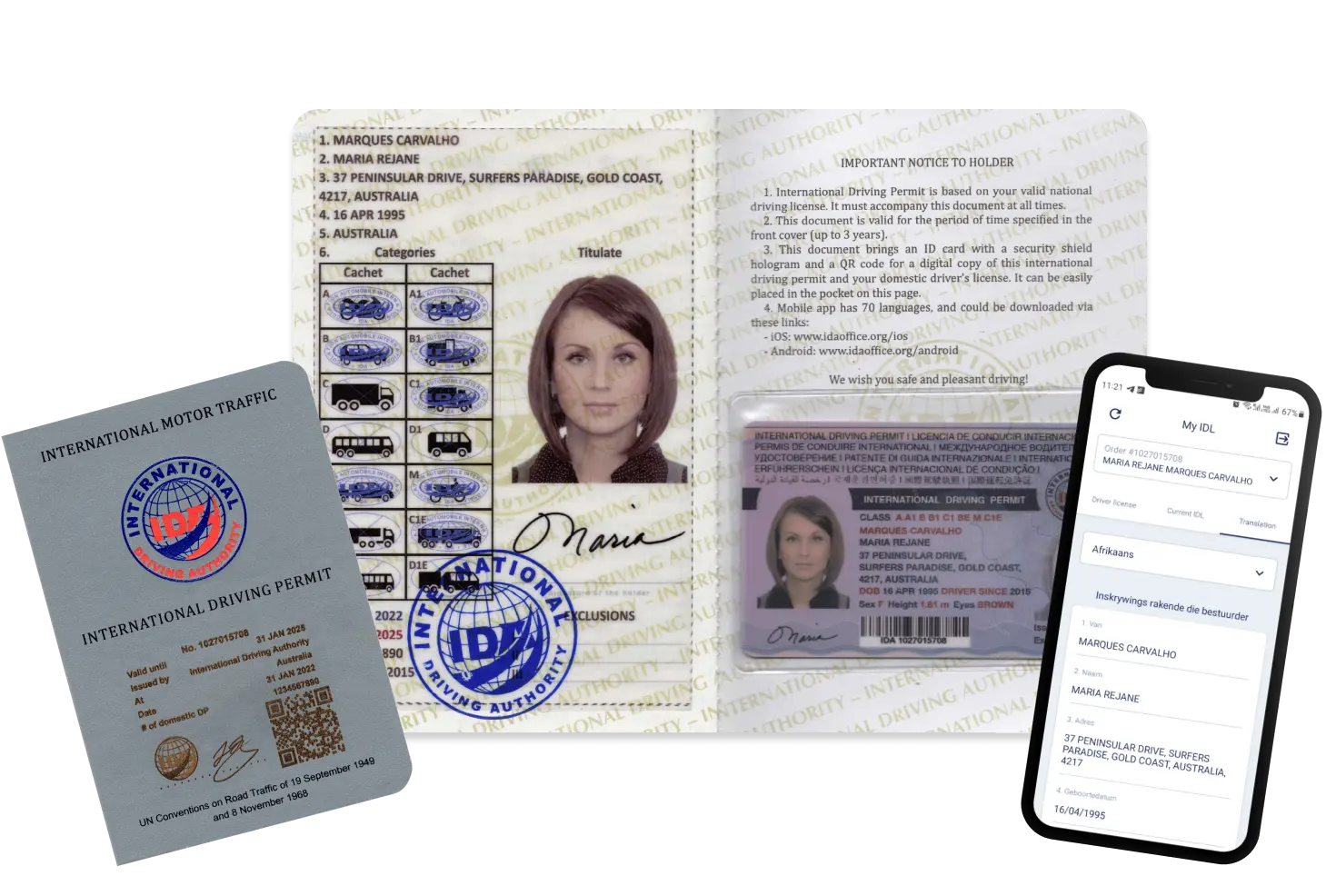
- The United Nations Standard International Driving Permit includes a plastic ID card, a booklet and a mobile application for Android and iOS with the translation into 70 languages (29 in a booklet and all 70 in a mobile app). The IDP is made in compliance with United Nations Conventions on road traffic standards for document size, color, format, etc.
-
Electronic International Driving License
- The Electronic International Driving License or eIDL includes a printable PDF document of a booklet and a mobile application for Android and iOS with the translation into 70 languages.
- De jure, according to the United Nations Convention on road traffic, physical copy of IDL is mandatory, as there is no such notion in the UN Convention as an eIDL yet. De facto we and our clients used digital version many times, and road police and car rentals accept it. However, we advise you to choose the United Nations standard IDP if you have enough time for delivery.
- Cancelation and refund are possible only until your order is not processed. Once an order is processed, and an email with eIDL is submitted to you, our service is completed, and the respective PDF file shall be considered exploited and shall become non-redeemable.

How to get an International Driving Permit in Kosovo?
According to the Vienna Convention of 1968, International Driving Permits (IDPs) are authorized to be issued by national governments or designated organizations. In most countries, this function is carried out by automobile associations affiliated with the AIT/FIA, the police, or other authorized entities. To obtain an International Driving Permit in Kosovo, you must possess a local license and apply to the relevant authorities here (please notify us if the link is not working). The cost and processing time for an IDP vary by country.
If you hold a national license not issued in Kosovo, you must verify if your license permits you to drive and if you require an IDP. If an IDP is necessary, the only option is to order a translation of your driver's license, available either via delivery or as an electronic version (confirm with the rental car company if an electronic version is acceptable), for example, through our services.
For U.S. citizens with only a U.S. driver's license, you can obtain an IDP from AAA, but it must be done before traveling to Kosovo!
FAQ
How to get an International Driving Permit in Kosovo?
expand_more
If you have a local license and want to travel, contact a competent organization. If you are an American and plan to travel in advance, you can get an IDP from AAA. In other cases, you can have your driver's license translated into the required languages so that you can travel with your national license and its translation.
How to apply for International Driving Permit?
expand_more
Our application process is fast and simple. Complete the IDP application form, attach a copy of your valid driver's license, your handwritten signature and a color ID photo, and make the payment. You can apply for an IDP online here.
Do I need an International Driving Permit for Kosovo?
expand_more
Kosovo has not unified its driving license in accordance with the 1968 Vienna Convention. Drivers from other countries need an International Driving License, unless Kosovo and the country that issued your license have an additional agreement on the recognition of driving licenses.
Can I drive in Kosovo with a US license?
expand_more
You can only drive in Kosovo with your driver's license if you have a valid International Driving Permit (IDP). Additional information for traveling U.S. citizens can be found on the government website.
Can an American drive in Kosovo?
expand_more
To drive an American in Kosovo, you must have an International Driving Permit (IDP). Additional information for traveling U.S. citizens can be found on the government website.
What is the International Driver's Document?
expand_more
Our IDD is ideal for travelers visiting multilingual destinations. No test is required, and the IDD is valid for up to three years. This document is used in conjunction with, but does not replace, your valid national license; it is a translation of your driver’s license in three formats.
Can I rent a car with this document?
expand_more
Usually, yes. However, as requirements vary from region to region, you are advised to inquire directly with car rental companies.
Can I purchase car insurance with the IDD?
expand_more
Usually, yes. However, as requirements vary from region to region, you are advised to inquire directly with local insurances companies.
What do you need to know to drive in Kosovo?
🗓 Facts checked against Kosovo's road-traffic law and official sources. Research last updated: . You may copy this information only if you provide a link back to this page.
⚠ This page is general information about driving rules, not legal advice. Rules change, and each authority applies its own — confirm your case with the relevant authority before you drive.
ℹ We are a private company. We are not a government body, a licensing or issuing authority, or a treaty organisation, and we are not affiliated with, endorsed by, or acting for any of them. The International Driver's Document we sell is a translation of your national driving licence: it is not a driving licence, and it is not a government-issued document.
- Driving in Kosovo: key facts
- Do you need an International Driving Permit in Kosovo?
- What side of the road does Kosovo drive on?
- How long can you drive in Kosovo with a foreign licence?
- Is Kosovo a party to the 1949 or 1968 Road Traffic Convention?
- Why acceptance of your licence varies from place to place
- Can you drive in Kosovo with your country's licence?
- Where to get an International Driving Permit
- Moving to Kosovo? Rules for new residents
- Driving rules in Kosovo tourists get fined for
- Read more about driving in Kosovo
- Sources
Driving in Kosovo: key facts
| Question | Answer |
|---|---|
| Side of the road | Right |
| International Driving Permit (IDP) | Not required for 231 of the 240 origin licences, 9 of which have no established rule — see the row for your country of issue, in the table below |
| UN Road Traffic Conventions | Party to neither convention |
| Time limit for visitors | Kosovo's Law on Road Traffic Rules lets a holder of a valid foreign licence drive (Art. 231(1)) and names no visitor period; neither does the Law on Driving Licence. |
| Minimum age | 18 to drive — Law No. 05/L-064 on Driving Licence, Art. 82(1.2): 18 is the minimum age to take the exam for categories A2, B and BE |
| Alcohol limit | The limit is 0.5 g/kg of alcohol in the blood for drivers of cars and motorcycles, and zero for drivers aged up to 24, drivers in their first two years, professional drivers and drivers of trucks and buses. |
| Speed limits | Law No. 08/L-186 on Road Traffic Rules sets 50 km/h in built-up areas unless signs say otherwise (Art. 52(1)). Outside built-up areas the maximum is 130 km/h on motorways, 110 km/h on expressways, 100 km/h on national roads with two physically separated lanes in each direction, and 80 km/h on other national roads and on regional and local roads, or less where signs say so (Art. 53(1)). Novice drivers, whose licence is less than two years old, may not exceed 110 km/h on motorways, 80 km/h on expressways and 70 km/h on other roads (Art. 235(1)). Reduce well below these for poor surfaces, rural roads, night driving, winter conditions, flooding and landslide risk. |
| Emergency number | Dial 112 for emergency services. For an ambulance, dial 94 from a landline or 194 from a mobile. |
Do you need an International Driving Permit in Kosovo?
No IDP is required from any visitor. Kosovo is not a contracting party to the 1949 Geneva or 1968 Vienna Convention, but its Law No. 08/L-186 on Road Traffic Rules states that through it both conventions are applied unilaterally in Kosovo (Art. 1(2)). Law No. 05/L-064 on Driving Licence defines the international driving permit that Kosovo issues for driving abroad by reference to the 1968 Vienna Convention (Art. 3(1.3)). Neither law says which IDP edition, if any, Kosovo accepts from a visitor: check with the authorities before you rely on one. Art. 98(2) of Law No. 05/L-064 states 'International driving licence is not allowed to be used as a document while driving within the Republic of Kosovo', with a EUR 130 fine under Art. 98(4). Always carry the original national licence.
- Tourists and short-term visitors: carry your national licence together with the document named in the row for your country of issue, in the table below — for most origin licences that document is not an IDP, so read your own answer rather than assuming one.
No specific penalty for driving without the required document was verified from an authoritative source. Official source.
What side of the road does Kosovo drive on?
Kosovo drives on the right-hand side of the road, and overtaking is done on the left. Cars in Kosovo are left-hand drive.
How long can you drive in Kosovo with a foreign licence?
Kosovo's Law on Road Traffic Rules lets a holder of a valid foreign licence drive (Art. 231(1)) and names no visitor period; neither does the Law on Driving Licence. The only statutory one-year clock, in Art. 106 of the Law on Driving Licence, is a residence clock: it runs for 'a foreigner to whom has been granted a temporary or permanent residence', returning Kosovo citizens, and the staff of diplomatic and consular representations, foreign missions, international organisations, foreign trade, transport, cultural and other representations and foreign correspondents' offices, who 'can drive the vehicle on the basis of a foreign valid drivers licence for the period up to one (1) year from the date of entry into Kosovo'. Do not read that year as a tourist allowance. A separate and much shorter clock governs the vehicle rather than the licence: a foreign-registered car may be driven in Kosovo for three months at most from entry, and in some cases for only eight days (Law No. 05/L-132 on Vehicles, Art. 41; see the driving rules below). (Law No. 08/L-186, Art. 231(1) (driving on a valid foreign licence); Law No. 05/L-064, Art. 106 (residence clock); neither law states a visitor period)
Planning to move to Kosovo? Different rules apply once you become a resident — see the residents section below.
Is Kosovo a party to the 1949 or 1968 Road Traffic Convention?
Kosovo is party to neither the 1949 Geneva Convention nor the 1968 Vienna Convention on Road Traffic. National law nonetheless states that both conventions are applied unilaterally in Kosovo (Law No. 08/L-186 on Road Traffic Rules, Art. 1(2)); that law does not say which International Driving Permit edition is accepted from visitors.
Why acceptance of your licence varies from place to place
Whether a foreign country accepts your driving licence hangs on a tangle of variables: three different road-traffic conventions signed decades apart (1926, 1949, 1968) — the oldest predates the United Nations itself, and only the latter two were concluded under it — countries at different stages of joining each (signed vs. accepted vs. ratified), licences printed in alphabets local police can't read, vehicle-category systems that don't line up between countries, document generations that may not meet a convention's format even when the country is a member, bilateral deals between individual states, and local laws that are looser in one place and stricter in the next. The same licence can be fine at one border and rejected at the next — even at the next rental desk. The International Driving Permit exists to cut through most of it: a standardized, multilingual presentation of your existing licence, with harmonized category symbols, that most officials can read at a glance. It doesn't replace your national licence or grant new rights — you carry both — and it doesn't guarantee acceptance: a handful of destinations still require a local permit alongside or instead of it, but for most it meaningfully improves your odds.
Can you drive in Kosovo with your country's licence?
This table is for tourists and temporary visitors. Moving to Kosovo as a resident? Different rules apply — see the residents section below. Find your licence's country of issue below. Kosovo sits outside both road-traffic conventions and outside the Green Card insurance system, so everything here is driven by its own laws rather than by any treaty obligation. Its Law No. 08/L-186 on Road Traffic Rules lets a visitor from any country drive on a valid foreign national licence (Art. 231(1)), and neither that law nor Law No. 05/L-064 on Driving Licence names a visitor period or requires an IDP. Two traps: the one-year figure people quote is a residence clock, not a tourist allowance; and an international driving permit may not be used as the driving document inside Kosovo at all, at a EUR 130 fine, so the original licence must always be in the car. Green Card insurance is invalid — border third-party cover has to be bought on entry. Rules change — confirm with official sources before you travel. Last verified: October 2026.
Legend: "1949" — Geneva Convention on Road Traffic (IDP valid up to 1 year); "1968" — Vienna Convention (IDP valid up to 3 years).
What the Status column means on this page:
- National licence OK — the destination lets a visitor drive on the national licence itself. The row for your country of issue, in the table below, gives the basis, and any period or condition that qualifies it.
- National licence OK — IDP advised — the destination does not require an IDP for this licence, but carrying one is advised. The row for your country of issue, in the table below, gives the reason and any conditions attached.
- National licence OK — IDD/translation advised — the destination does not require an IDP for this licence, and no official convention IDP can be issued for it; carry an IDD or a certified translation instead. The row for your country of issue, in the table below, gives the reason and any conditions attached.
- Not established — the record does not settle whether you may drive here on this licence; confirm with the destination's licensing authority before you rely on it. The row for your country of issue, in the table below, says what could not be confirmed.
Show the full list, all 240
| Country of licence | # |
|---|---|
| Abkhazia | 10 |
| Afghanistan | 4 |
| Albania | 1 |
| Algeria | 1 |
| American Samoa | 2 |
| Andorra | 1 |
| Angola | 1 |
| Antigua and Barbuda | 7 |
| Argentina | 1 |
| Armenia | 1 |
| Aruba | 1 |
| Australia | 2 |
| Austria | 1 |
| Azad Kashmir | 10 |
| Azerbaijan | 1 |
| Bahamas | 2 |
| Bahrain | 2 |
| Bangladesh | 2 |
| Barbados | 2 |
| Belarus | 1 |
| Belgium | 1 |
| Belize | 2 |
| Benin | 1 |
| Bermuda | 2 |
| Bhutan | 2 |
| Bolivia | 2 |
| Bosnia and Herzegovina | 1 |
| Botswana | 1 |
| Brazil | 1 |
| British Virgin Islands | 2 |
| Brunei | 2 |
| Bulgaria | 1 |
| Burkina Faso | 1 |
| Burundi | 1 |
| Cambodia | 1 |
| Cameroon | 1 |
| Canada | 2 |
| Cape Verde | 1 |
| Caribbean Netherlands | 1 |
| Cayman Islands | 2 |
| Central African Republic | 1 |
| Chad | 5 |
| Chile | 2 |
| China | 8 |
| Colombia | 2 |
| Comoros | 9 |
| Congo (Brazzaville) | 1 |
| Congo (Democratic Rep.) | 1 |
| Cook Islands | 2 |
| Costa Rica | 2 |
| Croatia | 1 |
| Cuba | 1 |
| Curacao | 1 |
| Cyprus | 1 |
| Czech Republic | 1 |
| Denmark | 1 |
| Djibouti | 1 |
| Dominica | 2 |
| Dominican Republic | 2 |
| East Timor | 1 |
| Ecuador | 2 |
| Egypt | 3 |
| El Salvador | 2 |
| Equatorial Guinea | 1 |
| Eritrea | 8 |
| Estonia | 1 |
| Eswatini | 1 |
| Ethiopia | 3 |
| Falkland Islands | 1 |
| Faroe Islands | 1 |
| Fiji | 2 |
| Finland | 1 |
| France | 1 |
| French Guiana | 1 |
| French Polynesia | 1 |
| Gabon | 1 |
| Gambia | 1 |
| Georgia | 1 |
| Germany | 1 |
| Ghana | 1 |
| Gibraltar | 1 |
| Greece | 1 |
| Greenland | 1 |
| Grenada | 7 |
| Guadeloupe | 1 |
| Guam | 2 |
| Guatemala | 2 |
| Guernsey | 1 |
| Guinea | 1 |
| Guinea Bissau | 1 |
| Guyana | 2 |
| Haiti | 1 |
| Honduras | 2 |
| Hong Kong | 2 |
| Hungary | 1 |
| Iceland | 1 |
| India | 2 |
| Indonesia | 2 |
| Iran | 3 |
| Iraq | 1 |
| Ireland | 1 |
| Israel | 1 |
| Italy | 1 |
| Ivory Coast | 1 |
| Jamaica | 2 |
| Japan | 3 |
| Jersey | 1 |
| Jordan | 2 |
| Kazakhstan | 1 |
| Kenya | 1 |
| Kiribati | 1 |
| Kuwait | 2 |
| Kyrgyzstan | 1 |
| Laos | 1 |
| Latvia | 1 |
| Lebanon | 2 |
| Lesotho | 1 |
| Liberia | 1 |
| Libya | 4 |
| Liechtenstein | 1 |
| Lithuania | 1 |
| Luxembourg | 1 |
| Macau | 1 |
| Madagascar | 1 |
| Malawi | 1 |
| Malaysia | 2 |
| Maldives | 1 |
| Mali | 1 |
| Malta | 1 |
| Marshall Islands | 7 |
| Martinique | 1 |
| Mauritania | 1 |
| Mauritius | 2 |
| Mayotte Island | 1 |
| Mexico | 2 |
| Micronesia | 7 |
| Moldova | 1 |
| Monaco | 1 |
| Mongolia | 1 |
| Montenegro | 1 |
| Montserrat | 2 |
| Morocco | 1 |
| Mozambique | 1 |
| Myanmar | 2 |
| Nagorno-Karabakh | 10 |
| Namibia | 1 |
| Nauru | 1 |
| Nepal | 2 |
| Netherlands | 1 |
| New Caledonia | 1 |
| New Zealand | 2 |
| Nicaragua | 2 |
| Niger | 1 |
| Nigeria | 2 |
| Niue | 2 |
| Northern Cyprus | 10 |
| Northern Mariana Islands | 2 |
| North Korea | 8 |
| North Macedonia | 5 |
| Norway | 1 |
| Oman | 2 |
| Pakistan | 2 |
| Palau | 7 |
| Palestine | 6 |
| Panama | 2 |
| Papua New Guinea | 2 |
| Paraguay | 1 |
| Peru | 2 |
| Philippines | 1 |
| Poland | 1 |
| Portugal | 1 |
| Puerto Rico | 2 |
| Qatar | 2 |
| Reunion | 1 |
| Romania | 1 |
| Russian Federation | 1 |
| Rwanda | 1 |
| Sahrawi Republic | 10 |
| Saint Martin | 1 |
| Saint Pierre and Miquelon | 1 |
| Samoa | 7 |
| San Marino | 1 |
| São Tomé and Príncipe | 1 |
| Saudi Arabia | 2 |
| Senegal | 1 |
| Serbia | 1 |
| Seychelles | 1 |
| Sierra Leone | 1 |
| Singapore | 2 |
| Sint Maarten | 1 |
| Slovak Republic | 1 |
| Slovenia | 1 |
| Solomon Islands | 7 |
| Somalia | 1 |
| Somaliland | 10 |
| South Africa | 1 |
| South Korea | 2 |
| South Ossetia | 10 |
| South Sudan | 1 |
| Spain | 1 |
| Sri Lanka | 1 |
| St. Kitts and Nevis | 2 |
| St. Lucia | 2 |
| St. Vincent | 2 |
| Sudan | 2 |
| Suriname | 1 |
| Sweden | 1 |
| Switzerland | 1 |
| Syria | 3 |
| Taiwan | 3 |
| Tajikistan | 1 |
| Tanzania | 1 |
| Thailand | 2 |
| Togo | 1 |
| Tokelau Islands | 6 |
| Tonga | 2 |
| Transnistria | 10 |
| Trinidad and Tobago | 2 |
| Tunisia | 1 |
| Turkey | 1 |
| Turkmenistan | 1 |
| Turks and Caicos Islands | 2 |
| Tuvalu | 1 |
| Uganda | 1 |
| Ukraine | 1 |
| United Arab Emirates | 2 |
| United Kingdom | 1 |
| United States of America | 2 |
| Uruguay | 2 |
| U.S. Virgin Islands | 2 |
| Uzbekistan | 1 |
| Vanuatu | 1 |
| Vatican | 1 |
| Venezuela | 2 |
| Vietnam | 1 |
| Wallis and Futuna | 1 |
| Western Sahara | 10 |
| Yemen | 2 |
| Zambia | 1 |
| Zimbabwe | 2 |
| # | Status | Country of licence | What you need to carry | Why |
|---|---|---|---|---|
| 1 | National licence OK | Albania, Algeria, Andorra, Angola, Argentina, Armenia, Aruba, Austria, Azerbaijan, Belarus, Belgium, Benin, Bosnia and Herzegovina, Botswana, Brazil, Bulgaria, Burkina Faso, Burundi, Cambodia, Cameroon, Cape Verde, Caribbean Netherlands, Central African Republic, Congo (Brazzaville), Congo (Democratic Rep.), Croatia, Cuba, Curacao, Cyprus, Czech Republic, Denmark, Djibouti, East Timor, Equatorial Guinea, Estonia, Eswatini, Falkland Islands, Faroe Islands, Finland, France, French Guiana, French Polynesia, Gabon, Gambia, Georgia, Germany, Ghana, Gibraltar, Greece, Greenland, Guadeloupe, Guernsey, Guinea, Guinea Bissau, Haiti, Hungary, Iceland, Iraq, Ireland, Israel, Italy, Ivory Coast, Jersey, Kazakhstan, Kenya, Kiribati, Kyrgyzstan, Laos, Latvia, Lesotho, Liberia, Liechtenstein, Lithuania, Luxembourg, Macau, Madagascar, Malawi, Maldives, Mali, Malta, Martinique, Mauritania, Mayotte Island, Moldova, Monaco, Mongolia, Montenegro, Morocco, Mozambique, Namibia, Nauru, Netherlands, New Caledonia, Niger, Norway, Paraguay, Philippines, Poland, Portugal, Reunion, Romania, Russian Federation, Rwanda, Saint Martin, Saint Pierre and Miquelon, San Marino, São Tomé and Príncipe, Senegal, Serbia, Seychelles, Sierra Leone, Sint Maarten, Slovak Republic, Slovenia, Somalia, South Africa, South Sudan, Spain, Sri Lanka, Suriname, Sweden, Switzerland, Tajikistan, Tanzania, Togo, Tunisia, Turkey, Turkmenistan, Tuvalu, Uganda, Ukraine, United Kingdom, Uzbekistan, Vanuatu, Vatican, Vietnam, Wallis and Futuna, Zambia (138) | Your national licence (No statutory visitor limit; residents/returnees: 1 year from entry (Law 05/L-064, Art. 106).) | Any valid foreign licence is accepted by law [1] |
| 2 | National licence OK — IDP advised | American Samoa, Australia, Bahamas, Bahrain, Bangladesh, Barbados, Belize, Bermuda, Bhutan, Bolivia, British Virgin Islands, Brunei, Canada, Cayman Islands, Chile, Colombia, Cook Islands, Costa Rica, Dominica, Dominican Republic, Ecuador, El Salvador, Fiji, Guam, Guatemala, Guyana, Honduras, Hong Kong, India, Indonesia, Jamaica, Jordan, Kuwait, Lebanon, Malaysia, Mauritius, Mexico, Montserrat, Myanmar, Nepal, New Zealand, Nicaragua, Nigeria, Niue, Northern Mariana Islands, Oman, Pakistan, Panama, Papua New Guinea, Peru, Puerto Rico, Qatar, Saudi Arabia, Singapore, South Korea, St. Kitts and Nevis, St. Lucia, St. Vincent, Sudan, Thailand, Tonga, Trinidad and Tobago, Turks and Caicos Islands, United Arab Emirates, United States of America, Uruguay, U.S. Virgin Islands, Venezuela, Yemen, Zimbabwe (70) | Your national licence (No statutory visitor limit; residents/returnees: 1 year from entry (Law 05/L-064, Art. 106).); an IDP is advisable | Any valid foreign licence is accepted by law [1] [a] |
| 3 | National licence OK — IDP advised | Egypt, Ethiopia, Iran, Japan, Syria, Taiwan (6) | Your national licence (No statutory visitor limit; residents/returnees: 1 year from entry (Law 05/L-064, Art. 106).); an IDP is strongly advisable | Any valid foreign licence is accepted by law [1]; your licence has no Latin-script data — an IDP sets out its details in the standard international form [a] |
| 4 | National licence OK — IDP advised | Afghanistan, Libya (2) | Your national licence (No statutory visitor limit; residents/returnees: 1 year from entry (Law 05/L-064, Art. 106).); an IDP is strongly advisable | Any valid foreign licence is accepted by law [1]; your licence has no Latin-script data — an IDP sets out its details in the standard international form |
| 5 | National licence OK — IDP advised | Chad, North Macedonia (2) | Your national licence (No statutory visitor limit; residents/returnees: 1 year from entry (Law 05/L-064, Art. 106).); an IDP is advisable | Any valid foreign licence is accepted by law [1]; licence format not independently verified for this country |
| 6 | National licence OK — IDP advised | Palestine, Tokelau Islands (2) | Your national licence (No statutory visitor limit; residents/returnees: 1 year from entry (Law 05/L-064, Art. 106).); an IDP is advisable | Any valid foreign licence is accepted by law [1]; licence format not independently verified for this country [a] |
| 7 | National licence OK — IDD/translation advised | Antigua and Barbuda, Grenada, Marshall Islands, Micronesia, Palau, Samoa, Solomon Islands (7) | Your national licence (No statutory visitor limit; residents/returnees: 1 year from entry (Law 05/L-064, Art. 106).); no official convention IDP is issued for it — carry an IDD/translation [b] | Any valid foreign licence is accepted by law [1] [a] |
| 8 | National licence OK — IDD/translation advised | China, Eritrea, North Korea (3) | Your national licence (No statutory visitor limit; residents/returnees: 1 year from entry (Law 05/L-064, Art. 106).); no official convention IDP is issued for it — carry an IDD/translation [b] | Any valid foreign licence is accepted by law [1]; your licence has no Latin-script data — a certified translation sets out its details [a] |
| 9 | National licence OK — IDD/translation advised | Comoros (1) | Your national licence (No statutory visitor limit; residents/returnees: 1 year from entry (Law 05/L-064, Art. 106).); no official convention IDP is issued for it — carry an IDD/translation [b] | Any valid foreign licence is accepted by law [1]; licence format not independently verified for this country |
| 10 | Not established | Abkhazia, Azad Kashmir, Nagorno-Karabakh, Northern Cyprus, Sahrawi Republic, Somaliland, South Ossetia, Transnistria, Western Sahara (9) | Check with local authorities before travel | The recognition norm covers foreign-state-issued licences; this issuer’s statehood is not generally recognized — validity not established |
Sources and notes for the table above
[1] Law No. 08/L-186 on Road Traffic Rules, Art. 231(1) (Official Gazette No. 6 / 18 March 2024); Law No. 05/L-064 on Driving Licence, Arts. 97, 98 and 106 (Official Gazette No. 17 / 10 June 2016)
[a] Licence categories do not follow the convention A–E scheme — rental staff may ask for an IDP to map them.
[b] IDD = International Driver's Document, a standardized translation of your national driving licence. You can apply here: https://idaoffice.org/apply-now/.
Where to get an International Driving Permit
An International Driving Permit must be obtained before you travel, and only certain countries may issue one to you — you cannot buy an official IDP from an unrelated country. Under the 1968 Vienna Convention it may be issued only by the Contracting Party where you normally reside and which issued or recognizes your licence — by that Party's competent authority or by an association it has duly empowered. Under the 1949 Geneva Convention it is issued by the competent authority of a Contracting State, or by an association that authority has duly empowered. Which body that is varies by country: a government agency in some, an authorized motoring club in others.
- Travelling from Kosovo? Kosovo's IDPs are issued by Ministry of Internal Affairs (Document Issuance Centres). Official site. Kosovo is party to neither road-traffic convention, so the permit is issued outside the UN convention framework and is not an official convention IDP — check that your destination accepts it.
- Travelling from another country? Ask that country's driving-licence authority which body it authorizes to issue IDPs — a government agency in some countries, an authorized motoring club in others.
Separately, IDA offers a digital International Driver's Document — a translation of your national licence that you carry alongside it. It is not an International Driving Permit issued under the 1949 or 1968 conventions by the body your country authorizes for that purpose, and it is not a certified, sworn or otherwise official translation: no authority certifies it, and where a country requires an official or certified translation by law, our document does not satisfy that requirement. It is a private translation meant to make your national licence readable at rental desks and roadside checks.
Moving to Kosovo? Rules for new residents
Two distinct steps. (1) Grace period: under Law No. 05/L-064 Art. 106(1), a foreigner granted temporary or permanent residence, a Kosovo citizen returning from abroad, and the staff of diplomatic and consular representations, foreign missions, international organisations, foreign trade, transport, cultural and other representations and foreign correspondents' offices 'can drive the vehicle on the basis of a foreign valid drivers licence for the period up to one (1) year from the date of entry into Kosovo'. Art. 106(2) carves out UN, KFOR and OSCE representatives, for whom bilateral arrangements may say otherwise. (2) Exchange: after that year a Kosovo licence is needed. Official source.
Driving rules in Kosovo tourists get fined for
- Mandatory equipment: Cars, trucks and buses must carry a first-aid kit, a warning triangle, a towing device and a reflective vest, all complete and within their expiry date, and a fire extinguisher where other legislation requires one; the fine for missing equipment is EUR 30 (Law No. 08/L-186, Art. 207(1) and (4)). From 15 November to 15 March, vehicles must have winter equipment, at a EUR 40 fine (Art. 227(1) and (5)); for vehicles up to 3.5 t this means winter tyres with at least 4 mm of tread on all wheels, and studded tyres are not allowed (Administrative Instruction (MESPI) No. 09/2025 on winter equipment, Art. 5). Headlamp converters are required for right-hand-drive vehicles, and spare bulbs are widely recommended. Carry the original national licence, passport, vehicle registration, rental agreement and the Kosovo-valid border insurance policy.
- Drink-driving: The limit is 0.5 g/kg of alcohol in the blood for drivers of cars and motorcycles, and zero for drivers aged up to 24, drivers in their first two years, professional drivers and drivers of trucks and buses. Law No. 08/L-186 on Road Traffic Rules, Art. 233(2), sets the 0.5 g/kg limit, measured in the blood or as the corresponding value in exhaled air, for licence categories A1, A2, A, B, BE, T, L and AM; Art. 233(1) bars from driving under the influence of alcohol drivers of categories C1, C1E, C, CE, D1, D1E, D and DE, driving instructors, young drivers (aged up to 24), novice drivers (licence held for less than two years) and category B drivers who drive for a living, such as taxi and ambulance drivers. Do not drink and drive. Under Law No. 08/L-186, Art. 233, a driver is fined EUR 200 with a three-month driving ban and 2 penalty points for more than 0.5 g/kg and up to 1 g/kg, EUR 300 with six months and 2 points for more than 1 g/kg and up to 1.5 g/kg, EUR 400 with nine months and 3 points for more than 1.5 g/kg and up to 2 g/kg, and EUR 500 with twelve months and 3 points above 2 g/kg; a driver held to the zero limit is fined EUR 150 with a three-month ban and 1 point for any alcohol up to 0.5 g/kg. Refusing a breath, blood or urine test is fined EUR 150 with a six-month ban and 3 points, and the driver is then treated as having been under the influence of alcohol (Art. 241(9) and (11)). Police may also hold an impaired driver for up to 12 hours and have the vehicle moved at the driver's or owner's cost (Art. 241(8)). A driving ban on a foreign licence applies within Kosovo and, with the driver's consent, can be converted into a payment of twice the fine (Art. 252).
- Speed limits: Law No. 08/L-186 on Road Traffic Rules sets 50 km/h in built-up areas unless signs say otherwise (Art. 52(1)). Outside built-up areas the maximum is 130 km/h on motorways, 110 km/h on expressways, 100 km/h on national roads with two physically separated lanes in each direction, and 80 km/h on other national roads and on regional and local roads, or less where signs say so (Art. 53(1)). Novice drivers, whose licence is less than two years old, may not exceed 110 km/h on motorways, 80 km/h on expressways and 70 km/h on other roads (Art. 235(1)). Reduce well below these for poor surfaces, rural roads, night driving, winter conditions, flooding and landslide risk.
- Green Card insurance is worthless in Kosovo — buy border third-party insurance. UK travel advice states verbatim: 'European green card vehicle insurance is not valid. You should buy local third-party insurance at the border or from the nearest town at the earliest opportunity.' The Kosovo Insurance Bureau sells it at the crossings (Merdare, Hani i Elezit, Vermica and others) and online. The only mutual-recognition exceptions are memoranda with Albania, North Macedonia, Montenegro and Serbia.
- Carry the original national licence at all times. An international driving permit may not serve as the driving document inside Kosovo — Law No. 05/L-064 Art. 98(2) prohibits it and Art. 98(4) sets a EUR 130 minor-offence fine.
- The vehicle has its own clock, separate from the licence. Under Law No. 05/L-132 on Vehicles, Art. 41, as the Ministry of Internal Affairs sets it out for visitors, a foreign-registered vehicle owned by a foreign citizen may be driven in Kosovo for up to three months from the date of entry, as may one owned by a Kosovo citizen living abroad who can show a residence permit there; a person who has no residence in the country the vehicle comes from may drive it for up to eight days. A foreign-registered vehicle owned by a Kosovo citizen living abroad may not be driven by another Kosovo citizen without the owner present, unless that driver also lives in the vehicle's country and holds an authorisation from it. Breaking these rules carries a EUR 200 fine. The ministry announced full enforcement from 15 March 2026.
- Registration marks can attract trouble. UK travel advice states verbatim: 'There have been some incidents where Serbian-registered hire cars have been targeted in more isolated areas of Kosovo'.
- Landmines and unexploded ordnance persist off the tarmac. UK travel advice states verbatim: 'There is a risk you could encounter landmines or other unexploded weapons when travelling in some remoter parts of Kosovo.' Stay on made roads.
- Road quality is uneven. UK travel advice states verbatim: 'Road standards vary from fair to poor. Roads are particularly bad in rural areas and after bad weather. There is a risk of landslides and flooding. Avoid travelling at night if possible. The quality of fuel varies'.
Read more about driving in Kosovo
Watch what driving in Kosovo looks like
A few minutes of real POV footage is the fastest way to feel confident before your first drive in Kosovo:
Open the video on YouTube if the player does not load.
Sources
- National road-traffic law
- Resident licence conversion rule
- Official Gazette record for Law No. 05/L-064, including its three amending laws
- Law No. 08/L-186 on Road Traffic Rules (18.03.2024) — current road-rules law, repealing Law No. 05/L-088
- Administrative Instruction (MIA) No. 07/2023 of 02.11.2023 on the procedure for obtaining a Kosovo driving licence
- Kosovo Insurance Bureau — why border insurance is required and which countries are exempt
- AMRKS border-insurance page — Green Card non-membership, points of sale
- UK FCDO Kosovo travel advice — transport risks, green-card invalidity, Serbian plates, landmines, road standards
- UK FCDO Kosovo health page — ambulance numbers 94 / 194
- RAC Kosovo driving guide (linked from UK travel advice) — BAC, speed limits, equipment, IDP recognised but not required
- Law No. 05/L-132 on Vehicles (Official Gazette No. 15 / 11 May 2017), Art. 41 — how long foreign-registered vehicles may be driven in Kosovo
- Kosovo Ministry of Internal Affairs notice of 16.01.2026 on foreign-registered vehicles — full enforcement from 15 March 2026
- Administrative Instruction (MESPI) No. 09/2025 on winter equipment — winter tyres from 15 November to 15 March
- Ministry of Internal Affairs (Document Issuance Centres) — authorized IDP issuer in Kosovo
- UN Treaty Collection — 1949 Geneva Convention on Road Traffic
- UN Treaty Collection — 1968 Vienna Convention on Road Traffic
