

Greece is famous for ancient civilization, mythology, democracy, philosophy, islands, Orthodox traditions, olive-oil-based cuisine, and a way of life shaped by the sea. UNESCO currently lists 20 World Heritage properties in Greece, including the Acropolis, Delphi, Olympia, Meteora, Mount Athos, and the Minoan Palatial Centres, which helps explain why the country is known not only for tourism, but for its enormous historical and cultural influence.
1. Athens
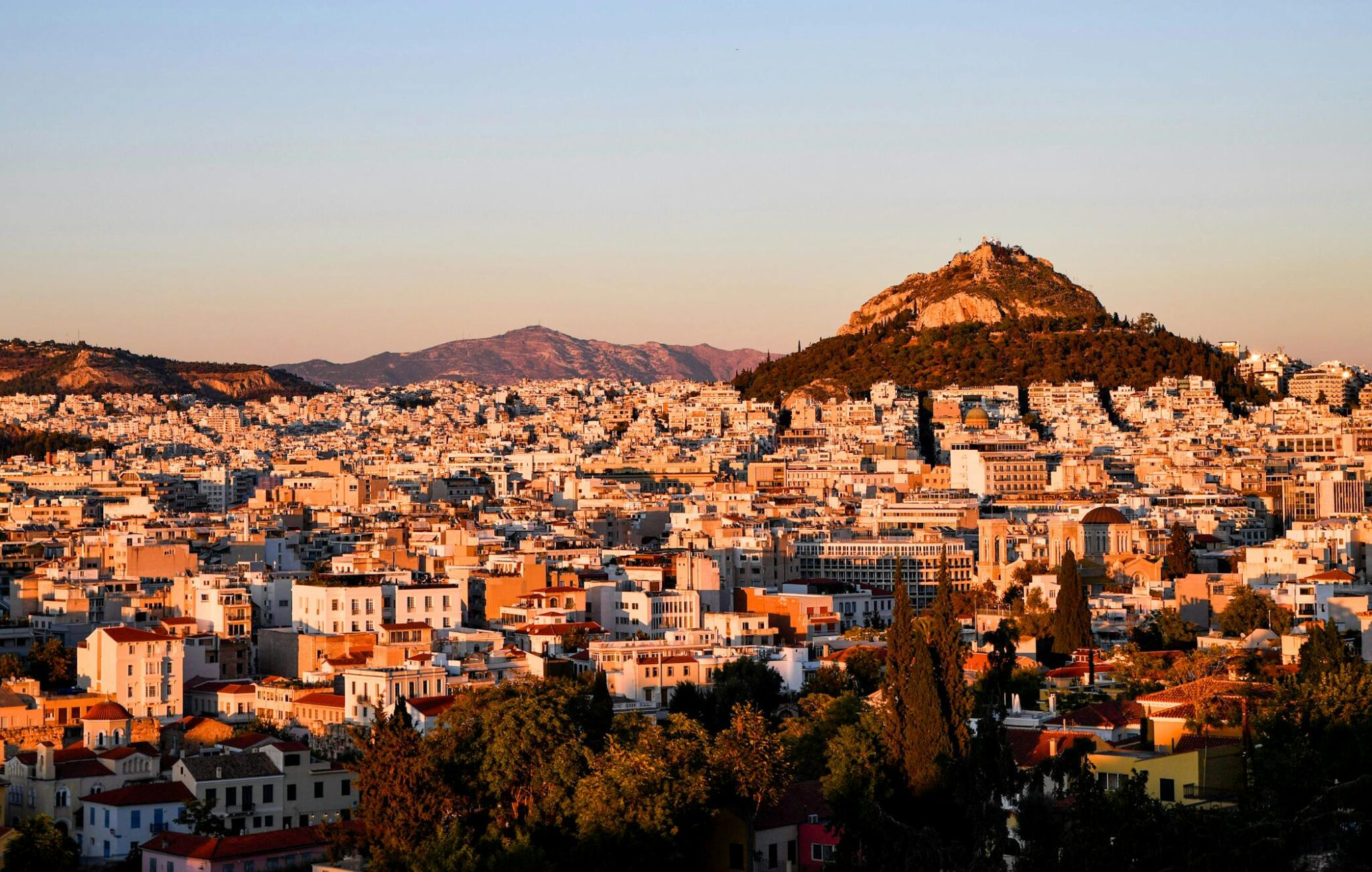
Athens is the first place many people connect with Greece because it concentrates so much of the country’s ancient identity in one city. Its recorded history stretches back around 3,400 years, and the Acropolis still gives the capital its strongest visual symbol: the Parthenon, the Propylaea, the Erechtheion and the Temple of Athena Nike all sit above a modern city that has grown around them. Athens is also tied to ideas that travel far beyond Greece itself – classical philosophy, theatre, civic debate, the first forms of democracy and the Olympic revival, with the city hosting the first modern Olympic Games in 1896 and again in 2004.
Its fame is not only historical. Athens is now a large Mediterranean capital where ancient sites, dense neighbourhoods, museums, cafés, street life and the port of Piraeus all function together. The wider metropolitan area had about 3.64 million residents in the 2021 census, while Athens International Airport handled a record 33.99 million passengers in 2025, up 6.7% from 2024. Those figures show why Athens is more than an entry point to the islands: it has become a major city-break destination in its own right, with Plaka, Monastiraki, the Acropolis Museum, Lycabettus Hill and the coastal districts giving visitors several versions of Greece in one urban area.
2. The Acropolis and the Parthenon
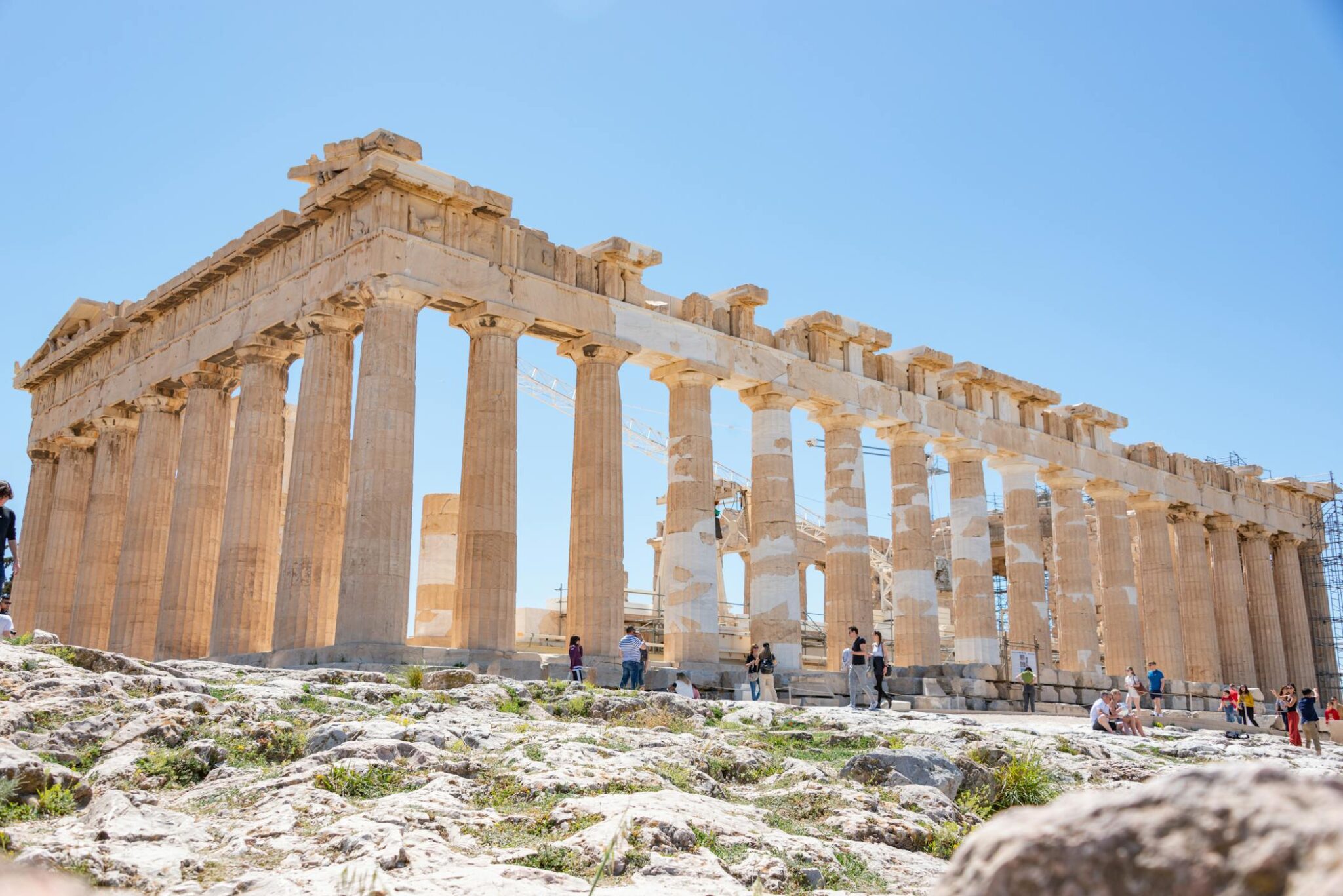
The Acropolis is the image of ancient Greece that even people who have never visited Athens usually recognize. It rises above the modern city as a compact sacred complex, not as a single monument: the Parthenon, the Propylaea, the Erechtheion and the Temple of Athena Nike all belong to the same 5th-century BC building programme. The Parthenon is the centre of that image. Built between 447 and 432 BC, it was dedicated to Athena and made from Pentelic marble brought from a quarry about 17 kilometres away. Its 46 outer columns, slight optical corrections and sculptural decoration turned it into the clearest surviving symbol of Classical Athens. In September 2025, scaffolding was removed from the western side, giving visitors a rare unobstructed view after decades of conservation work; lighter scaffolding was later planned as the final phase continued toward summer 2026.
3. Democracy, philosophy, and classical drama
Greek influence on world culture is often traced through Athens, where politics, public speech and intellectual life became unusually visible in the 5th and 4th centuries BC. Athenian democracy developed after the reforms of Cleisthenes around 508 BC, when political identity was reorganized around citizenship and local districts rather than old family clans. It was not democracy in the modern sense – women, enslaved people and foreigners were excluded – but the idea that citizens could debate, vote and take part directly in public decision-making became one of Greece’s most lasting historical associations. Pericles later gave that system its most famous political image, while the city’s courts, assemblies and public spaces made argument a normal part of civic life.
The same culture of argument helped make Athens a centre of philosophy, science and drama. Socrates, Plato and Aristotle turned questions about ethics, knowledge, politics and nature into texts and methods that are still taught today. Theatre grew in the same public world: tragedy flourished in 5th-century BC Athens through Aeschylus, Sophocles and Euripides, while Aristophanes gave comedy a sharp political and social voice.
4. Greek mythology and Mount Olympus
Greek mythology is one of the main reasons Greece is recognized far beyond its borders. Its stories are not tied to one monument or one city: they connect islands, mountains, sanctuaries, seas and ancient kingdoms into a shared cultural map. Zeus, Hera, Athena, Apollo, Artemis, Poseidon, Aphrodite, Hermes and the other Olympian gods became part of a storytelling system that explained power, nature, family, war, love, travel and fate. Many of the best-known sources were already ancient by the Classical period: Homer’s Iliad and Odyssey shaped the heroic world, while Hesiod’s Theogony, written around 700 BC, gave one of the clearest early accounts of the gods’ origins and relationships.
Mount Olympus gives those stories a real landscape. Rising to 2,918 metres at Mytikas, it is the highest mountain in Greece and was imagined as the home of the Olympian gods. The mountain also works as a natural symbol because it is not only mythological: it became Greece’s first national park in 1938, covers about 45 square kilometres, and contains around 1,700 plant species, including endemic species found only in that area. Litochoro, at its foot, remains the main starting point for hikes into the Enipeas Gorge and toward the high refuges.
5. Olympia, the Olympic Games, and Marathon
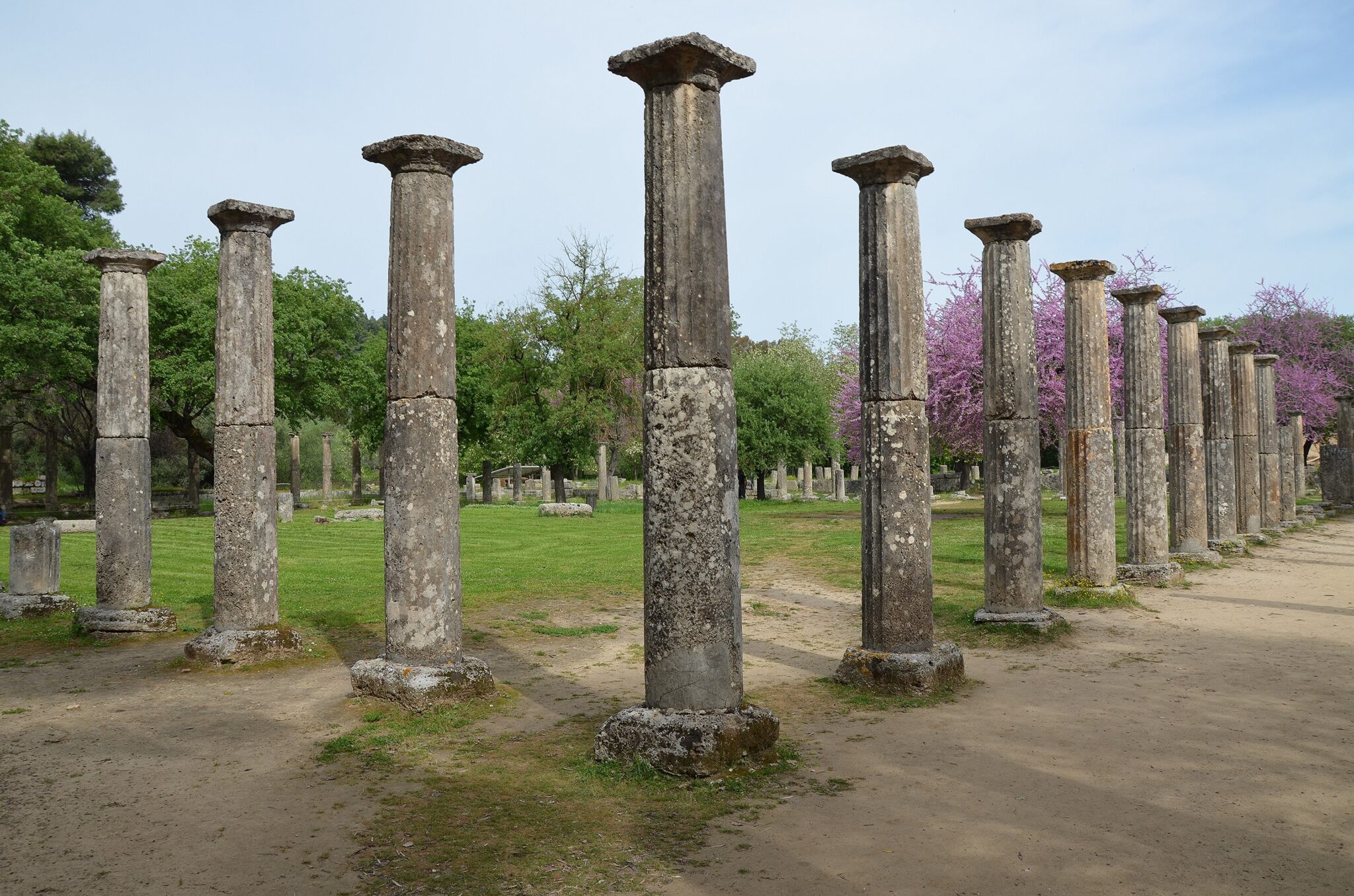
Olympia gives Greece one of the strongest links between ancient religion, sport and modern global culture. The sanctuary stood in the Peloponnese as a major place of worship for Zeus, and the Olympic Games were held there every four years beginning in 776 BC. The site was not only a stadium: it included temples, treasuries, training areas, baths and administrative buildings connected with the Games. The ancient festival was so important that the Olympiad, the four-year period between Games, became a way of measuring time in the Greek world.
The modern side of the story is just as closely tied to Greece. Athens hosted the first modern Olympic Games in 1896, and the marathon was created for that revival, inspired by the legendary run from Marathon to Athens after the battle of 490 BC. Today the Athens Marathon keeps that connection visible: the route starts in Marathon, passes the Tomb of the Marathon fighters, runs through Attica, and finishes inside the Panathenaic Stadium. The 2026 edition is scheduled for 8 November, with the event programme built around five races, about 75,000 runners, 15 support stations and 5,000 volunteers.
Carole Raddato from FRANKFURT, Germany, CC BY-SA 2.0 https://creativecommons.org/licenses/by-sa/2.0, via Wikimedia Commons
6. Delphi and the Oracle
Delphi gives Greece one of its strongest sacred landscapes: a mountain sanctuary on the slopes of Mount Parnassus, above the valley that leads toward the Gulf of Corinth. In antiquity, it was treated as the omphalos, the “navel” or symbolic centre of the world, and the oracle of Apollo made it one of the most influential religious places in the Greek world. Rulers, city-states and private visitors came to consult the Pythia before wars, colonisation, laws or major political decisions. By the 6th century BC, Delphi had become more than a local shrine; it functioned as a pan-Hellenic meeting point where religion, politics and prestige were tied together.
The site still feels important because its monuments were built into a dramatic route rather than placed on flat ground. Visitors move past treasuries, the Temple of Apollo, the theatre and the stadium, with each level opening wider views over the valley. The Pythian Games, held at Delphi from 586 BC, added music, poetry and athletic contests to its religious role, making the sanctuary a rival in status to Olympia.
7. The Greek islands
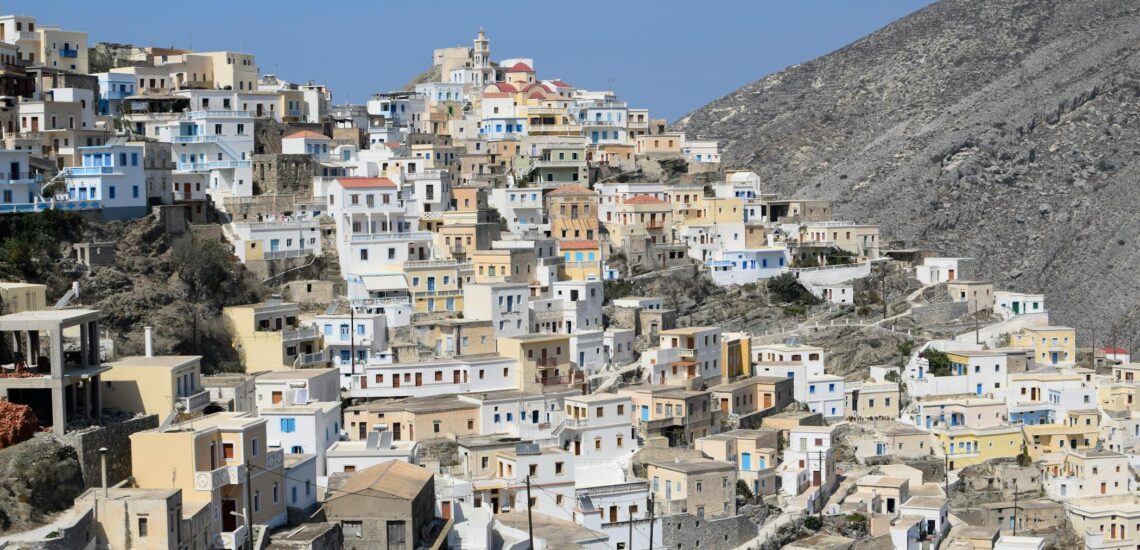
Greece has around 6,000 islands and islets, but only 227 are inhabited, scattered mainly across the Aegean and Ionian seas. They also account for about 7,500 kilometres of the country’s roughly 16,000 kilometres of coastline, which explains why beaches, ports, ferries and small harbours are so central to the Greek travel image. The islands are not one uniform product either: Crete is large enough to feel almost like a country within the country, the Cyclades are known for whitewashed villages and dry Aegean scenery, the Ionian Islands are greener, and the Dodecanese carry stronger eastern Mediterranean influences.
Their fame also comes from movement between them. Island-hopping works because ferries connect famous names such as Santorini, Mykonos, Naxos, Paros, Rhodes, Corfu, Kos, Zakynthos and Crete with smaller places that feel less exposed to mass tourism. This creates a travel style that is almost uniquely Greek: visitors can combine archaeology, beaches, fishing villages, nightlife, monasteries, hiking routes and local food without leaving the island network.
8. Santorini
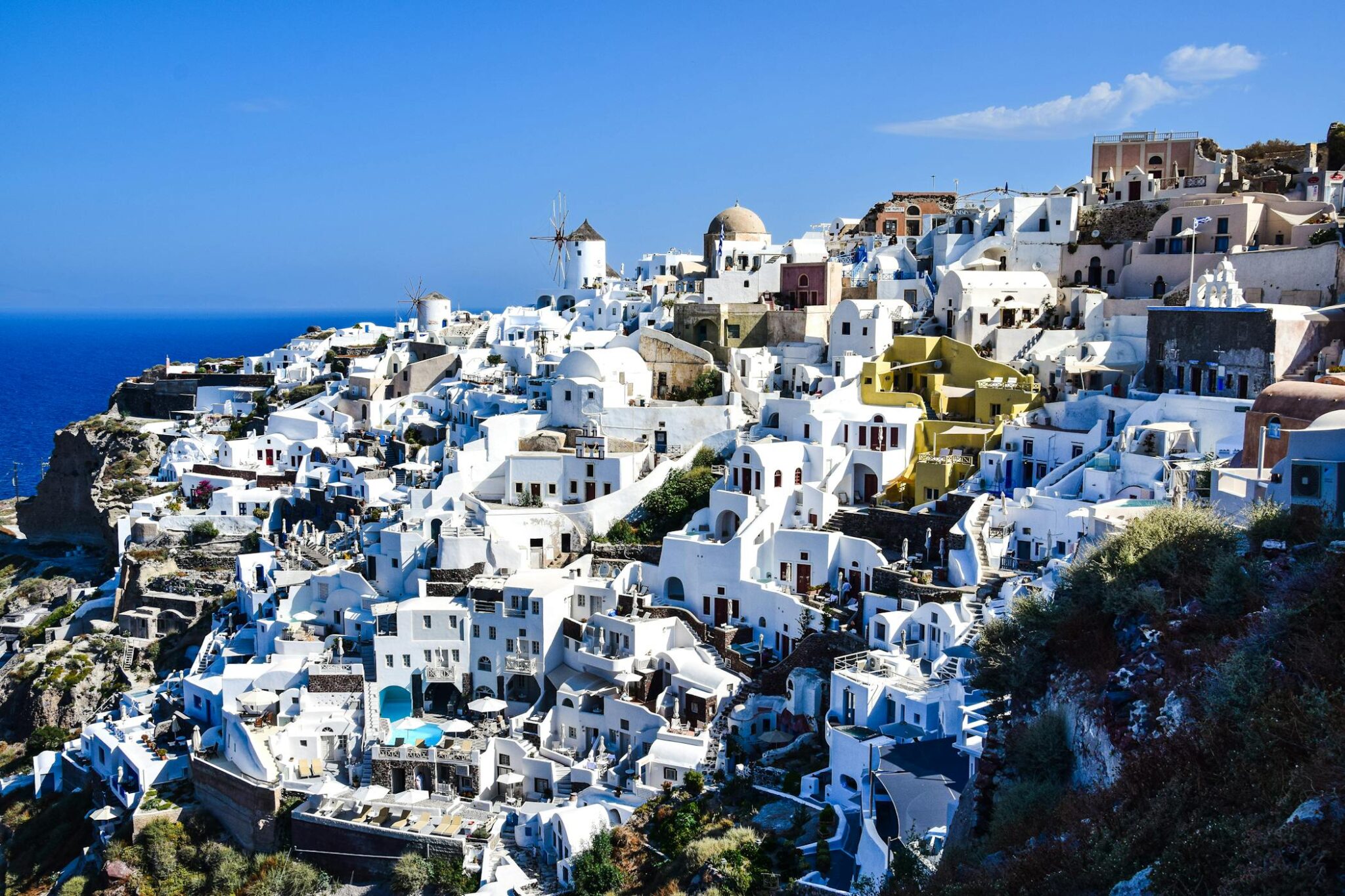
Santorini is Greece’s most recognizable island image because its beauty is tied to a dramatic geological event. The island is part of a volcanic group that includes Thira, Thirassia, Aspronisi, Palea Kameni and Nea Kameni, with the flooded caldera forming the view that made Oia, Fira and Imerovigli famous. The cliffs rise sharply above the Aegean, white houses sit along the rim, and the volcano is not just a backdrop: Santorini remains an active volcanic system, with the last eruption recorded in 1950. Santorini is small, but it receives visitor numbers closer to a major resort region than a single island. Before the 2025 earthquake disruptions, reporting on the island pointed to around 2.5–3.4 million annual visitors, while cruise arrivals alone reached about 1.34 million in 2024. This scale explains both the island’s global appeal and its current tourism debate: sunsets in Oia, caldera hotels, volcanic boat trips, black-sand beaches, Akrotiri and local Assyrtiko wine have made Santorini a bucket-list name, but crowding, construction and water pressure are now part of the same story.
9. Mykonos
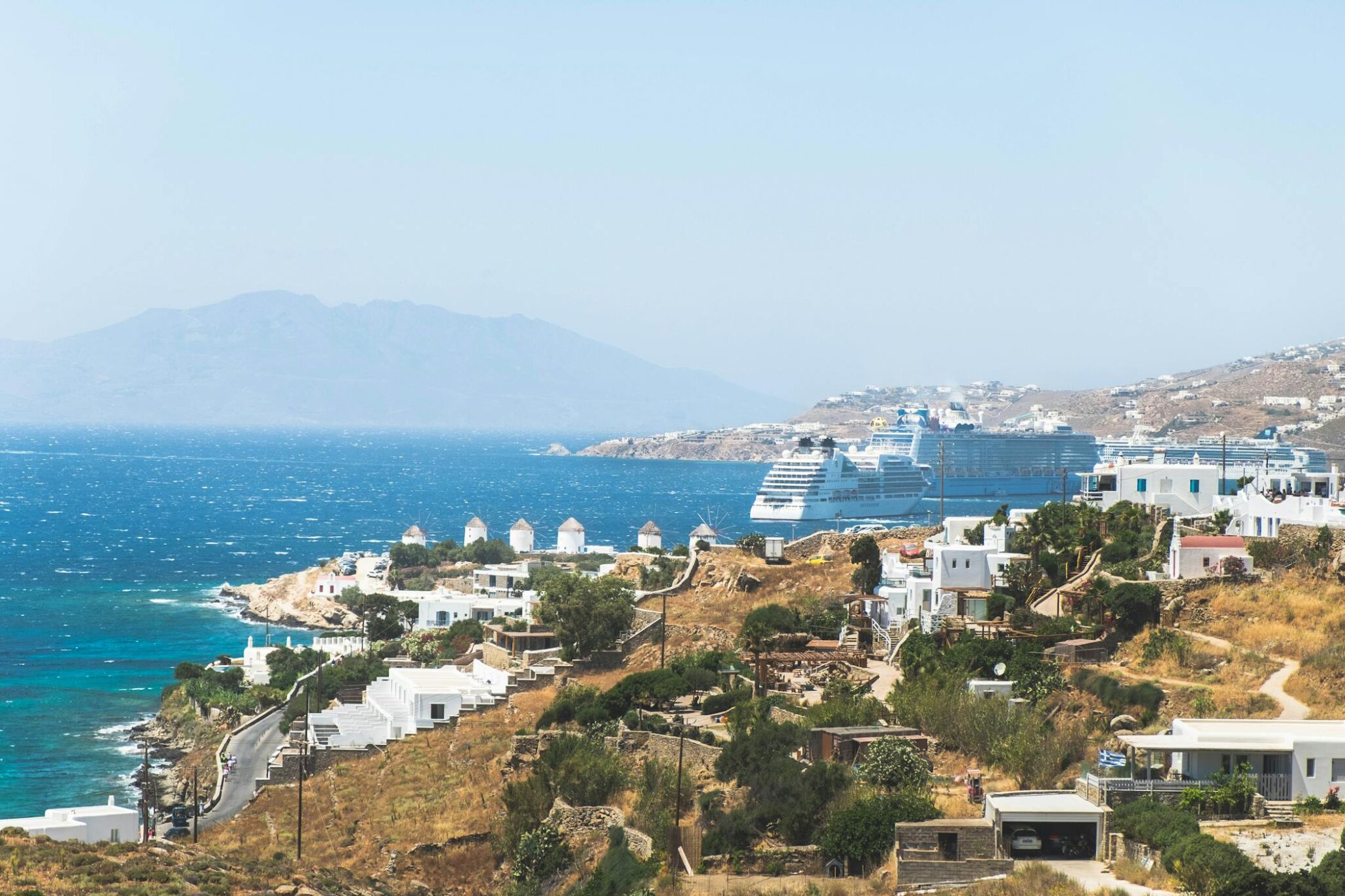
Mykonos became famous as the Greek island where Cycladic scenery turned into a cosmopolitan summer brand. The island is small – about 85.5 square kilometres, with 10,704 permanent residents in the 2021 census – but its name carries the weight of a major Mediterranean resort. Chora, Little Venice, the windmills, white lanes, boutiques, beach clubs and restaurants all support the same image: a place where the day moves from the old town to the beaches and then into nightlife. Psarou, Paradise, Super Paradise and Elia are not just swimming spots; they are part of the social map that made the island known far beyond Greece.
10. Crete and Knossos
Crete gives Greece a wider historical depth than the classical image of Athens alone. The island is the largest in Greece and was home to the Minoan civilization, one of the earliest advanced societies in the Mediterranean. Knossos, near Heraklion, is the best-known site from that world and the largest Minoan palace complex, covering about 22,000 square metres. Its palace was not only a residence or ceremonial space, but a centre of administration, storage, religion and craft production, with courtyards, multi-level buildings, frescoes, water-management systems and traces of early writing. Crete’s Minoan importance became even more visible in 2025, when six palatial centres – Knossos, Phaistos, Malia, Zakros, Zominthos and Kydonia – were added to the World Heritage List as one serial site. These places date mainly from 1900 to 1100 BC and show that Minoan culture was not limited to one palace near Heraklion. It formed a network across the island, with planned architecture, storage systems, religious spaces, maritime contacts and artistic traditions that connected Crete with the wider Aegean and eastern Mediterranean.
11. Meteora
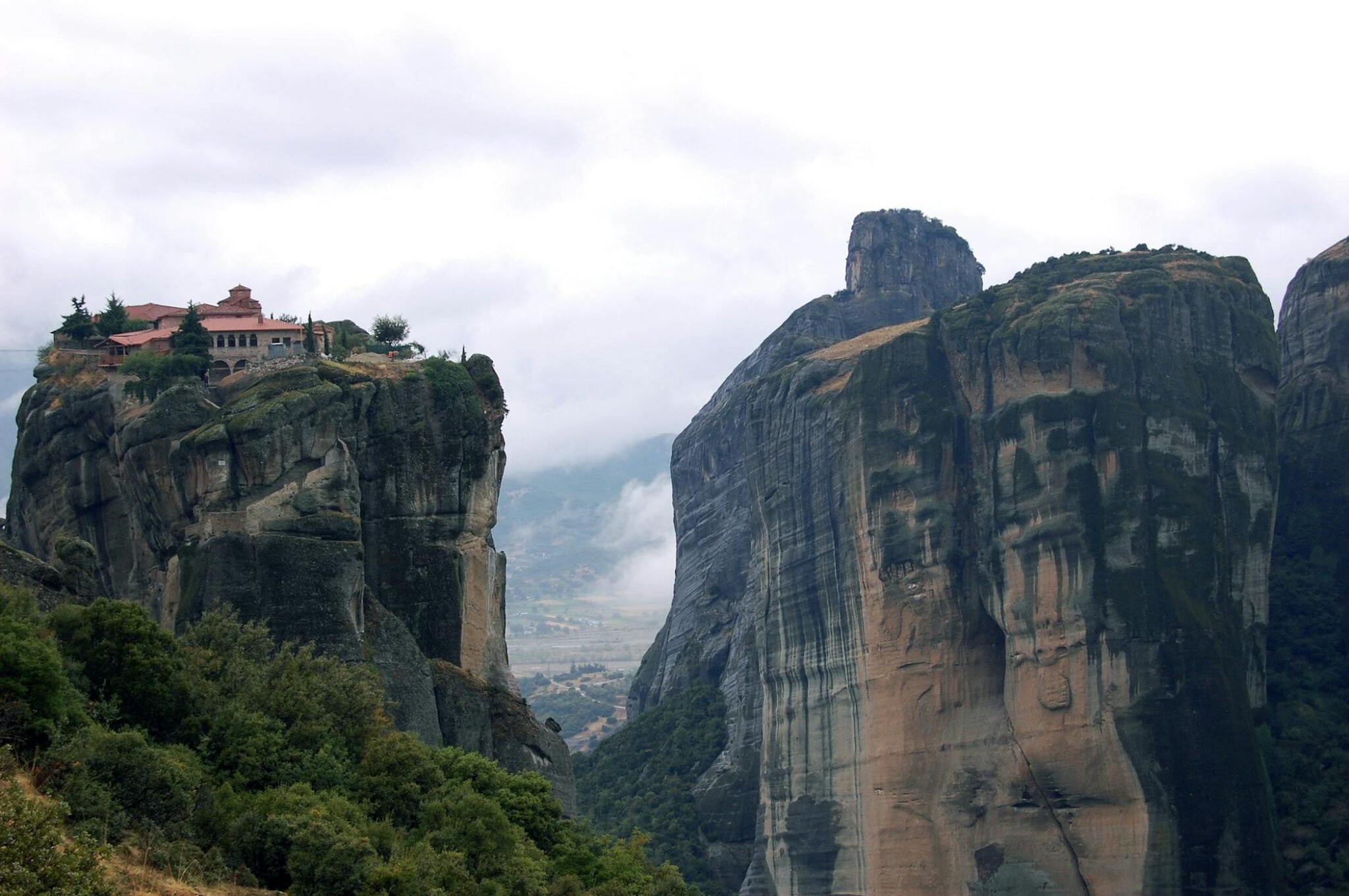
Meteora is one of the places that makes Greece look unlike anywhere else in Europe. It is a landscape of towering sandstone pillars rising above the plain of Thessaly near Kalambaka, with monasteries built on top of the rocks rather than beside them. The site developed mainly from the 14th century, when monks began establishing communities in positions that offered isolation and security, and at its peak there were 24 monasteries in the area. Today six remain active and open to visitors. Their setting is the reason Meteora became so famous: the buildings are important in their own right, but what people remember first is the combination of sheer rock, height, silence and human construction in places that seem almost unreachable.
That visual power is matched by historical importance. Meteora was inscribed on the UNESCO World Heritage List in 1988 for both its cultural and natural value, which is unusual and helps explain its status in Greece. The monasteries preserve frescoes, manuscripts, chapels and monastic traditions, while the rock formations themselves turn the whole area into a landmark rather than a single monument. Access is much easier now than in the past, when monks used nets, ladders and winches, yet the sense of separation still defines the visit.
12. Mount Athos
Mount Athos gives Greece one of its most unusual forms of fame: a living monastic republic inside a modern European state. The peninsula lies in northern Greece, on the easternmost “finger” of Chalkidiki, and has been an Orthodox spiritual centre for more than a thousand years. Its self-administered status goes back to Byzantine times, with the first constitution signed in 972, and the area is still governed through the Holy Community of its monasteries under Greek sovereignty. The scale is compact but exceptional: the protected area covers just over 33,000 hectares, yet contains 20 monasteries, sketes, cells, chapels, farms, libraries and collections of icons, manuscripts and liturgical objects.
Its fame also comes from strict continuity. Mount Athos is not visited like a normal historic site: entry is controlled by permit, stays are limited, and access is reserved for male pilgrims because of long-standing monastic rules. Around 1,400 monks live there, keeping daily prayer, agriculture, craft traditions and restoration work tied to the same landscape. The monasteries influenced Orthodox architecture and painting far beyond Greece, including the Balkans and Russia, while the peninsula’s forests and farming patterns helped it receive mixed cultural and natural World Heritage status in 1988.
13. Rhodes and its medieval city
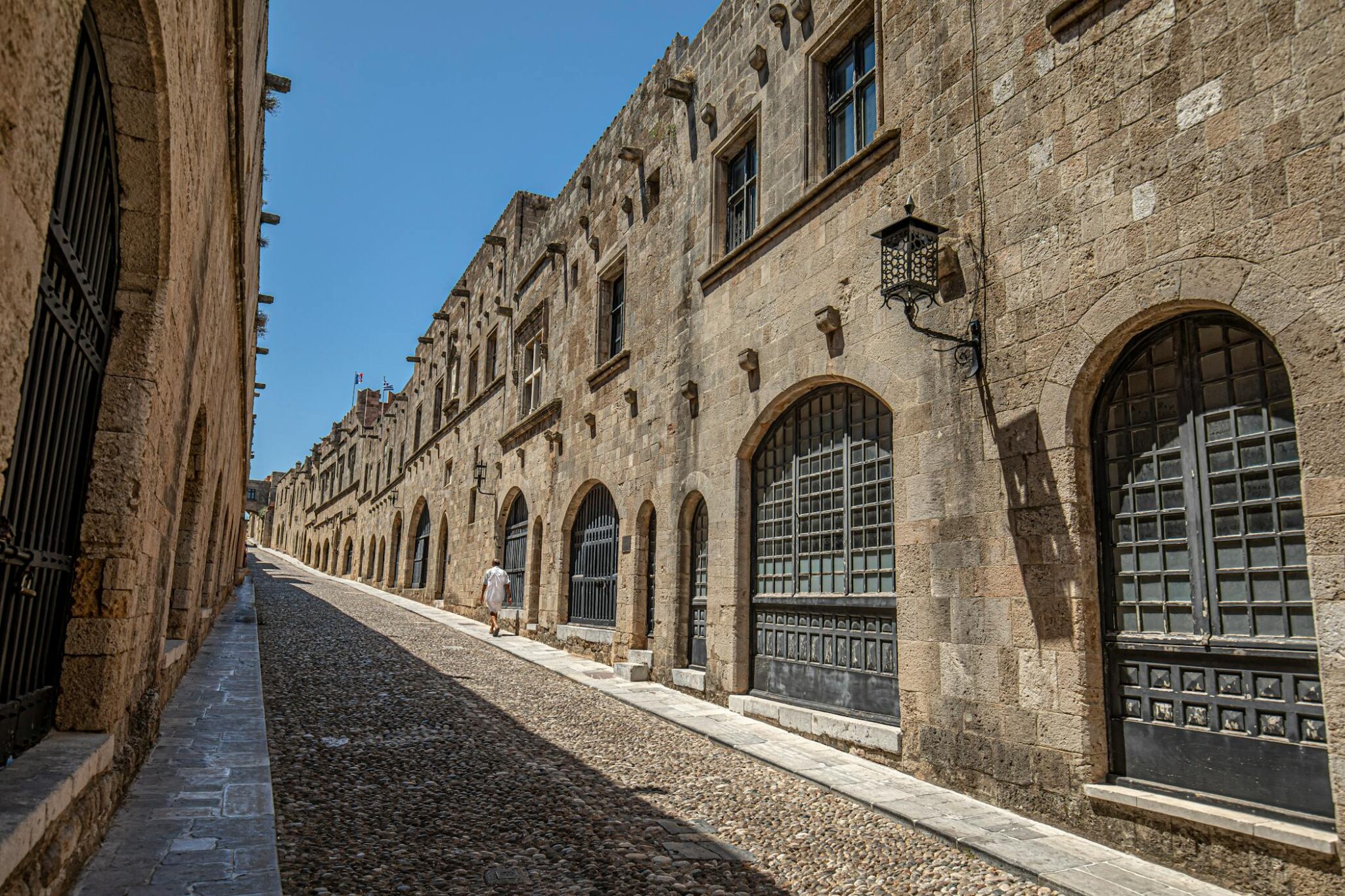
Rhodes gives Greece a very different historical image from Athens, Olympia or the whitewashed Cycladic islands. Its old town is a fortified medieval city, enclosed by roughly 4 kilometres of walls, with gates, towers, bastions, narrow streets and stone buildings that still shape daily life inside the historic centre. The strongest layer comes from the Knights of Saint John, who ruled Rhodes from 1309 to 1522 and turned the island into one of the main military and religious strongholds of the eastern Mediterranean. The Palace of the Grand Master, the Street of the Knights and the old inns of the knightly “tongues” make the city feel closer to a crusader fortress than to the usual image of a Greek island town.
Its fame also comes from the way different periods remained visible instead of replacing one another completely. The high town was shaped by the Knights, while the lower town kept a denser mix of homes, shops, churches, mosques, baths and public buildings from later centuries. After the Ottoman conquest in 1522, the city changed again, but much of the medieval fabric survived; later Italian rule restored and reshaped several landmarks, including the Grand Master’s Palace. Since 1988, the medieval city has been protected as a World Heritage Site, not as an empty museum quarter, but as a lived-in historic town.
14. Feta
Feta is one of the Greek foods that became internationally recognizable without losing its link to place. It is a white brined cheese made from sheep’s milk, or from sheep’s milk mixed with up to 30% goat’s milk, and it must mature for at least two months in brine. Its sharp, salty taste comes from that milk base, the grazing landscape and the traditional production method, not from added colourants or preservatives. Since 2002, feta has been protected in the EU as a Protected Designation of Origin, which means the name is reserved for cheese produced in specific parts of Greece under defined rules. Feta is used in Greek salad, pies, baked dishes, mezze plates and everyday home cooking, so it works as both a local staple and an export symbol. In 2024, Greece produced about 140,000 tonnes of feta worth around €800 million, with exports to the United States alone making up about 8% of the total export volume.
15. Olive oil and classic Greek cuisine
Olive oil is one of the main reasons Greek cuisine feels so tied to the land. It is used in salads, vegetable dishes, pulses, fish, grilled meat, pies and simple bread-based meals, so it works less like a garnish and more like the base of everyday cooking. Greece remains one of the world’s major olive oil producers: the 2024/25 crop year was estimated at about 250,000 tonnes, a recovery of roughly 30% after a weaker previous season.
The international image of Greek food is shaped by a few classics, but those dishes point to a wider kitchen. Greek salad shows the importance of tomatoes, cucumber, olives, onion, oregano and feta; moussaka brings together eggplant, minced meat and béchamel; souvlaki turns grilled meat into everyday street food; and baklava reflects the layered pastry and syrup tradition shared across the eastern Mediterranean. Behind those familiar names are the same core ingredients that define the Mediterranean diet: olive oil, grains, vegetables, fruit, fish, dairy, meat in moderation, herbs and shared meals.

16. Greek Orthodox Easter
The date changes each year according to the Orthodox calendar; in 2026, Easter Sunday fell on 12 April, one week after Western Easter. The main rhythm is built around Holy Week: evening services, candlelit processions, the midnight Resurrection service on Holy Saturday, red eggs, sweet Easter bread, and the Easter Sunday meal, often centred on lamb or kid. It is not only a church event, but a social one, when cities, villages and islands change pace and many people return to family homes. Its fame also comes from the way different places turn the same celebration into local theatre. Corfu is known for Holy Week music and the botides custom, when clay pots are thrown from balconies on Holy Saturday. Patmos gives Easter a more solemn setting through its connection with the Monastery of Saint John and the Cave of the Apocalypse. Chios is known for the Vrontados rocket-war tradition, while Leonidio lights the night with floating Easter balloons.
17. Epidaurus and ancient theatre
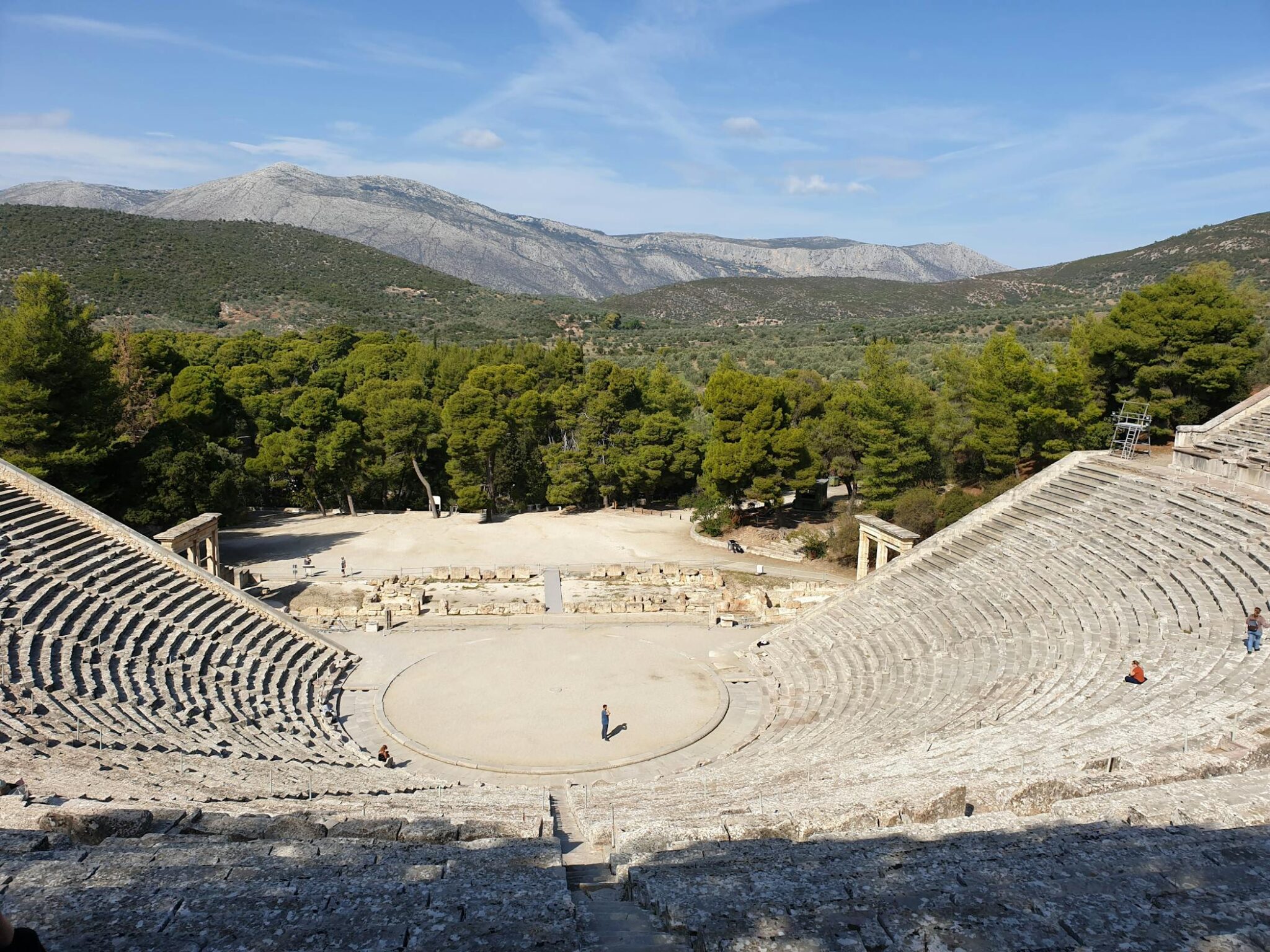
Epidaurus is one of the clearest places where ancient Greek theatre still feels alive rather than distant. The theatre was built in the 4th century BC as part of the sanctuary of Asklepios, the healing god, and its scale still surprises visitors: it could hold about 14,000 spectators. Its fame comes from the precision of the design as much as from its age. The seating, orchestra and hillside setting create the acoustic effect that made the theatre legendary, allowing speech and sound to travel with unusual clarity through the stone rows.
That continuity is what gives Epidaurus its modern importance. Ancient drama returned to the theatre in 1938 with a performance of Electra, and the Epidaurus Festival began in the 1950s, turning the site into one of Greece’s main summer cultural stages. Tragedies by Aeschylus, Sophocles and Euripides, comedies by Aristophanes and modern interpretations of classical texts are still performed there under open sky. In 2026, the Ancient Theatre of Epidaurus programme includes productions such as The Bacchae, showing that the monument is not only preserved as archaeology.
18. The Greek debt crisis
The Greek debt crisis became one of the hardest modern chapters in the country’s image abroad. It began after the 2008 financial shock exposed deep problems in public finances, and from 2010 to 2018 Greece relied on three international assistance programmes. In total, about €256.6 billion was lent during that period, while austerity measures, tax rises, pension cuts and unemployment reshaped everyday life for millions of people. The crisis was not only a financial story: it became a eurozone test case, with debates about debt relief, budget discipline, bank stability and whether Greece might leave the euro. For many outside observers, the images of protests, closed banks in 2015 and repeated bailout negotiations became part of modern Greece’s global reputation.
The recovery has been long, but the direction is now different. Greece’s debt-to-GDP ratio peaked at 209.4% in 2020, then fell to 146.1% by the end of 2025, still very high but far below the worst point of the crisis. The economy has also returned to steadier growth, credit ratings have improved, and Greece is expected to stop being the eurozone’s most indebted country by the end of 2026. That does not erase the social damage: many households still feel the after-effects through lower purchasing power, debt burdens and years of lost income.
19. Philoxenia and Greek hospitality
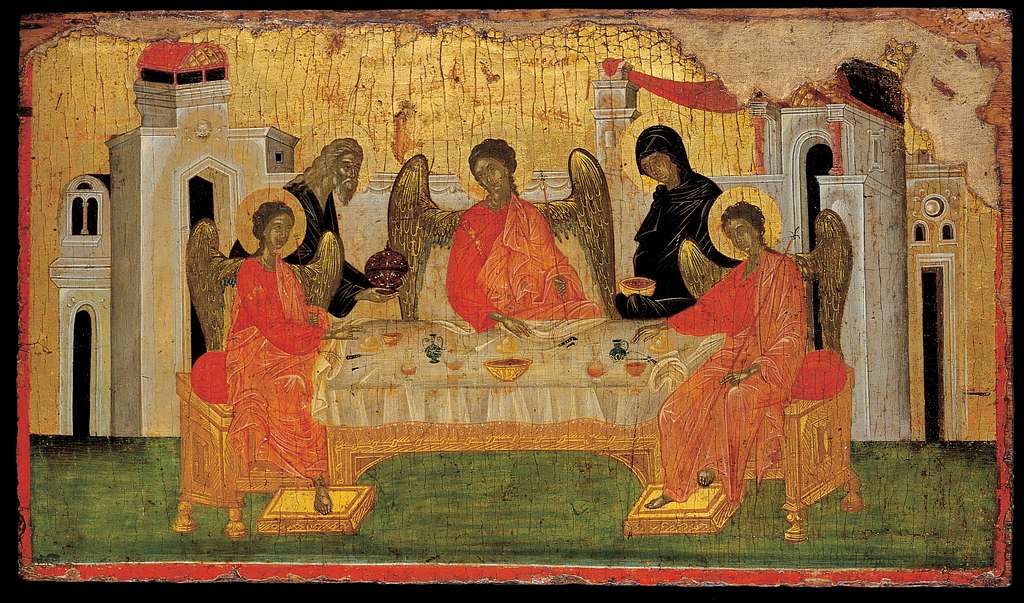
Philoxenia is one of the Greek ideas that still feels active in everyday life. The word is often translated as hospitality, but its older sense is closer to being a “friend to the stranger”, which makes the guest–host relationship feel more personal than formal. In ancient Greece, welcoming travellers was not only good manners; it was tied to honour, religion and social trust in a world where journeys could be difficult and strangers depended on local protection. That older meaning helps explain why Greek hospitality is usually described through food, conversation, invitations, family tables and small gestures rather than through service alone.
20. Seafaring and shipping
Greece’s connection with the sea is not limited to islands, beaches and ferries. It is also one of the world’s largest commercial shipping powers. As of 1 January 2025, Greek owners controlled about 398 million deadweight tons of shipping capacity, the largest figure for any economy, equal to 16.4% of global fleet capacity. That puts Greece ahead of China and Japan in ship-owning capacity, despite its much smaller population and economy.
21. Beaches and Blue Flags
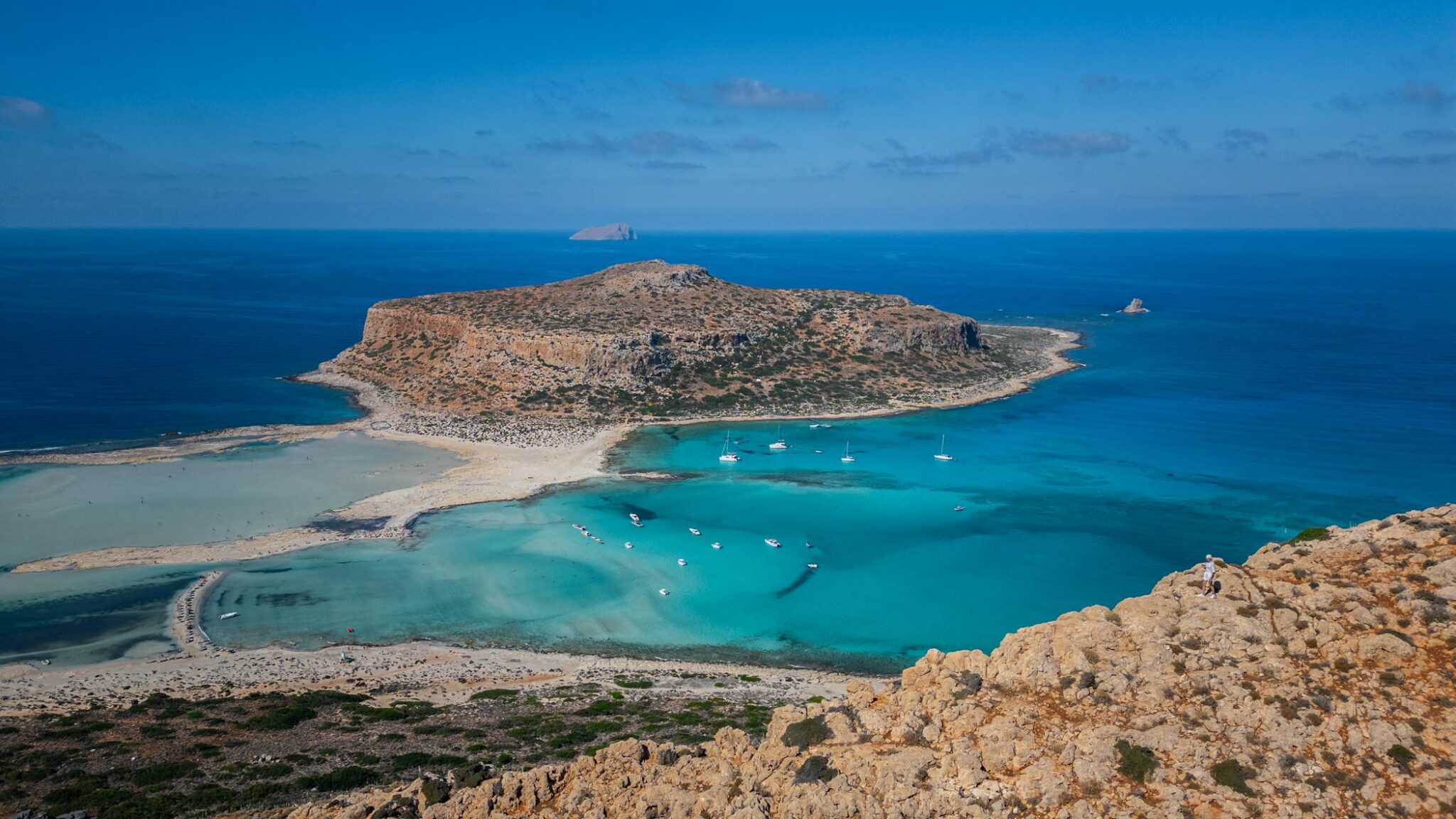
Finally, Greek beaches are famous because they are not limited to one type of coast. The country has long sandy resort beaches, small coves below cliffs, volcanic black-sand beaches, pink-tinted shores such as Elafonissi, pine-backed beaches in the Ionian Islands and clear-water bays scattered across the Aegean. This variety comes from Greece’s geography: about 7,500 kilometres of the country’s coastline belong to islands, so beach travel is spread across hundreds of coastal settings rather than concentrated in one resort strip. Places such as Navagio, Balos, Myrtos, Sarakiniko, Voidokilia and Porto Katsiki became internationally recognizable because each shows a different version of the Greek coast.
The Blue Flag ranking gives that image a measurable side. In 2025, Greece ranked second worldwide among 52 participating countries, with 623 awarded beaches, 17 marinas and 17 sustainable tourism boats. Greek beaches made up about 15% of all Blue Flag beaches globally, while Crete led the country’s regions with 153 awards and Halkidiki followed with 93. The label is not given only for attractive scenery; it is tied to water quality, environmental management, safety, services and information for visitors.
If you’ve been captivated by Greece like us and are ready to take a trip to Greece – check out our article on interesting facts about Greece. Check if you need an International Driving Permit in Greece before your trip.

Published April 26, 2026 • 18m to read