

Most problems with international driving begin before the engine starts. They begin with assumptions about paperwork, language, and what documents are enough.
You can lose a driving trip without ever turning the key.
Not because the car broke down. Not because the route was wrong. Not because of weather.
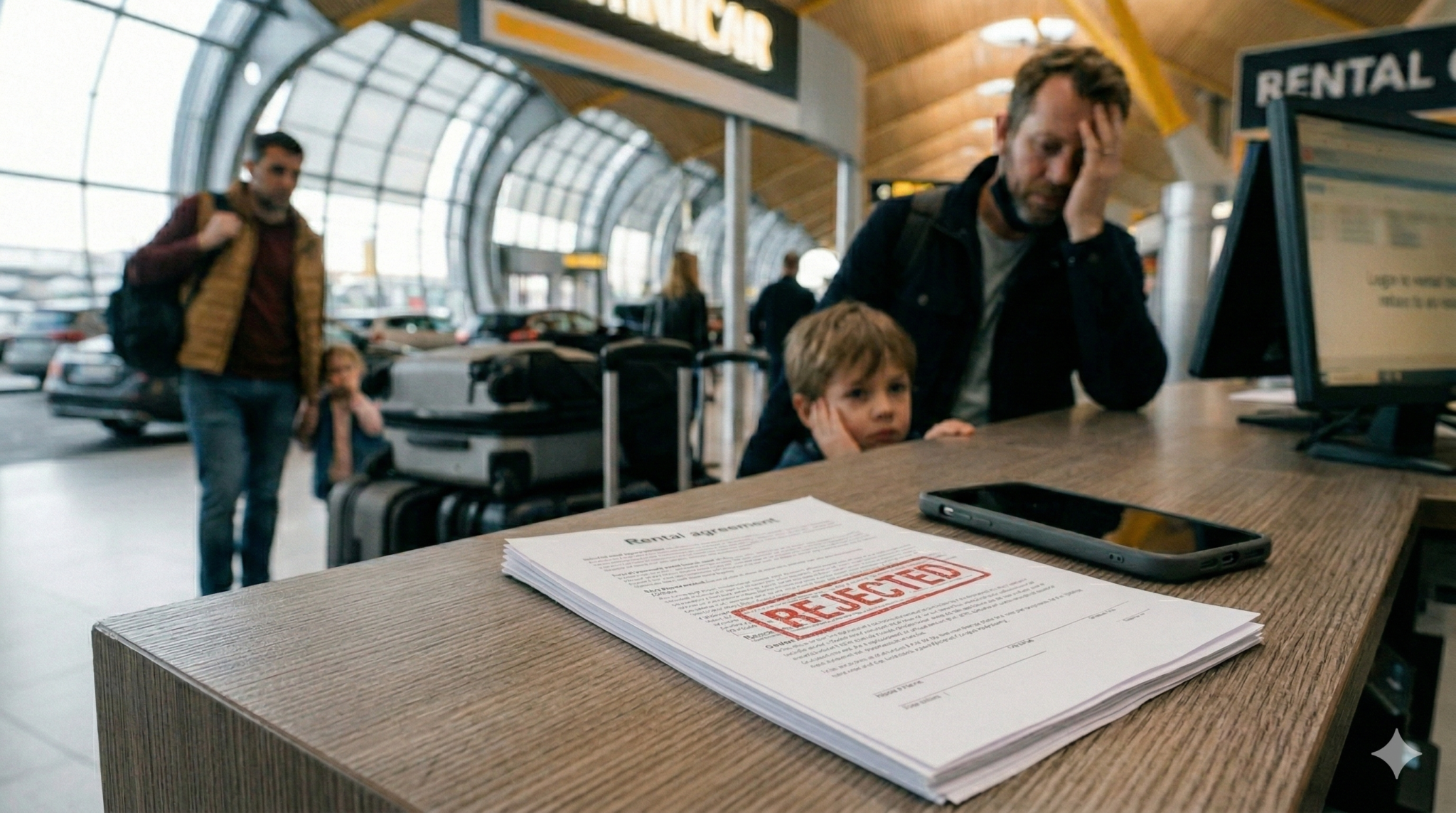
You lose it when a tired traveler, a pile of luggage, a stressed partner, and a rental desk employee all meet at the same moment. And then a simple sentence changes everything:
“We need one more document.”
This is one of the least interesting moments in travel, but also one of the most common.
People imagine road-trip problems as dramatic events: broken tires, mountain roads, missed turns, police checkpoints. But many real travel disasters are much simpler. They start with paperwork. Or, more precisely, with the difference between what the traveler has and what the local system expects.
For travelers with a U.S. driver’s license, the official recommendation is clear: if the destination requires an International Driving Permit, obtain it before departure from AAA or AATA, confirm it is valid, and carry it together with the U.S. driver’s license. This is not a minor detail. It is the part most people remember too late.
The Part of Travel Nobody Talks About
Travel content celebrates movement. Airports. Desert highways. Coastal roads. Beautiful parking spots at sunset.
What it almost never shows is the paperwork behind mobility.
A traveler can do almost everything correctly and still get stuck, because the document side of driving abroad was treated as unimportant. Flights are booked. The hotel is confirmed. Insurance is partially understood. The route is saved. The children are tired. The line at the counter is long. And then someone asks for a document the traveler assumed was not necessary.
That is the moment when the vacation mindset meets the document mindset.
At IDA Office, we see this pattern repeatedly: not careless travelers, not dishonest people, not anyone trying to cheat the system. Just ordinary people who thought driving would be the simple part.
The trip usually fails before the engine starts.
Why Prepared Travelers Still Get Caught
The mistake is rarely about not knowing things. It is usually about being too optimistic.
People assume that because their license is valid at home, it will be understood abroad. They assume that because the rules were simple in one country, they will be simple in the next. They assume that because they are clearly legal drivers, local systems will automatically recognize that.
But international travel has many layers.
There is the law of the country. There is the policy of the rental company. There is the requirement of the insurance provider. There is the judgment of the person standing in front of you.
These four things do not always agree.
That is why two travelers can arrive with similar documents and have completely different experiences. One gets the car keys in five minutes. The other spends an hour explaining, calling support, searching through emails, and wondering if the entire trip is about to fail.
Three Preventable Mistakes That Ruin Good Trips
Mistake 1: Remembering the Paperwork Only After Landing
Everything feels manageable before departure, until it does not. A traveler lands, goes to collect the car, and only then discovers that the destination, the rental agency, or the person at the counter expects something more than a national license alone.
At that point, the problem is not only legal. It is logistical.
Official government documents are usually easiest to obtain before travel, not after. Once a person is already abroad, options become limited, shipping becomes a factor, time zones work against them, and the emotional pressure increases immediately because the trip is already happening.
The consequences are real. Delayed plans. Unhappy children. Lost reservations. Extra hotel nights. Missed meetings. Arguments that had nothing to do with driving.
Mistake 2: Carrying the Translation but Leaving the Original License Behind
This seems too simple to be a real problem, but it happens constantly.
People assume the international document is the main document. In reality, the supporting document is exactly that: supporting.
The public legal information on our own website clearly states that the document is a translation, not a standalone replacement for a valid national license, and must be accompanied by the original license. Official U.S. guidance also says travelers should carry their U.S. driver’s license with the IDP.
In practice, travelers separate documents all the time. The booklet goes in the car. The original stays in the hotel safe. Or the phone has the PDF, but the wallet with the actual license is back in the room.
That is how a person who believed they were well prepared ends up looking unprepared during a routine stop.
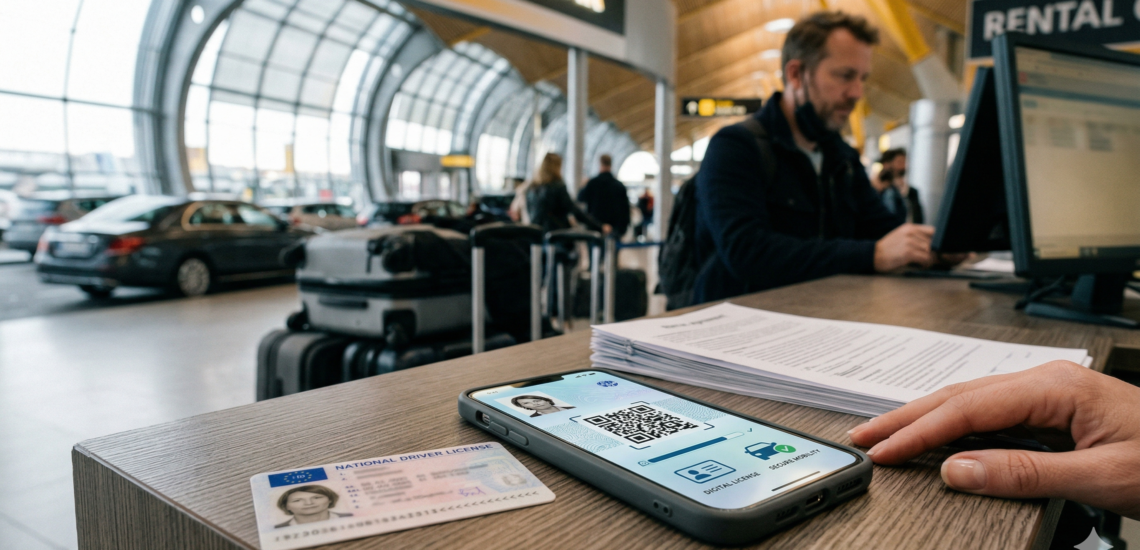
Mistake 3: Assuming Digital Always Means Universally Accepted
Modern travelers trust screens, and for good reason. Most of travel has become digital. Boarding passes, hotel confirmations, insurance documents, maps. All digital.
So people naturally assume that driving paperwork will also be digital everywhere.
Sometimes it works. Sometimes it does not.
The issue is not whether a digital document is convenient. It is. The issue is whether the person checking it wants convenience or certainty. On the road, at a checkpoint, or behind a rental desk, a printed document still has a practical advantage. It is readable immediately. No dead battery. No app updates. No screen glare. No need to zoom in.
This is why the paper-versus-digital question is not outdated. It is practical.
And this is also why honest travel guidance needs clear limits. Our own public FAQ openly states that our document is not accepted in China, Georgia, Japan, and South Korea. That is not attractive marketing. But it is the right thing to tell travelers.
The Truth About “Acceptance”
People want the word “accepted” because it sounds final.
But in travel, “accepted” is almost never a simple yes or no.
A document may be acceptable by law, but still questioned by a specific office, a specific officer, or a specific employee who is trying to avoid risk.
That does not necessarily mean anyone is acting wrongly. Often the opposite is true. The person making the decision is trying to protect themselves, their employer, or the process they are responsible for.
The traveler experiences that as an obstacle. The institution experiences it as caution.
Understanding this makes travel planning less emotional and more realistic.
The goal is not to win a theoretical argument about what should be accepted. The goal is to carry the documents least likely to create a real problem.
The best travel document is not the one with the biggest promise. It is the one nobody needs explained twice.
Why a Printed Booklet Still Matters
Paper survives in international driving not because the world resists progress, but because paper solves a human problem.
It is visible. It is immediate. It is familiar. It works without internet. It reduces the need for interpretation.
That does not make digital documents useless. Digital copies are fast, portable, searchable, and very valuable in urgent situations.
But a traveler who wants the smoothest experience should think about how many different people may need to look at this document. The more hands it passes through, the more useful a clear, physical, printed document becomes.
That is not exciting. But it is effective.
A Practical Pre-Trip Checklist
Before you travel, ask five practical questions:
1. What does the destination require?
Not what someone wrote on a forum three years ago. Not what a friend thinks. What the destination currently requires.
2. What does the rental company require?
Country rules and rental company rules are not always the same. A rental company may have stricter requirements than the law.
3. Will I carry my original national license every time I drive?
Not in the suitcase. Not in the hotel. With you, every time.
4. Do I need paper documents, digital documents, or both?
If there is any uncertainty, the safest answer is usually both.
5. Am I traveling as a visitor, or is my situation more complicated?
Long stays, repeated travel, and changes in status can move you out of the simple tourist category.
For travelers with a U.S. license: if an official IDP is required, obtain it before travel from AAA or AATA and carry it with your license.
The Point Is Protecting the Trip
Nobody dreams about travel paperwork.
People dream about movement. About arrival. About freedom. About a few days of not worrying too much.
But driving abroad is one of those areas where a simple checklist protects the good parts.
The family road trip. The honeymoon route. The work trip with one free weekend. The feeling of driving in a new country for the first time.
Those things are worth protecting.
The good news is that most document-related travel failures are not mysterious. They are predictable. And that means they are usually preventable.
That is the real lesson. Not that travel is harder than people think. But that a little less assumption and a little more document preparation can save a very good trip from a very avoidable failure.

Published March 21, 2026 • 7m to read