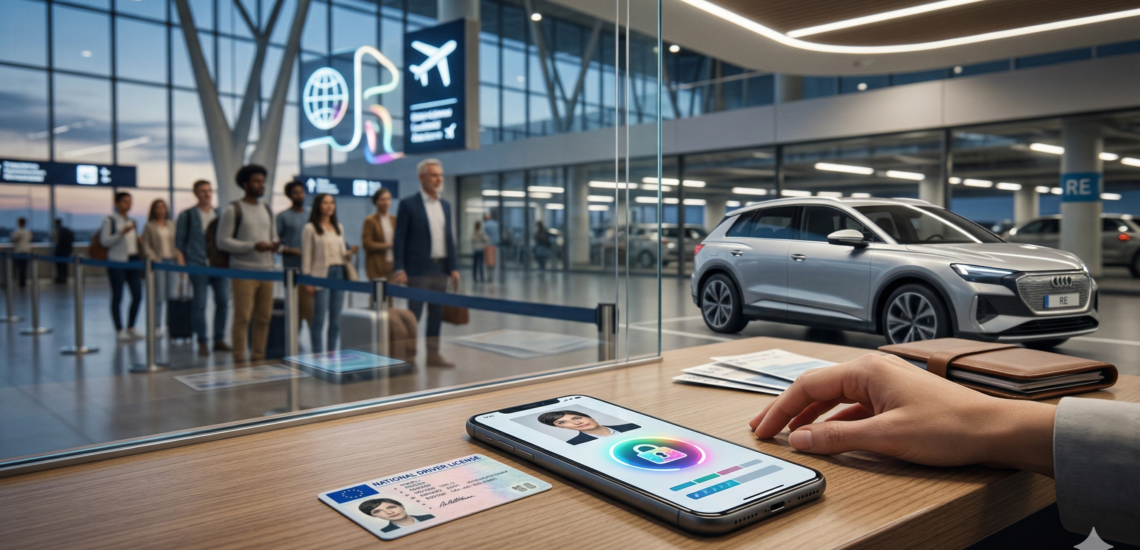


Travel became digital. Proving that you are allowed to drive across languages and legal systems did not.
It is surprising how modern travel can feel until the exact moment you try to prove, in another language and another legal system, that you are allowed to drive.
You can book a flight in under a minute. Check in to a hotel from your phone. Open a boarding pass on your watch. Pay for fuel without speaking to anyone.
And then, at a rental counter or a roadside stop, the system suddenly asks you to go backward.
Not because technology failed. Because standards did not keep up.
The Hidden Problem at the Center of Global Travel
Modern mobility is global. Driver identity is still mostly local.
That problem is the source of a large amount of travel difficulties.
International road-traffic documentation is still based on convention structures from 1949 and 1968. Current working discussions at the international level continue to address driving licenses and international driving permits within those frameworks. Even current official U.S. travel guidance still tells travelers that if an IDP is required, they should obtain it before the trip and carry it with their license.
This is not a historical issue that quietly disappeared. It is still active.
That matters because travelers experience this fragmentation as inconvenience. But institutions experience it as risk.
The traveler thinks: “I am a legal driver. Why is this difficult?”
The institution thinks: “I need a readable, trustworthy, familiar way to verify what I am looking at.”
Both positions are reasonable. The problem is that the system between them is outdated.
Where the Problems Actually Come From
Cross-border driving problems usually come from five sources.
1. Language.
A valid domestic license can be difficult to read if the person reviewing it does not know the language, alphabet, abbreviations, or category structure.
2. Format.
Some licenses look modern and standardized. Others still look very local in design. People trust documents visually before they evaluate them legally.
3. Verification.
Even if a document looks correct, the question remains: is it current, valid, suspended, replaced, or expired?
4. Paper versus digital expectations.
Travelers think in digital terms. Institutions often still make final decisions based on paper documents.
5. Changing context.
The rules around driving can become more complicated when a person moves from simple tourism into longer stays, repeated presence, residency, or work-related use.
None of this means the traveler is wrong. It means the system was not built for large-scale international mobility.
Why Paper Documents Continue to Exist
Many people in travel technology talk about paper as if it is only a sign of being outdated.
That misses the real point.
Paper continues to exist because paper solves a practical problem: it is easy to inspect.
International driving permit formats have included booklet-style models for decades, which is why the paper format remains familiar and trusted in practice.
A printed document is not elegant, but it is readable. It does not need a signal. It does not need a battery. It does not need instructions.
That is why paper remains useful in situations where trust is limited and time is short.
The future is not about replacing paper with digital. It is about using digital where digital helps, paper where paper reduces problems, and a common verification system behind both.
What a Modern Standard Should Separate
One reason the current system feels disorganized is that several different functions are mixed together.
A modern cross-border driving standard should separate at least three layers:
The right to drive.
This belongs to the domestic licensing authority. It is the legal foundation.
The translation of that right.
This is the readability layer. It helps another person understand the original document.
The verification of that right.
This is the trust layer. It answers whether the document is current, real, and still valid.
Today these layers are often combined in ways that create confusion. A better system would make them separate but connected.
That would help travelers. It would also help rental companies, insurers, and enforcement authorities who currently fill the gaps with guesswork.
What a Better Cross-Border Credential Should Do
A modern standard should be built around several principles:
Human-readable. A person at a counter should understand the essential information quickly.
Machine-verifiable. A company or officer should be able to confirm status without relying on visual judgment alone.
Offline-capable. Cross-border mobility does not happen only in areas with good internet.
Revocable and updatable. A document should not appear valid when the underlying driving right has changed.
Minimal by design. Show what is needed, not everything that could possibly be shown.
Consistent across formats. Paper, PDF, app, and card should feel like parts of one trusted system, not competing alternatives.
This is not unrealistic. It is a practical response to the actual problem.
Privacy Is Part of the Trust System
When people discuss digital credentials, they often focus on convenience and forget about restraint.
That is a mistake.
The more portable and verifiable a document becomes, the more important it is to limit data exposure, data storage, and unnecessary sharing. A system that shares too much information is not useful. It is invasive.
The principles should be: clear purpose, limited data collection, real accountability, and meaningful user control.
At IDA Office, our privacy policy references UK ICO registration and describes compliance with UK data protection law, CCPA, LGPD, and GDPR requirements. Customers can delete their data through their account, and can request complete removal of all information within 24 hours.
Regardless of platform or provider, this approach should become normal in mobility: the future of cross-border driver identity should not only be easier to verify. It should also be easier to trust.
Why This Matters Beyond Travel
This is larger than one more travel document.
A better cross-border driving standard would reduce: rental-counter disputes, roadside confusion, avoidable document fraud, uncertainty about whether paper or digital is sufficient, and the number of legal travelers who get caught in preventable administrative problems.
It would also reduce the pressure on staff at rental desks, border crossings, and roadside checkpoints to make difficult decisions with incomplete information.
That matters more than it may seem. Because every bad international-document experience teaches travelers the same lesson: that the system is less modern than the trip itself.
The Best Future Is Simple
The best standards are simple in the best possible way.
They do not create problems. They remove them.
Nobody should remember a driving document because it was confusing or controversial. They should remember it because it worked — quietly, under pressure, in another language, with no unnecessary difficulty.
That is what a better system looks like. Not louder branding. Not more complex language. Not a competition to make the biggest promise.
Just a more logical layer between legal drivers and the countries, companies, and people who need to understand them.
Cross-border driving is still designed for another era. It does not have to stay that way.

Published March 27, 2026 • 6m to read