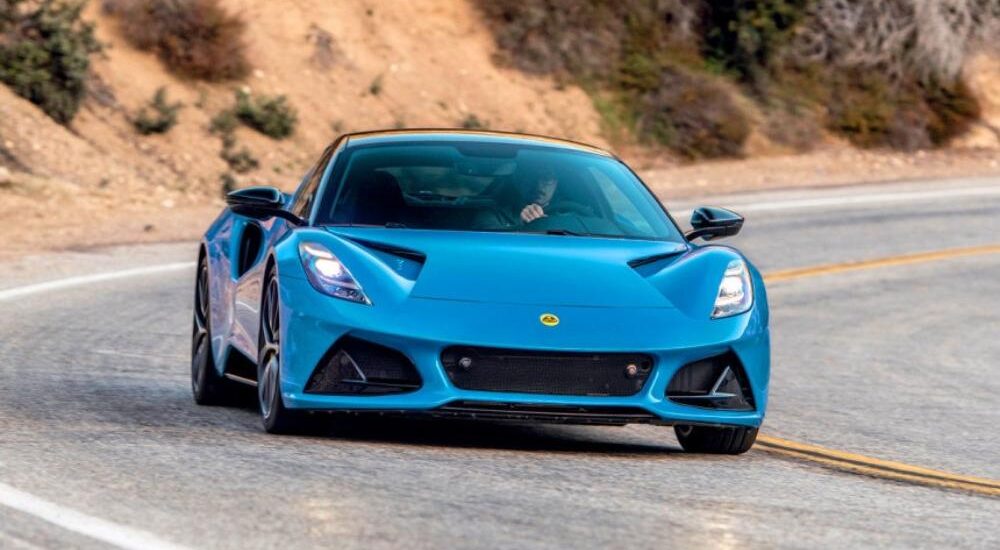


“I bought a new Lotus! Come over and take it for a spin.” Normally, I’d accept such an invitation without hesitation, but this time I paused: which Lotus are we talking about? The electric SUV? No — my friend from the UAE had just acquired a Lotus Emira coupe, the most old-school model in the current lineup, complete with a supercharged V6! Needless to say, I booked my flight the same day.
For many, Lotus still evokes cars built by the principles of Colin Chapman, who sought maximum weight reduction. My generation remembers the captivating Elise and Exige models, while older enthusiasts think of the wedge-shaped Esprit penned by Giugiaro. But in 2017, a controlling stake in Lotus was acquired by Chinese holding Geely. How has this affected the brand’s British principles? Let’s take a look at the 2024 lineup.
There’s the Lotus Emeya electric four-door Gran Turismo. Interestingly, in the FAQ section on the official website, the first question they rush to answer is, “Is Emeya a true Lotus?” Clearly, doubts persist.
Then there’s the electric SUV Lotus Eletre, which we’ve already tested in Autoreview. Both battery-powered models are built in China.
The electric hypercar Lotus Evija features four electric motors with a combined output of 1500 kW. Unveiled in late 2019 at the Guangzhou Auto Show, customer deliveries began only at the end of 2023.
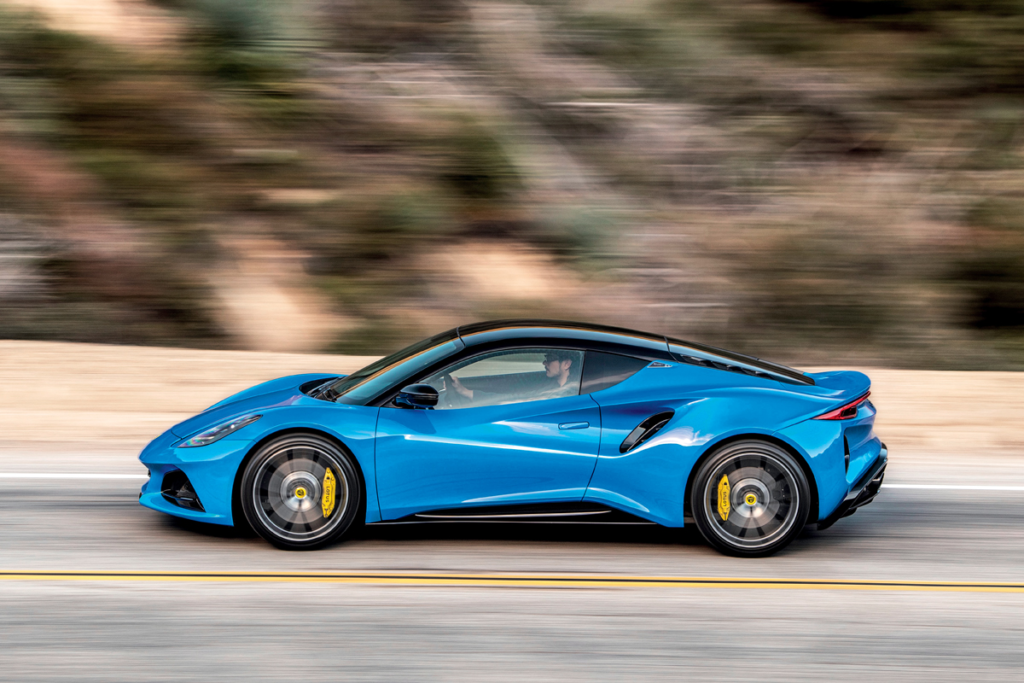
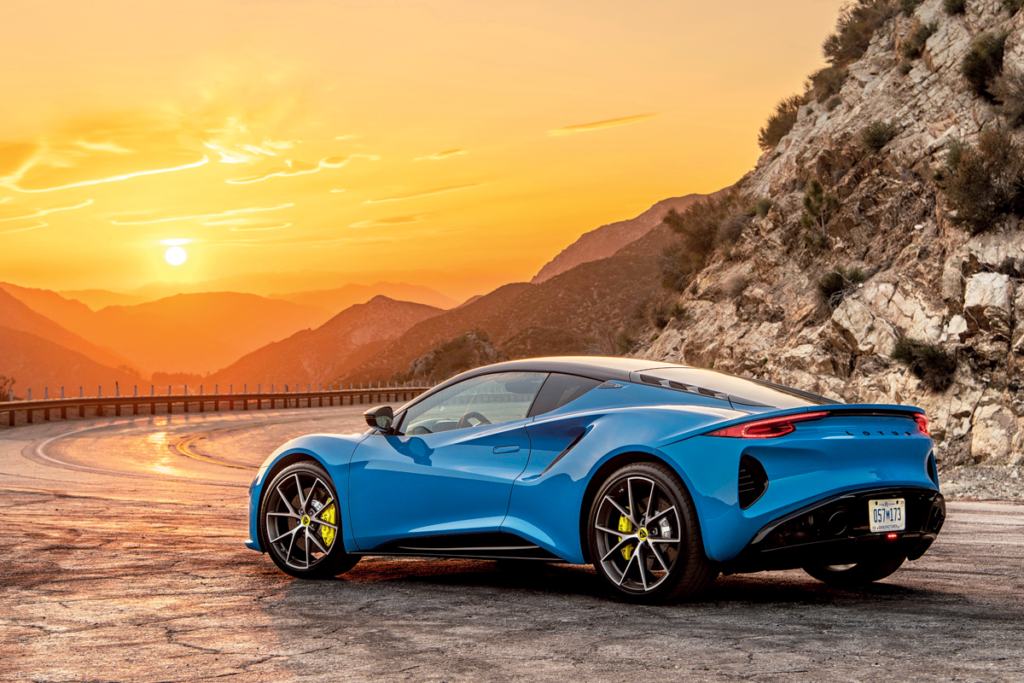
And finally, the Lotus Emira — a classic mid-engine coupe intended to rival the Porsche 718 family. Imagine the weight of responsibility on this elegant silhouette! The Emira replaced not one but three orthodox models: the Exige, Elise, and Evora. Excluding countless special editions and modifications, the Emira, revealed in 2021, became the first all-new Lotus in fourteen years! It’s also the last Lotus with a purely internal combustion engine — no hybrid assistance. Lotus plans to switch entirely to hybrids and EVs, though that plan may change.
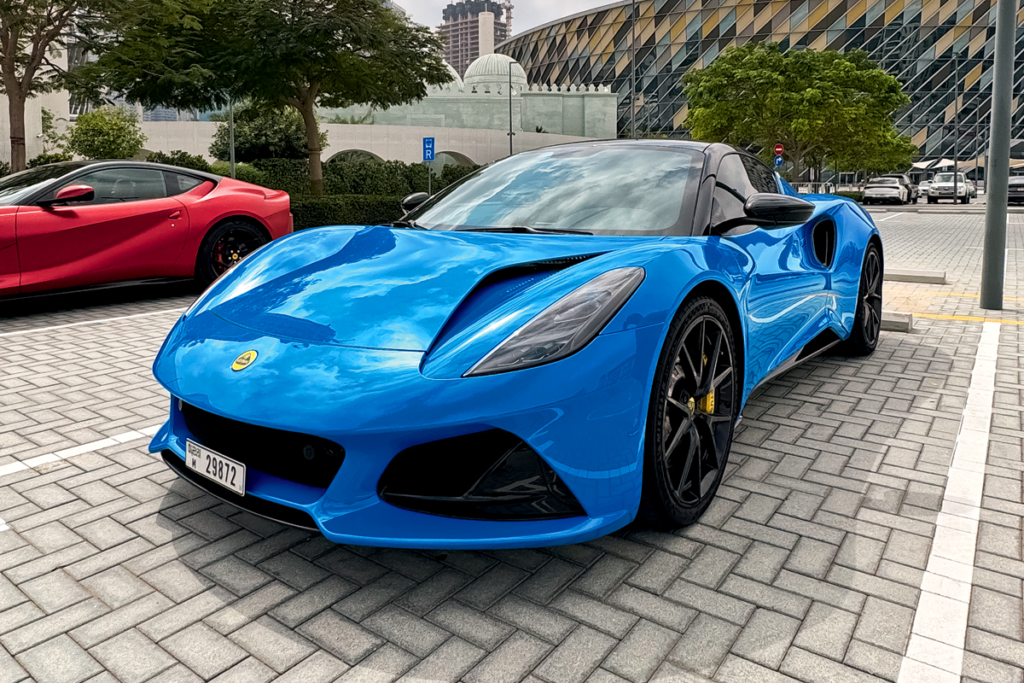
There is not a single moving element in the aerodynamic body kit; all surfaces are verified and calculated “once and for all”
The Emira greeted me with stunning looks — a genuine supercar! Its low, expressive silhouette features a sophisticated yet understated network of intakes and vents. Up close, you admire every line and detail, because everything you see serves a purpose. There are no fake openings or decorative grilles — every vent either draws in cool air or releases hot air.
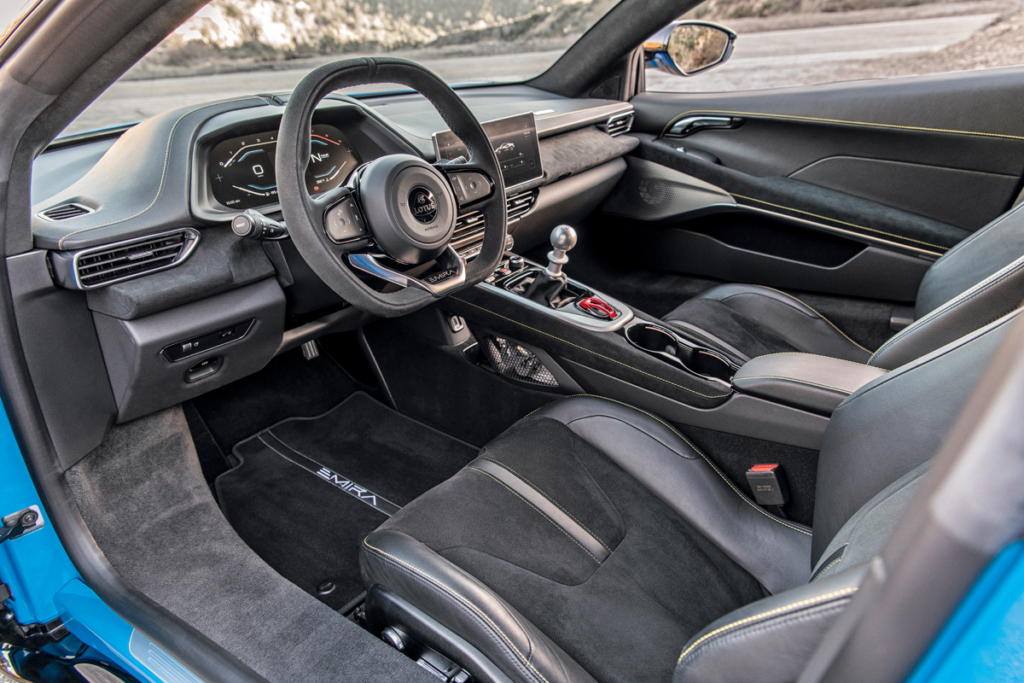
The ascetic spirit of Lotus is a thing of the past – Emira has a full interior trim with soft materials. Leather and suede are used for the seat upholstery, there is an electric drive
The wide-swinging door welcomes you into the cabin, but the broad sill reminds you that this isn’t just any low-slung car. These sills are a legacy of the original Lotus Elise, since the Emira retains essentially the same aluminum chassis made from large extruded sections.
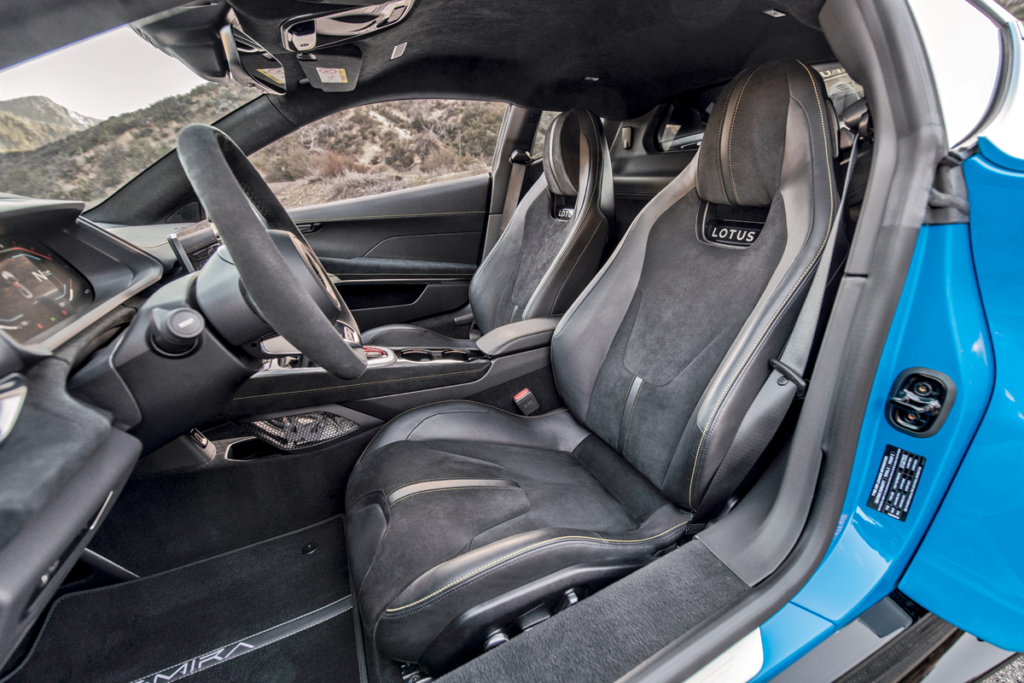
The seats are like from another car – very soft and thick. And because of the electric drive with memory, they are probably also heavy.
First impressions of the interior exceed expectations: it’s genuinely comfortable and inviting. Gone are the spartan days of older Lotuses! There’s a cushy, power-adjustable seat, quality trim materials, and even cupholders — unheard of in a Lotus before! The only reminder of the mid-engine layout is the pedal box offset to the right, with the left-foot rest replaced by a wheel arch.
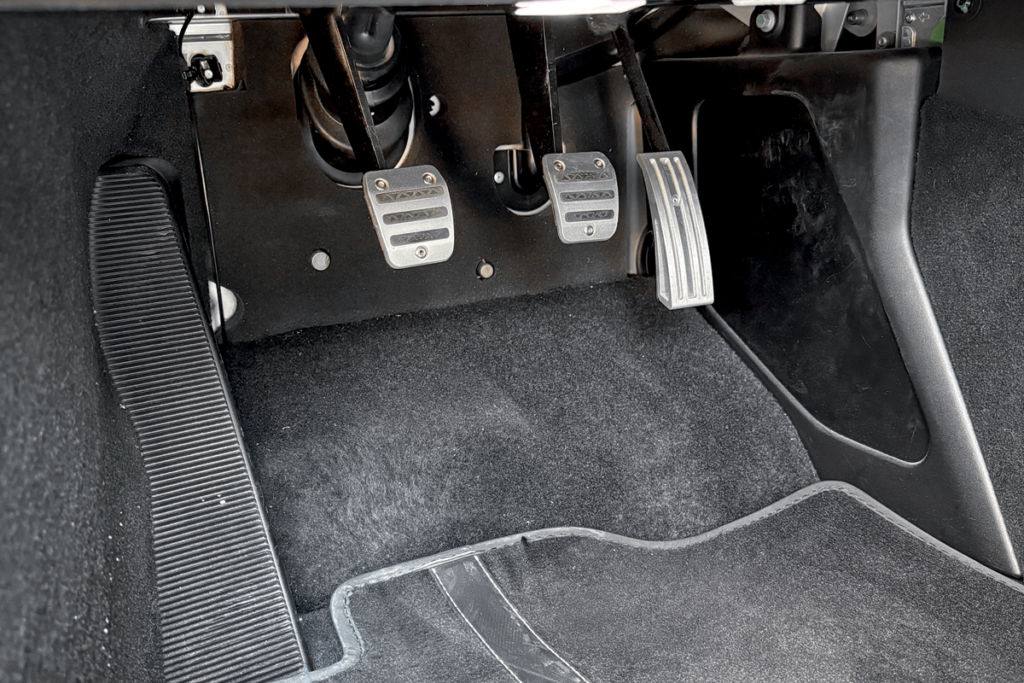
Big sneakers have no place here: the pedals are small and located too close to each other.
The stalks feel familiar. And those steering wheel buttons? Right — Geely also owns Volvo. For a small sports car maker like Lotus, sourcing such components from mass-market brands is a win — these parts work perfectly and don’t distract from the main point: driving. Even the key proudly bears the slogan: “For the drivers.”
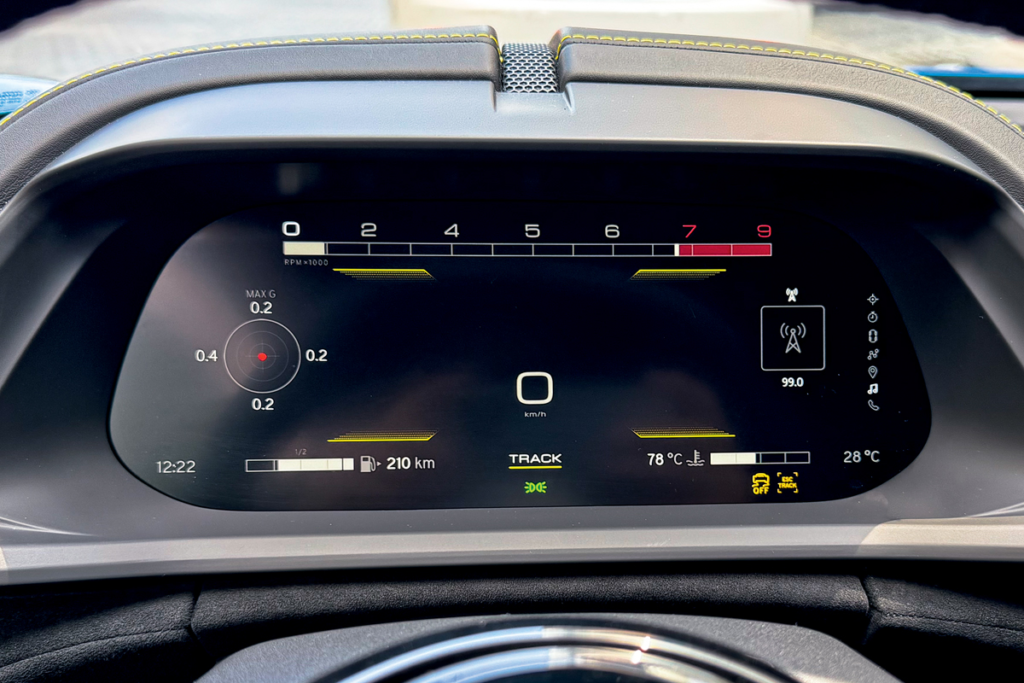
The instrument panel can display various data about the car, but I was unable to find information about the engine oil temperature.
Time to begin.
Flip up the red cover and press the start button. After a brief pause, the car sends a light tremor through the chassis and your ears confirm that the loud machinery just behind you has come to life. It’s Toyota’s 3.5-liter V6 paired with an Edelbrock 1740 supercharger — a tried-and-true combo Lotus has used since 2010 (earlier cars had Harrop blowers).
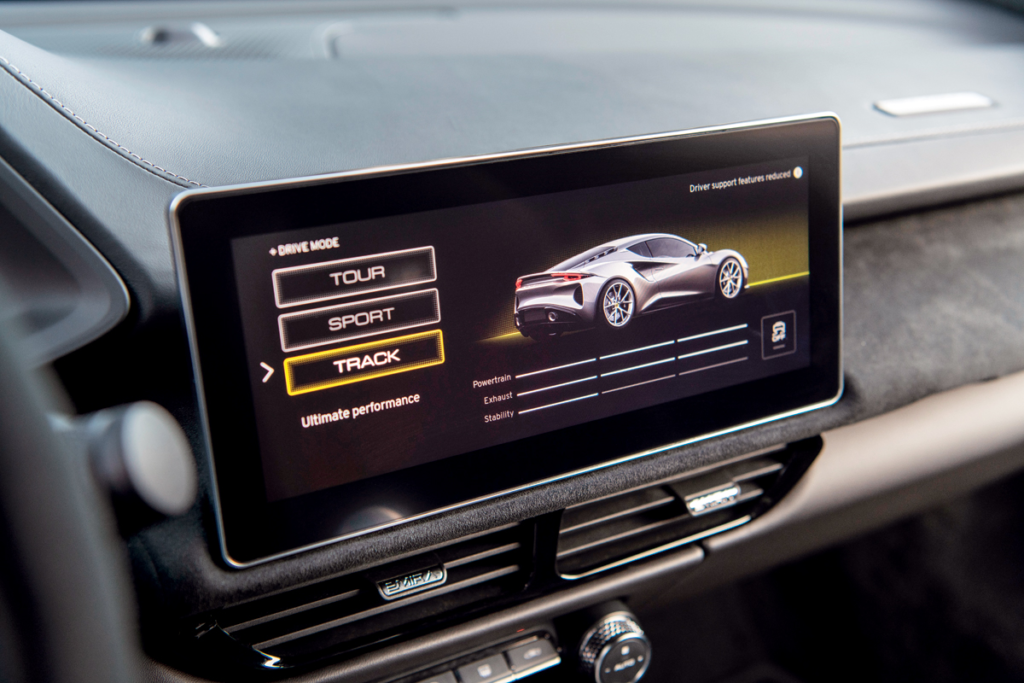
The media system screen pleases with its high resolution and good responsiveness
The “six” sounds noble — a rich, crisp tone, especially in the midrange, reminiscent of a Camry in its best voice. Amusingly, the rearview mirror not only frames the engine cover but also reveals the throttle linkage at work. That’s likely no accident — the exposed gear linkage for the six-speed Aisin manual gearbox is also proudly on display. An automatic from the same supplier is available, but my friend wisely chose the manual.
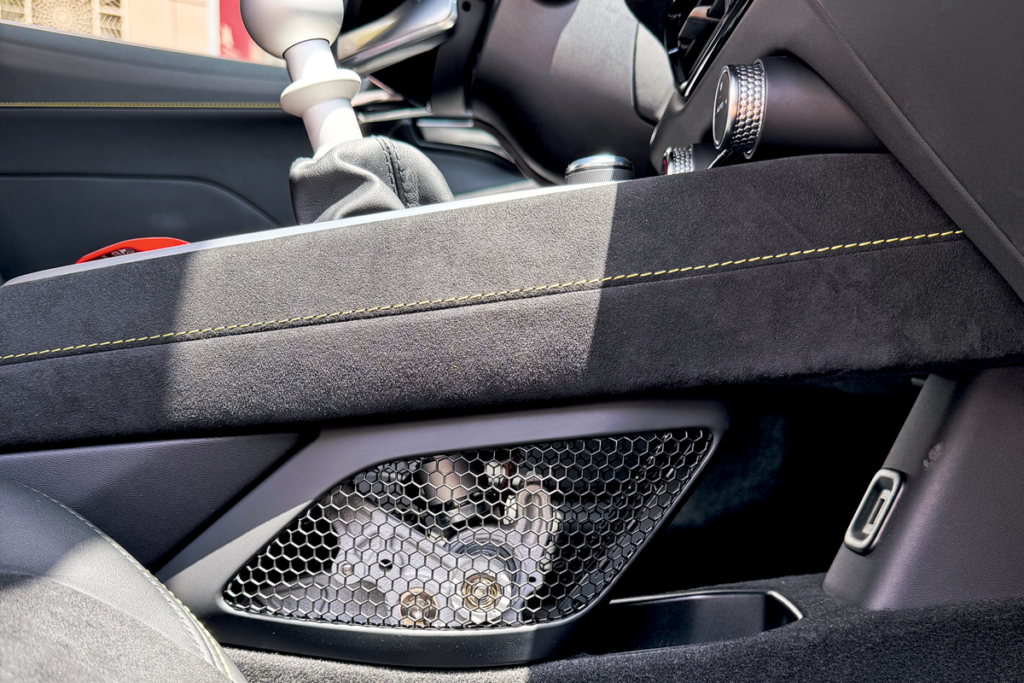
The manual gearbox drive is on display. The mechanism itself is precise, but requires getting used to the high force on the lever
My route covers just over 100 km, ending at a small mountain pass. Let’s see how the Emira fares in daily driving. City driving is arguably the least favorable mode for a Lotus, yet comfort exceeds expectations. The engine doesn’t heat the cabin or intrude with excessive noise. The suspension isn’t fond of sharp speed bumps but absorbs them without harsh knocks, feeling firm yet compliant.
On the highway, the dominant high-speed noise comes from aerodynamics — not tires or the engine behind you, but the airflow sculpted by the car’s many edges. Sometimes it whistles in tones unfamiliar enough to make you turn down the music to locate the source. Otherwise, the Emira feels well-suited for everyday use and short trips.
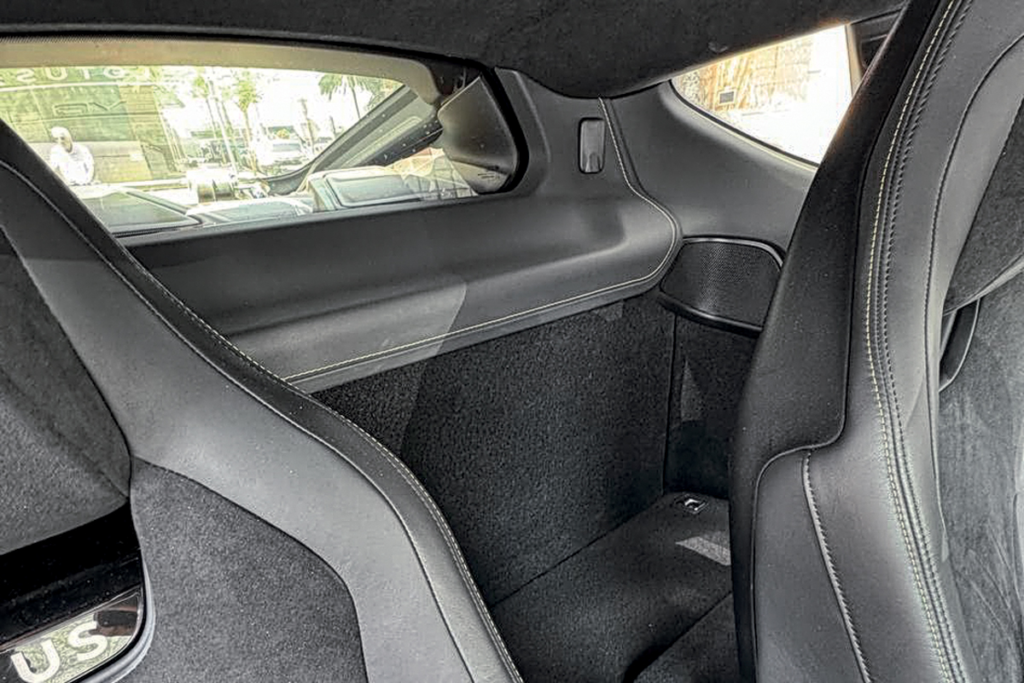
The seat backs fold down for easy access to the luggage rack
One drawback: cargo space. Beyond a couple of backpacks behind the seats, there’s a 150-liter rear trunk that gets hot from the nearby engine. The front compartment is off-limits — a service-only bay.
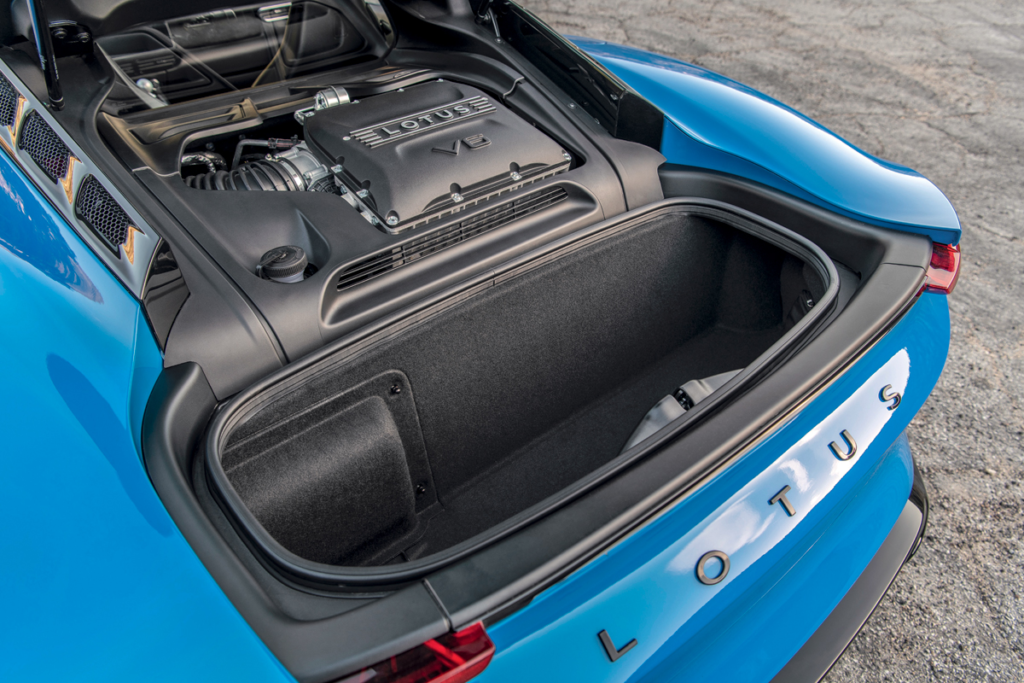
The Toyota 2GR-FE engine is located transversely in the base, and right behind it is the luggage compartment, which gets very hot while driving.
On to the mountain road. There are three drive modes — Tour, Sport, and Track — which alter only throttle response and exhaust valve behavior. The passive dampers can’t be stiffened. Selecting Track mode triggers a stability control warning. I’m ready.
Climbing uphill, the engine delivers strong, steady thrust. Acceleration isn’t breathtaking, but perfectly suited to a car of this size. Short gearing helps — each shift presses you firmly back into the seat. However, the gearlever’s hefty action slows quick shifts, especially across the gate.
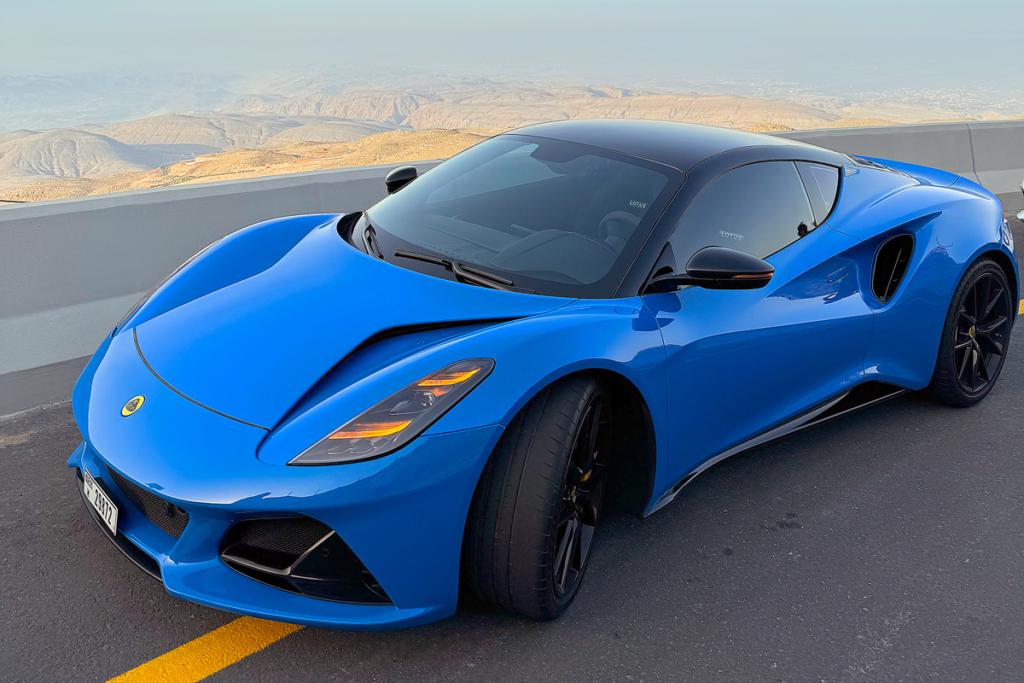
The engine’s performance is solid but emotionally neutral — no turbo surge in the midrange, no thrilling high-rev crescendo. Peak output is 405 hp at 6800 rpm, with 420 Nm arriving at 3200 rpm. The supercharger whines, the road offers hairpins for second gear, but the Emira never hints at tail-happy antics — it clings to its line, favoring precision over hooliganism.
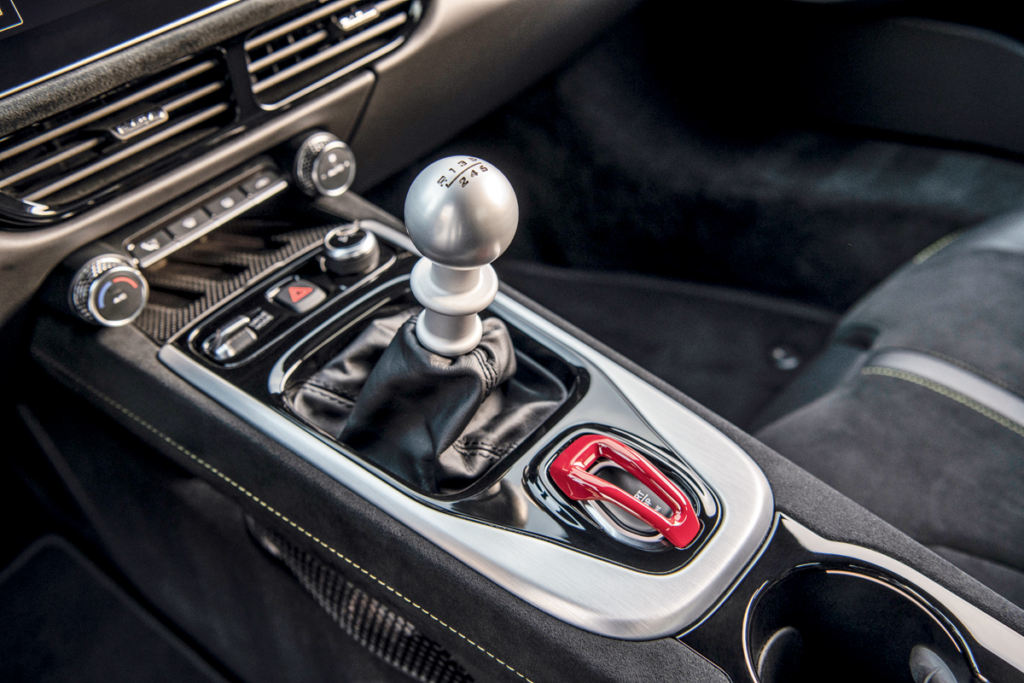
The six-speed Aisin manual transmission is only available for versions with a V6 supercharged engine. You can also order a classic automatic transmission from the same brand.
The chassis stays flat through quick transitions, with no diagonal pitch or unwanted steering effects. Michelin Pilot Sport Cup 2 tires provide immense grip, measuring 245 mm up front and 295 mm at the rear on 20-inch wheels.
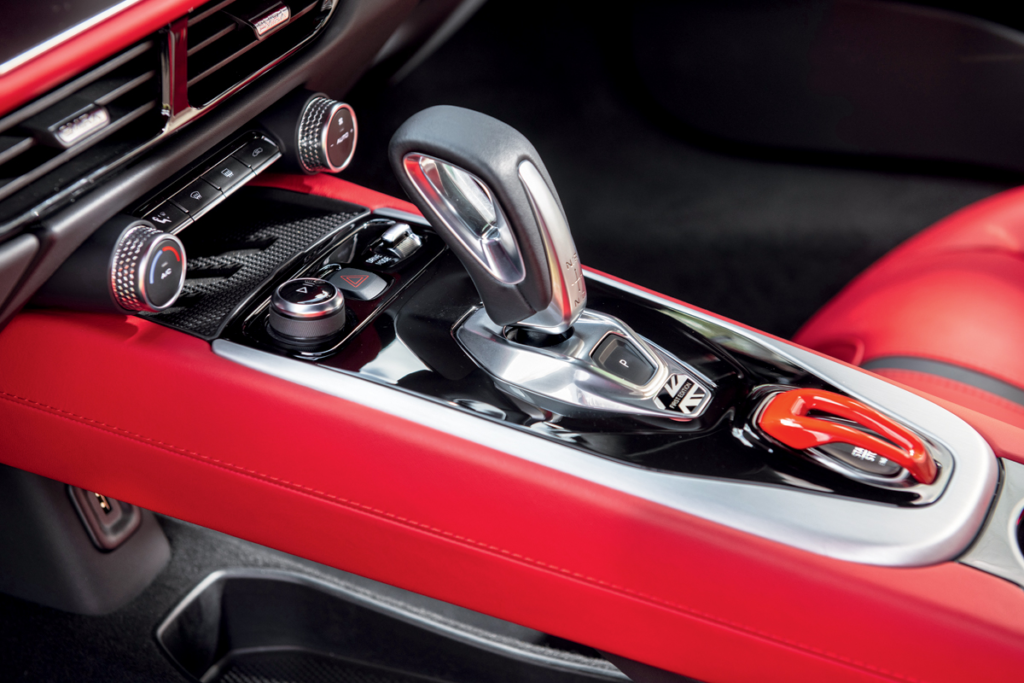
Emira also has a modification with a two-liter turbo four AMG M139 (365 hp, 430 Nm) and a Mercedes eight-speed “robot” with two clutches. This coupe is lighter and more economical, although in terms of dynamics it is slightly inferior to cars with a V6: acceleration to “hundreds” takes 4.4 s
The AP Racing brakes are faultless — firm, progressive, and consistent. The only critique is the small brake pedal’s close proximity to the throttle, making heel-and-toe less precise, especially without auto-blip.
And the heavy steering? Perhaps “for the drivers” indeed. It’s lighter than the unassisted racks of Elise or Exige, but still heavy by modern standards, tiring your arms after 15–20 minutes of hard driving.
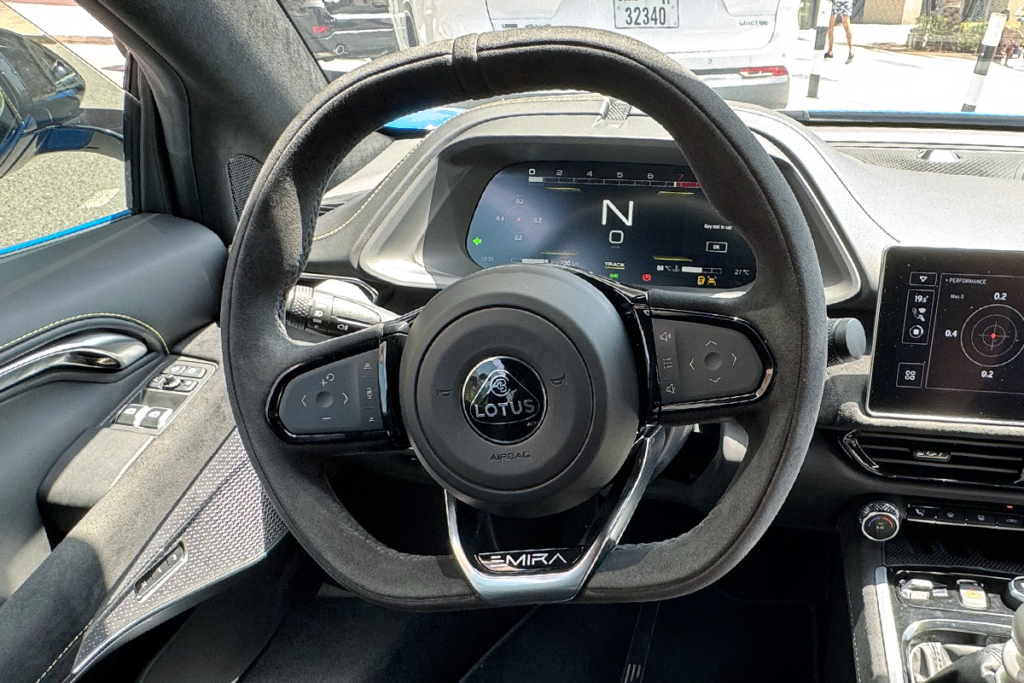
The wheel’s shape also forces your hands onto a near-vertical rim section. In feel and feedback, it’s no better than a Porsche 718, whose lighter, more communicative steering I prefer.
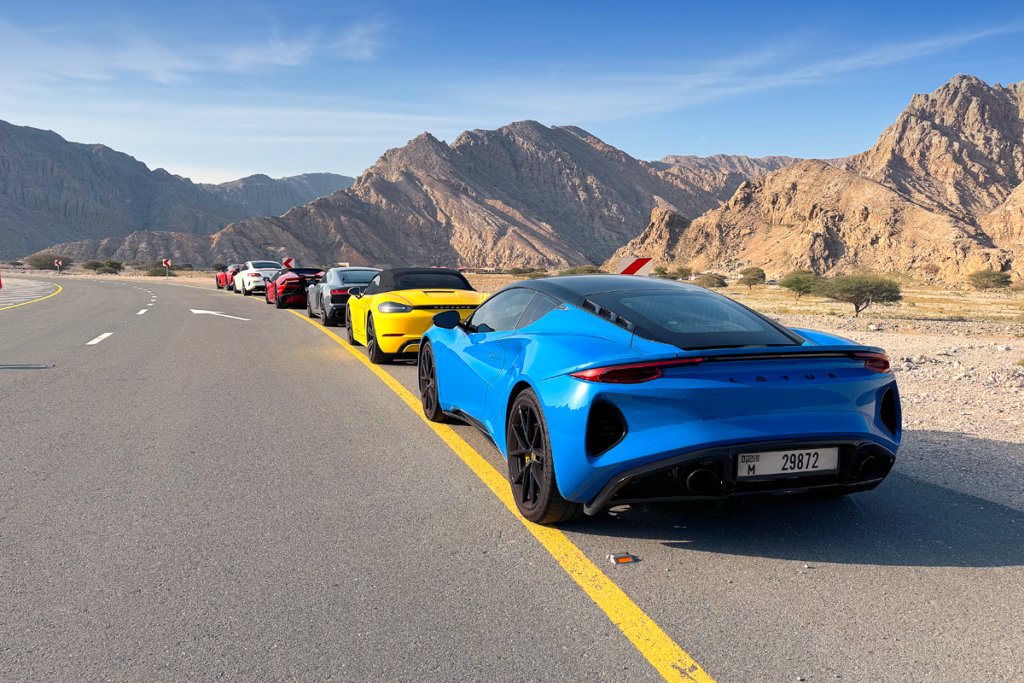
The pass ends. The Emira is unfazed — brakes, tires, and cooling are all fine. But I want a break: the heavy controls make it feel weightier than its 1486 kg curb weight. Lighter inputs would make it more playful; as is, it feels more like a track-oriented machine.
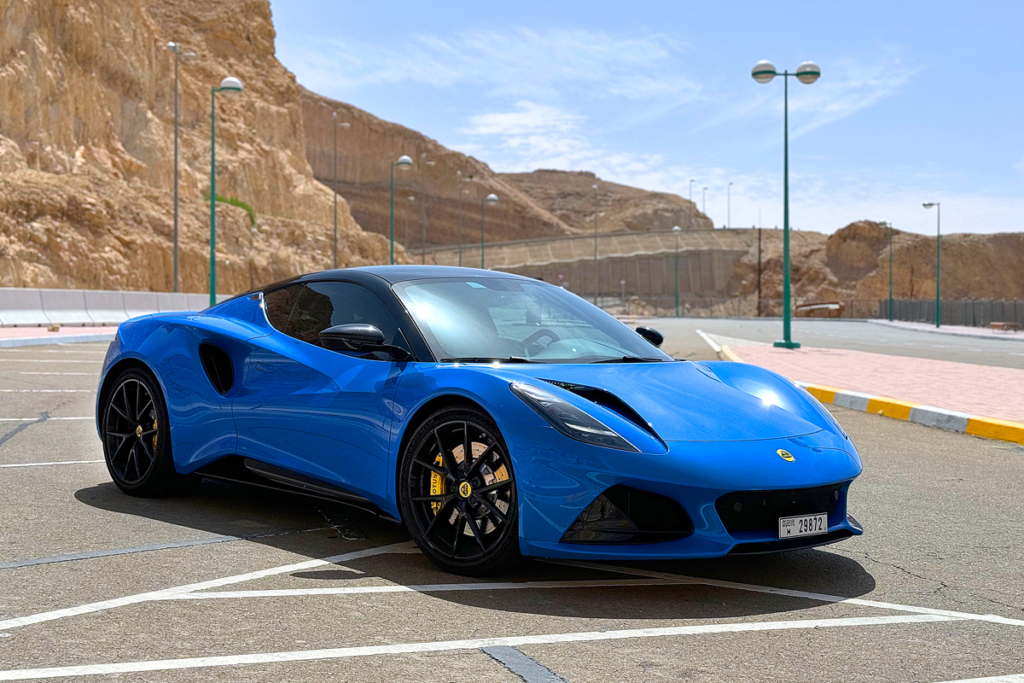
Track days in the UAE require a rookie session before you can join open track time. Rookies pay AED 650 (₽16,500) for three 25-minute runs on a basic layout, under instructor supervision. Obey overtaking rules and avoid marshal warnings, and you’re cleared for open sessions, which cost AED 900–1000 (₽23–25k) for three hours.
Dubai Autodrome’s paddock is packed with Porsche 911 GT3 RS models of various generations. I’m used to seeing regular GT3s on Russian tracks, but RS versions are rarer, often garage-bound.
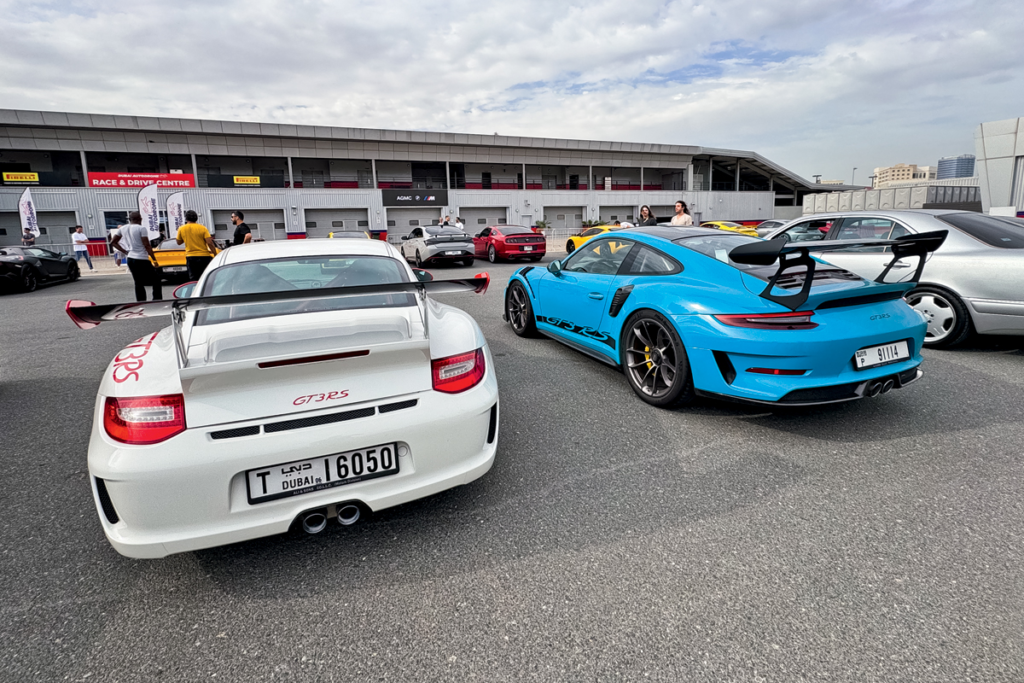
Porsche 911 GT3 RS are typical guests of the Emirates circuit: on the left is the 997 generation coupe, on the right is the more modern 991 model
Full tank, tire pressures set, quick briefing. I slip into the Emira and find the helmet doesn’t fit under the headliner — I have to put it on outside, then squeeze back in. Those plush power seats take their toll.
Two warm-up laps reveal a medium-speed circuit, mostly third-gear corners — perfect for a Lotus. Fifteen minutes vanish in focus, reacclimating to the tight pedal box and heavy shifter.
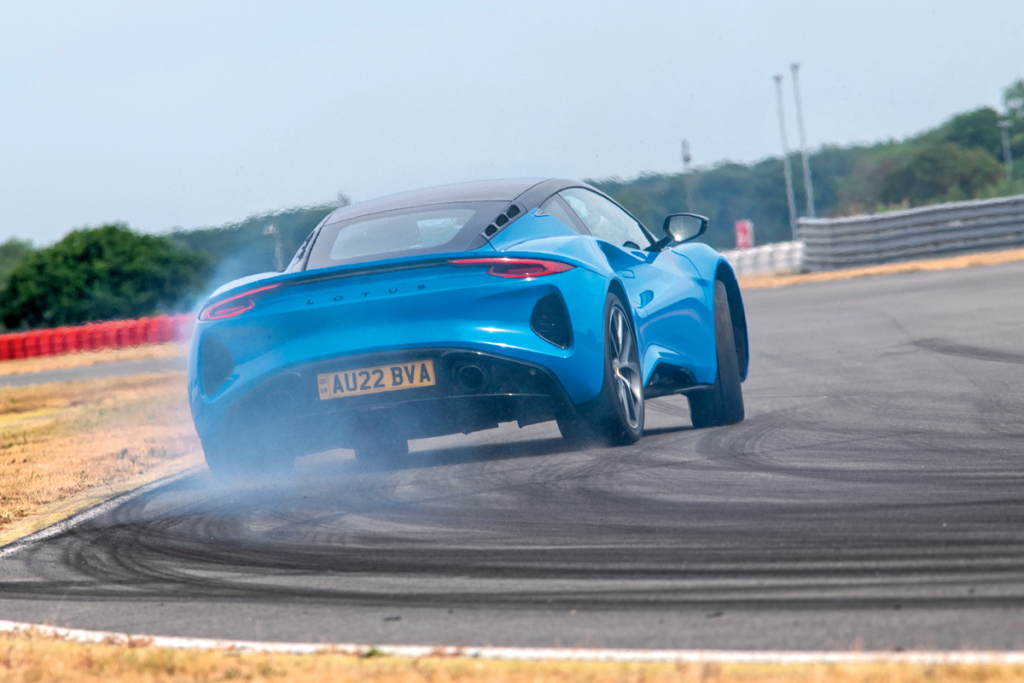
A red flag interrupts. In the pits, I compare lap times: I’m only 3–4 seconds slower than a 997-generation GT3 RS, despite no chassis setup tweaks. The Emira responds faithfully, allowing deep braking into apexes and gentle throttle rotation mid-corner. It feels like the chassis could handle another 50–80 hp. Tire temps are even, brakes strong, cooling sufficient — it’s a bona fide track tool.
A track-focused Emira special edition seems inevitable: more power, enhanced aero, less weight. Sport seats alone could shave 25 kg. For now, the production Emira is a superb gateway to mid-engined sports cars — not cheap (German prices start at €95k), but offering the layout’s unique experience, capable road manners, track readiness, and the joy of a manual ICE drivetrain. It truly lives up to the engraving on its key: “For the drivers.”
| Parameter | Lotus Emira |
|---|---|
| Body type | Two-door coupe |
| Seating capacity | 2 |
| Dimensions (mm) Length Width Height Wheelbase Track (front/rear) | 4413 2092 1226 2575 1624 / 1610 |
| Aerodynamic drag coefficient (Cx) | 0.349 |
| Luggage capacity, L | 151 / 208* |
| Curb weight, kg | 1486 |
| Gross weight, kg | 1763 |
| Engine | Gasoline, port fuel injection with belt-driven supercharger |
| Engine location | Transversely mounted behind the seats |
| Number and arrangement of cylinders | 6, V-shaped |
| Displacement, cm³ | 3456 |
| Bore / stroke, mm | 94.0 / 83.0 |
| Number of valves | 24 |
| Max. power, hp / kW / rpm | 405 / 298 / 6800 |
| Max. torque, Nm / rpm | 420 / 3200 |
| Transmission | 6-speed manual |
| Drive type | Rear-wheel drive |
| Front suspension | Independent, spring, double wishbones |
| Rear suspension | Independent, spring, double wishbones |
| Brakes | Ventilated disc |
| Tire size | 245/35 ZR20 (front), 295/30 ZR20 (rear) |
| Maximum speed, km/h | 290 |
| Acceleration 0–100 km/h, s | 4.3 |
| Fuel consumption (combined cycle), L/100 km | 11.3 |
| Fuel tank capacity, L | 58 |
| Fuel type | AI-98 gasoline |
* Rear compartment / platform behind the seats* Rear compartment / platform behind the seats
Photo: Lotus | Yaroslav Panin
This is a translation. You can read the original article here: Для водителей: Lotus Emira с механической коробкой передач — на дороге и треке

Published August 13, 2025 • 9m to read