

Main Directions of Car Body Tuning
Car body tuning — the art of upgrading and personalizing your vehicle’s exterior — remains one of the most popular ways to make your car truly one of a kind. Whether your goal is to boost aesthetic appeal, improve aerodynamic performance, or simply stand out on the road, body tuning offers something for every car owner. Once exclusive to the wealthy, modern tuning has become accessible and affordable for everyday drivers. In this guide, we’ll explore the main directions of car body tuning, what methods work best, and what to watch out for.
What Is External Car Tuning?
The word “tuning” means adjustment or customization. External car tuning involves the aesthetic modernization of body elements as a form of self-expression for the car owner. A well-executed tuning job guarantees individuality — drawing attention and admiration from fellow drivers who appreciate the skill and creativity behind the transformation.
Almost every part of the body can be tuned, including:
- Door sills and handles
- Hood and trunk lid
- Roof panels
- Splash shields and body kits
- Optics and lighting
- Wheel caps and trims
You can handle many tuning tasks yourself or work with professionals at a dedicated tuning studio — or combine both approaches. DIY tuning is a source of special pride for many car owners, as much of the work doesn’t require advanced skills yet delivers impressive, sometimes stunning results. Modern upgrade technologies, including protective film application, allow work to be completed quickly, efficiently, and at a relatively low cost.
Important: Unusually modified cars attract more attention from traffic officers. All significant upgrades must be officially registered with the relevant traffic authorities, as documents will be checked thoroughly during any stop.
The main solutions that transform the appearance of a standard production car fall into seven categories:
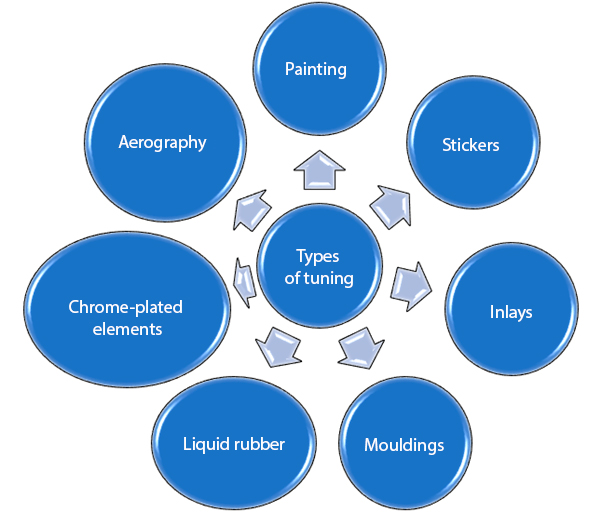
Painting
Stickers
Inlays
Mouldings
Liquid rubber
Chrome-plated elements
Aerography
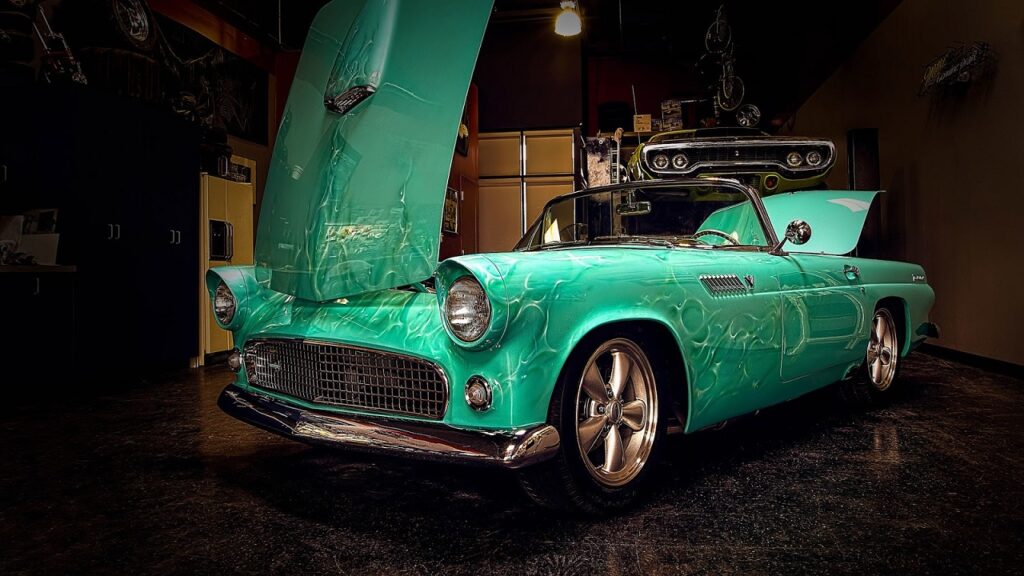
Aerography: Custom Airbrush Art for Your Car
Aerography is considered the most complex and premium method of car body tuning. It involves applying a unique, hand-crafted design to part of the body — or the entire vehicle — using an airbrush tool. Paint is sprayed onto the surface under air pressure, creating artwork that can range from subtle graphics to full photorealistic murals. The results are incredibly eye-catching and guaranteed to make any car stand out.
For those on a tighter budget, vinyl stickers are a cheaper alternative — however, they are less durable and don’t offer the same premium finish. They can, though, be easily swapped out for a new look whenever desired.
Here’s how the aerography process typically works:
- Stenciling — Special stencils are used to create correct proportions and outlines for the design.
- Detail work — Finer elements such as shadows and light gradations are painted separately by hand.
- Touch-ups — Small imperfections are corrected and smoothed out using a lacquer base.
- Base coat painting — Autobase car paint (the “base”) is applied. Crucially, aerography uses only standard automotive paint, so the original painting technology is preserved.
- Lacquer coating — Several layers of automotive lacquer are applied over the artwork to protect it from damage.
- Polishing — The final step involves varnishing and polishing for a flawless, showroom-quality finish.
If you’re considering aerography, it’s strongly recommended to work with a professional artist who has a solid portfolio and uses high-quality equipment — ideally a Japanese-made airbrush. While many aspects of the job can be done DIY with stencils and practice, the final quality depends heavily on experience and tools.
Body Kits and Lighting: Form Meets Function
Aerodynamic body kits are one of the most impactful upgrades in external car tuning — not just visually, but technically. When a car is in motion, aerodynamic forces shift the weight distribution between the front and rear axles, which can negatively affect handling and braking. Body kits address this by managing airflow around the vehicle.
Key components and their functions include:
- Adjustable spoilers — Installed on the roof or trunk lid to correct weight distribution and improve stability at speed.
- Front bumper spoilers (skirts) — Designed to increase downforce at high speeds, enhancing handling on straight roads and through corners.
- Additional air intakes — Help cool the engine, ventilated brakes, and turbochargers; can also provide a passive boost through intercoolers.
A word of caution: Many aftermarket decorative spoilers and bumpers claim to improve aerodynamics but in practice do the opposite — reducing high-speed stability and disrupting the car’s balance. Always research components carefully and, where possible, choose parts with verified aerodynamic testing data.
Exterior tuning also extends to lighting upgrades, which can dramatically change a car’s look and functionality:
- Neon underglow lights — Mounted beneath the car for a distinctive visual effect, popular in show and street tuning scenes.
- Xenon headlights — Significantly improve visibility in low-light conditions. When properly installed and aligned according to regulations, xenon lights do not blind oncoming drivers. Improperly installed units are illegal and subject to significant fines.
Whether your car is stock or fully tuned, always ensure you have the proper documentation to operate it legally on public roads — ideally an international driver’s license. If you haven’t obtained one yet, you can quickly and easily apply for an international driver’s license directly on our website.

Published December 17, 2020 • 5m to read